
Context:
Recently, the Ministry of External Affairs (MEA) informed Parliament that India has fully paid the USD 120 million committed for the development of the Chabahar Port, with the final tranche transferred on 26 August 2025. This development underscores India’s intent to honour international commitments despite external constraints.
About Chabahar Port Project:
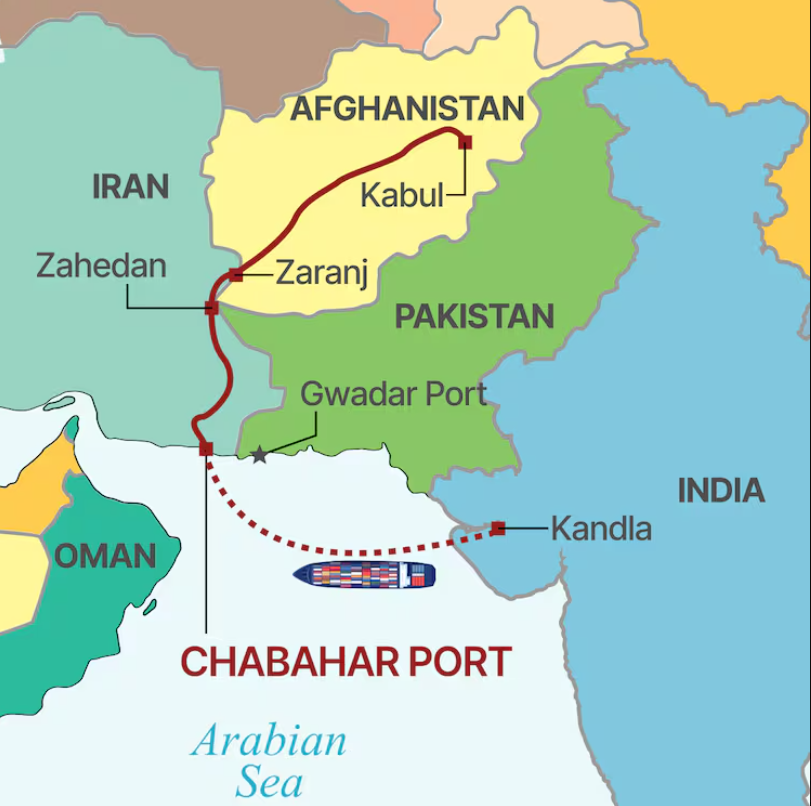
Chabahar is a deep-water port located in south-eastern Iran on the Gulf of Oman. It provides India with direct maritime access to Afghanistan and Central Asia, bypassing Pakistan, thereby enhancing regional connectivity and strategic outreach.
Long-term Contract:
On 13 May 2024, India and Iran signed a 10-year agreement under which India Ports Global Limited (IPGL) would equip and operate the Shahid Beheshti Terminal. Under this agreement, India committed USD 120 million for port equipment and infrastructure development.
Strategic Significance of the Project:
-
-
-
- Connectivity and Trade: Chabahar is central to India’s Connect Central Asia Policy, improving access to landlocked regions and facilitating trade routes.
- Counterweight to Gwadar: It serves as a strategic alternative to Gwadar Port in Pakistan, developed with Chinese assistance, thereby balancing regional influence.
- Economic and Humanitarian Engagement: The port has previously enabled humanitarian shipments such as wheat and pulses to Afghanistan, demonstrating its operational relevance.
- Connectivity and Trade: Chabahar is central to India’s Connect Central Asia Policy, improving access to landlocked regions and facilitating trade routes.
-
-
Challenges and Geopolitical Implications:
-
-
-
- US Sanctions Environment: Sanctions create uncertainty for Indian companies and long-term operations.
- Budgetary Shifts: The absence of allocations in the Union Budget 2026–27 suggests completion of funding or cautious recalibration.
- Diplomatic Balancing: India must carefully balance relations with Iran and the United States while protecting its strategic interests.
- US Sanctions Environment: Sanctions create uncertainty for Indian companies and long-term operations.
-
-
Way Forward:
It is essential for India to maintain sustained and proactive diplomatic engagement with all key stakeholders, including Iran, to effectively manage the political and strategic challenges associated with the project. Private sector participation, financial innovation and risk-mitigation mechanisms should also be considered to ensure the long-term operational viability of Chabahar Port. Additionally, connecting Chabahar Port to the International North-South Transport Corridor (INSTC) will strengthen regional connectivity and provide new impetus to India's trade, supply chain and strategic access with Eurasian countries.
Conclusion:
India’s fulfilment of the USD 120 million pledge to Chabahar Port reaffirms its commitment to strategic infrastructure diplomacy amid a complex geopolitical landscape. Despite sanctions-related and fiscal challenges, the port remains a vital pillar of India’s regional connectivity, strategic autonomy, and foreign policy outreach in West and Central Asia.



