
Context:
Recently, The Food Safety and Standards Authority of India (FSSAI) has proposed a draft amendment to the Food Safety and Standards (Prohibition and Restrictions on Sales) Regulations, 2011, seeking to restrict products made from non-milk constituents from being represented or marketed as “Paneer.” The draft was notified on September 24, 2026, and FSSAI has invited objections and suggestions from stakeholders and the public.
What Does the Draft Amendment Propose?
-
-
- The proposed Food Safety and Standards (Prohibition and Restrictions on Sales) Amendment Regulations, 2026 seek to insert a new provision under Regulation 2.1.1 dealing specifically with paneer made from constituents not derived from milk.
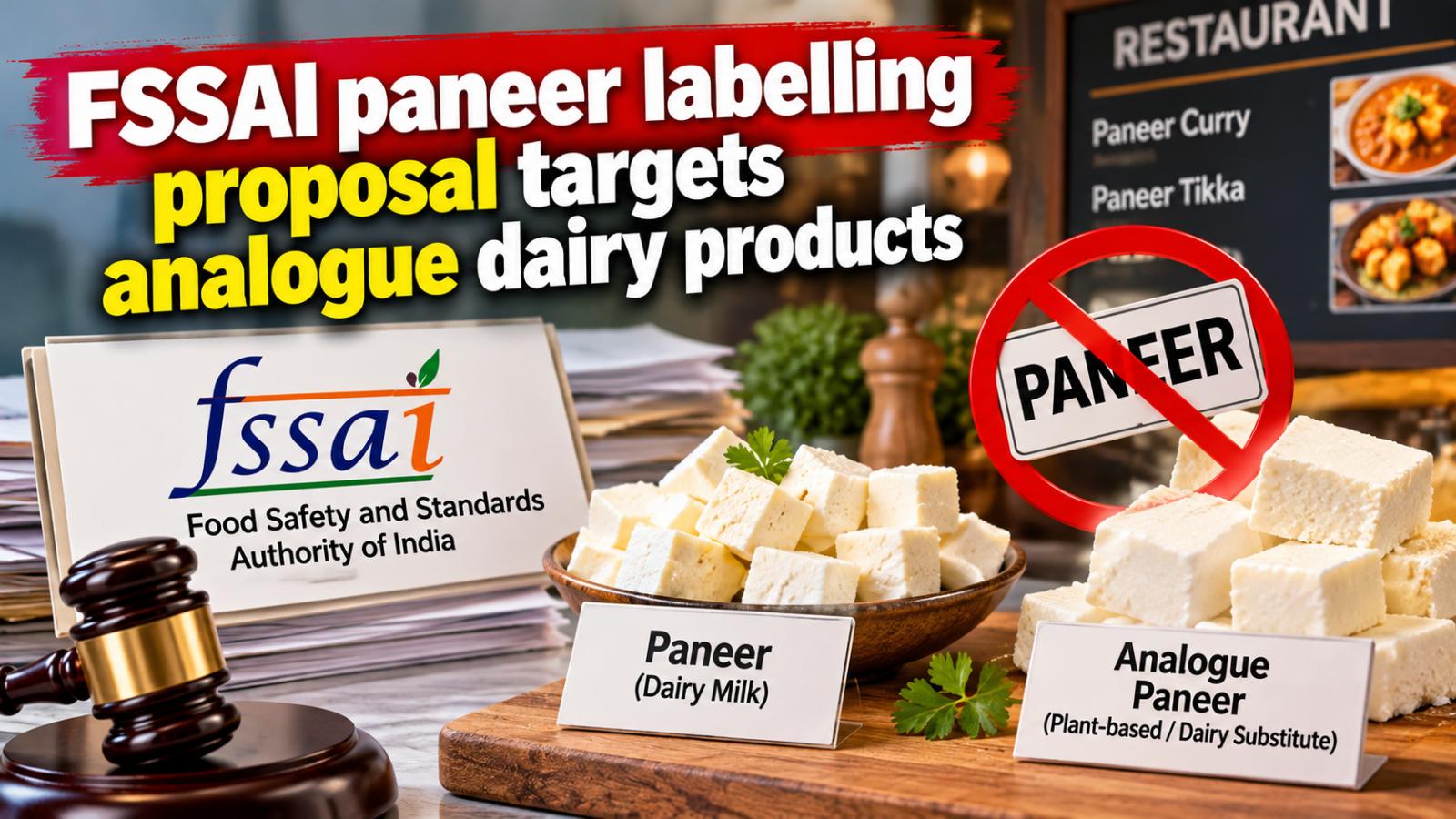
- Products currently licensed or registered under the “Analogue in Dairy Context” category would not be permitted to use the term “Paneer” in their nomenclature, labelling or marketing if they are not derived from milk.
- The proposal aims to ensure that the name and presentation of a food product accurately reflect its nature and composition, thereby enabling consumers to make informed choices.
- The proposed Food Safety and Standards (Prohibition and Restrictions on Sales) Amendment Regulations, 2026 seek to insert a new provision under Regulation 2.1.1 dealing specifically with paneer made from constituents not derived from milk.
-
What is Analogue Paneer?
-
-
- Analogue paneer is a factory-made substitute designed to resemble conventional dairy paneer in appearance, texture and cooking properties. It may use ingredients such as vegetable fats, starches, emulsifiers and stabilisers instead of relying entirely on milk-derived constituents.
- This distinction is important because consumers may otherwise assume that a product labelled “paneer” has the composition and nutritional characteristics of conventional dairy paneer.
- Analogue paneer is a factory-made substitute designed to resemble conventional dairy paneer in appearance, texture and cooking properties. It may use ingredients such as vegetable fats, starches, emulsifiers and stabilisers instead of relying entirely on milk-derived constituents.
-
Why is Regulation Important?
-
-
- The existing FSSAI framework already restricts the sale of certain food products containing substances that are inconsistent with their prescribed standards. Regulation 2.1.1 of the 2011 regulations, for instance, restricts the sale of specified milk and milk products containing substances not found in milk, subject to regulatory exceptions.
- The proposed amendment seeks to provide greater clarity specifically regarding the use of the term “paneer” and prevent misleading representation of non-milk products.
- The existing FSSAI framework already restricts the sale of certain food products containing substances that are inconsistent with their prescribed standards. Regulation 2.1.1 of the 2011 regulations, for instance, restricts the sale of specified milk and milk products containing substances not found in milk, subject to regulatory exceptions.
-
Consumer Protection Perspective:
-
-
- The proposal is closely linked to the principle of informed consumer choice. Accurate labelling enables consumers to understand what they are purchasing and compare products based on their composition.
- It can also strengthen regulatory oversight of food businesses and reduce ambiguity between genuine dairy products and dairy analogues.
- The proposal is closely linked to the principle of informed consumer choice. Accurate labelling enables consumers to understand what they are purchasing and compare products based on their composition.
-
About FSSAI:
The Food Safety and Standards Authority of India (FSSAI) is a statutory authority established under the Food Safety and Standards Act, 2006. It is responsible for regulating and supervising food safety and standards in India.
Key Functions:
-
-
- Establishing science-based food standards.
- Regulating food manufacturing, storage, distribution and sale.
- Licensing and registration of food businesses.
- Monitoring food quality and safety.
- Accrediting food-testing laboratories.
- Promoting consumer awareness regarding food safety.
- Establishing science-based food standards.
-
Conclusion:
The proposed amendment seeks to ensure truthful food labelling and informed consumer choice by reserving the term “paneer” for products derived from milk. Effective implementation, scientific testing and consumer awareness will be important for achieving these objectives.



