
Context:
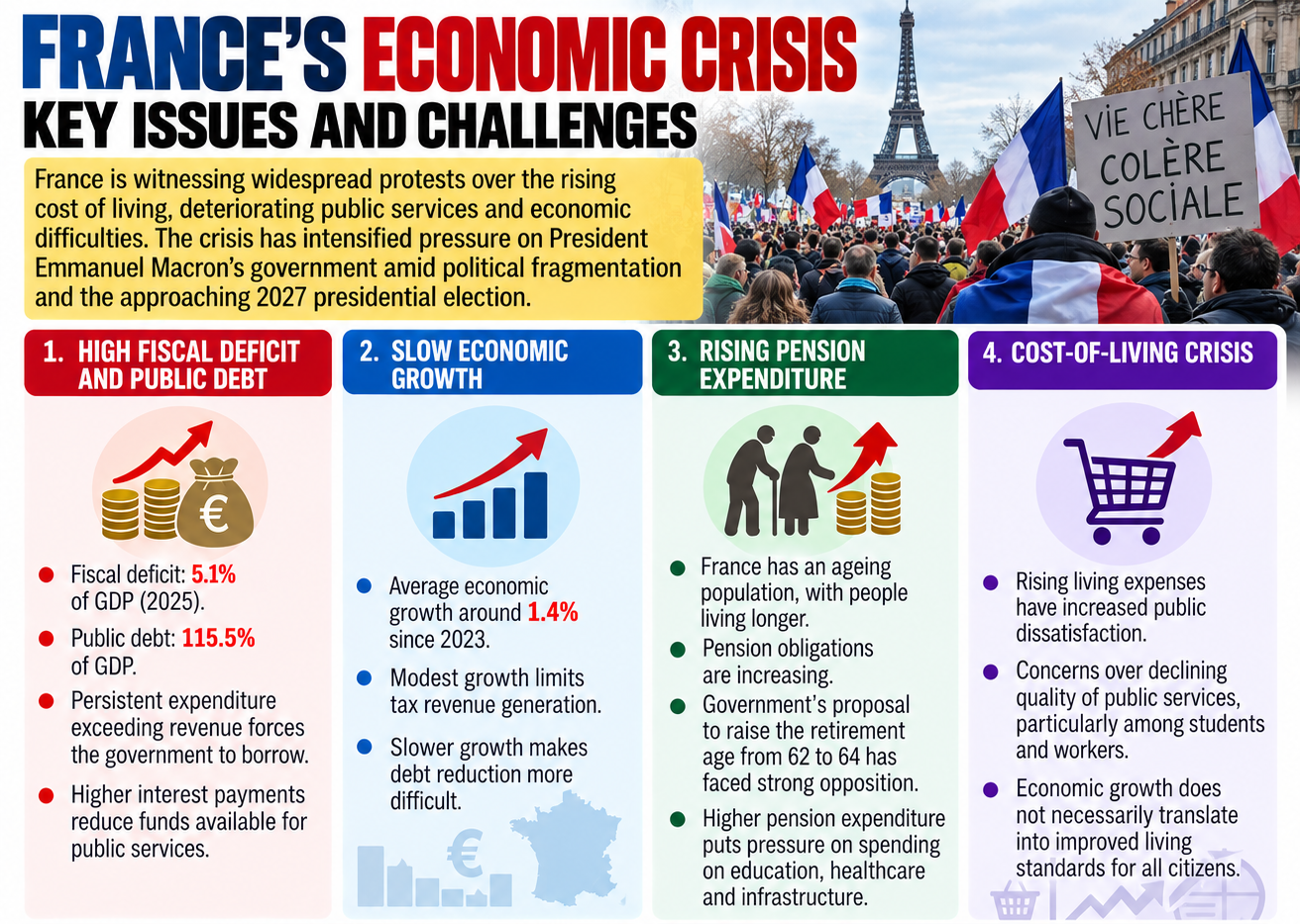
Recently, France is witnessing widespread protests over the rising cost of living, deteriorating public services and economic difficulties. The crisis has intensified pressure on President Emmanuel Macron’s government amid political fragmentation and the approaching 2027 presidential election.
Major Economic Problems of France:
-
-
- High Fiscal Deficit and Public Debt: France’s fiscal deficit stood at 5.1% of GDP in 2025, while public debt reached 115.5% of GDP. Persistent expenditure exceeding revenue forces the government to borrow, increasing interest payments and reducing funds available for public services.
- Slow Economic Growth: France’s average economic growth has been around 1.4% since 2023. Modest growth limits tax revenue generation and makes debt reduction more difficult.
- Rising Pension Expenditure: France has an ageing population, with people living longer and pension obligations increasing. The government’s proposal to raise the retirement age from 62 to 64 has faced strong opposition. Higher pension expenditure also puts pressure on spending on education, healthcare and infrastructure.
- Cost-of-Living Crisis: Rising living expenses and concerns over declining public-service quality have increased public dissatisfaction, particularly among students and workers. Economic growth does not necessarily translate into improved living standards for all citizens.
- High Fiscal Deficit and Public Debt: France’s fiscal deficit stood at 5.1% of GDP in 2025, while public debt reached 115.5% of GDP. Persistent expenditure exceeding revenue forces the government to borrow, increasing interest payments and reducing funds available for public services.
-
Political Dimensions of the Crisis:
Political polarisation between the far right, the left and centrist forces has complicated fiscal reforms. A fragmented Parliament makes it difficult to build consensus on taxation, pension reform and expenditure cuts. Consequently, political instability increases economic uncertainty and may discourage private investment.
Why Can France Not Borrow Indefinitely?
Higher public debt can increase borrowing costs as investors demand greater returns to compensate for perceived risks. Rising interest payments reduce fiscal space and may crowd out productive expenditure. Moreover, as a member of the euro area, France cannot independently issue its own currency; monetary policy is conducted by the European Central Bank.
Impact on the European Union:
France’s economic difficulties may affect eurozone financial stability, investor confidence and compliance with EU fiscal rules. They also highlight tensions between national fiscal autonomy and shared monetary policy.
India’s Perspective:
India and France established a strategic partnership in 1998. Their relationship was upgraded to a Special Global Strategic Partnership in February 2026. Cooperation covers defence, nuclear energy, space, technology and the Indo-Pacific.
-
-
- Defence cooperation: France is a major supplier of defence equipment, including Rafale aircraft. Any crises in France may have far greater effect on India's safety and security.
- Civil nuclear energy: Cooperation, including the proposed Jaitapur nuclear power project, supports India's energy security and low-carbon development. Any effects of French fiscal constraints on project costs or timelines require project-specific evidence.
- Trade, investment and technology: Economic uncertainty may influence business decisions and investment. India should encourage technology transfer, domestic value addition and diversified economic partnerships.
- Indo-Pacific and strategic autonomy: France is an important partner in maritime security and India's pursuit of a multipolar international order. Its stability matters for sustained bilateral cooperation.
- Defence cooperation: France is a major supplier of defence equipment, including Rafale aircraft. Any crises in France may have far greater effect on India's safety and security.
-
Lessons for India:
-
-
- Fiscal discipline: Maintain a credible medium-term fiscal consolidation path.
- Welfare reforms: Improve expenditure efficiency without weakening essential social protection.
- Pension sustainability: Prepare for population ageing and strengthen long-term pension financing.
- Democratic consultation: Communicate reforms transparently and consult stakeholders.
- Economic resilience: Expand manufacturing, employment, productivity and the tax base.
- Fiscal discipline: Maintain a credible medium-term fiscal consolidation path.
-



