
Context:
Recently, Raksha Mantri Shri Rajnath Singh launched Fleet Support Ship-1 (FSS-1), laid the keel of FSS-5, and inaugurated the upgraded Slipway-4 and 300-tonne Goliath Crane at Hindustan Shipyard Limited (HSL), Visakhapatnam. The developments mark an important milestone in India's efforts towards Aatmanirbharta in defence and indigenous shipbuilding.
What is a Fleet Support Ship?
-
-
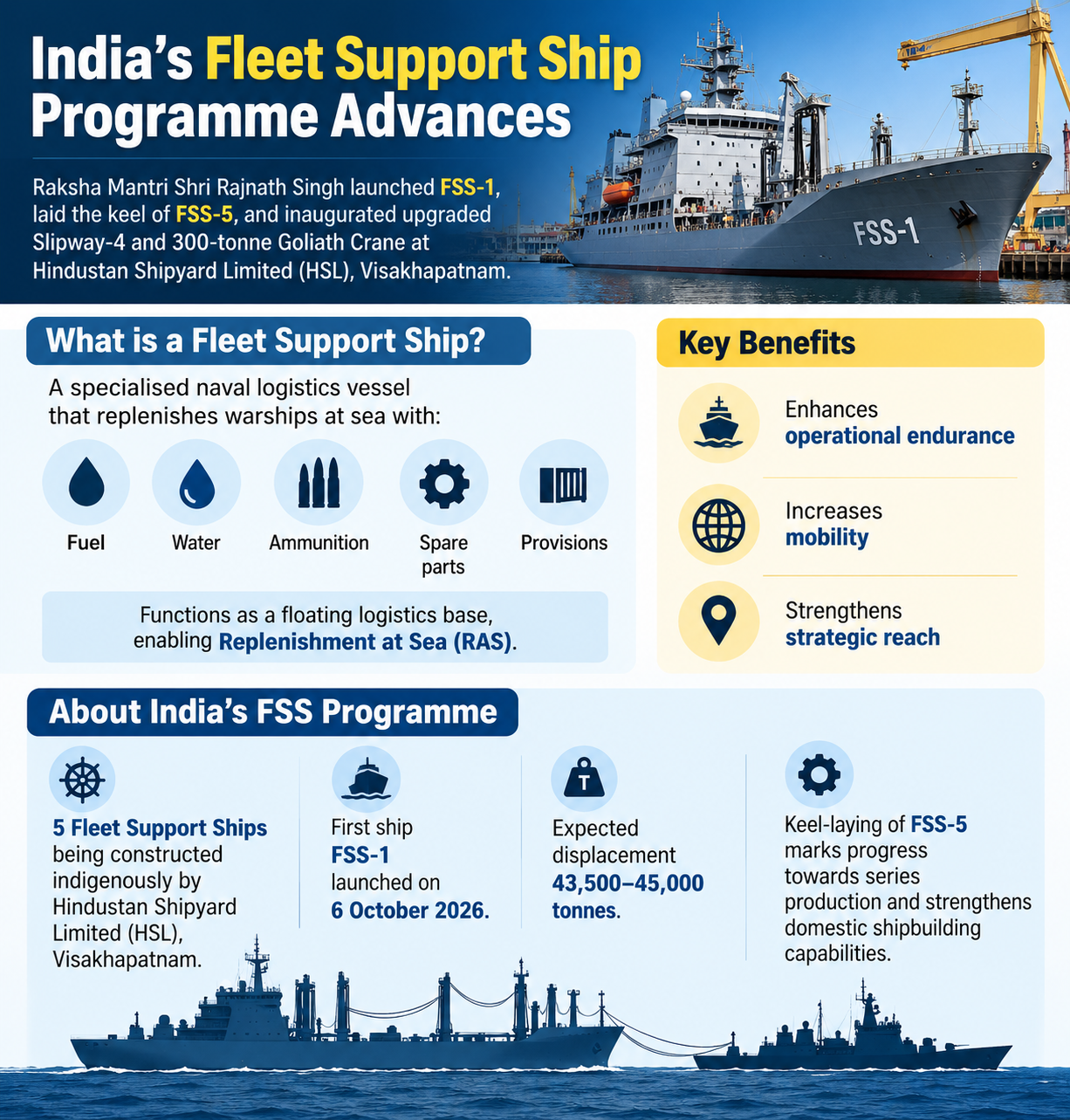
- A Fleet Support Ship (FSS) is a specialised naval logistics vessel designed to replenish deployed warships at sea with fuel, water, ammunition, spare parts and provisions. It functions as a floating logistics base, enabling warships to undertake Replenishment at Sea (RAS) and remain operational for longer periods without returning to harbour.
- Thus, FSSs significantly enhance a navy's operational endurance, mobility and strategic reach, which are essential for a blue-water navy.
- A Fleet Support Ship (FSS) is a specialised naval logistics vessel designed to replenish deployed warships at sea with fuel, water, ammunition, spare parts and provisions. It functions as a floating logistics base, enabling warships to undertake Replenishment at Sea (RAS) and remain operational for longer periods without returning to harbour.
-
About India's FSS Programme:
-
-
- The Indian Navy is undertaking an indigenous project to construct five Fleet Support Ships through Hindustan Shipyard Limited (HSL), Visakhapatnam. The first vessel, FSS-1, was launched on 6 October 2026.
- The ships are expected to have a displacement of approximately 43,500–45,000 tonnes and will support sustained naval operations across the Indian Ocean Region (IOR) and beyond.
- The keel-laying of FSS-5 represents progress towards series production and strengthens India's ability to undertake complex naval shipbuilding projects domestically.
- The Indian Navy is undertaking an indigenous project to construct five Fleet Support Ships through Hindustan Shipyard Limited (HSL), Visakhapatnam. The first vessel, FSS-1, was launched on 6 October 2026.
-
Modernisation of HSL:
The upgraded Slipway-4, along with the 300-tonne Goliath Crane, will enhance HSL's capacity to construct and launch larger vessels. Such infrastructure is important for developing a robust domestic shipbuilding ecosystem and reducing dependence on foreign shipyards.
Strategic Significance:
-
-
- Aatmanirbhar Bharat: Indigenous construction strengthens self-reliance in defence manufacturing.
- Blue-water capability: FSSs allow naval combatants to remain deployed for longer durations, enhancing India's maritime presence.
- Indo-Pacific security: Greater logistical endurance supports India's role as a net security provider and contributes to maritime stability.
- Strategic autonomy: Reduced dependence on foreign shipyards and shore-based replenishment facilities strengthens India's freedom of action during prolonged deployments.
- Maritime logistics: Reliable replenishment capability is crucial for protecting sea lanes, securing India's maritime interests and supporting Humanitarian Assistance and Disaster Relief (HADR) operations.
- Aatmanirbhar Bharat: Indigenous construction strengthens self-reliance in defence manufacturing.
-
Challenges:
India needs to further strengthen shipbuilding technology, skilled manpower, domestic supply chains, component manufacturing and project execution to develop a globally competitive maritime-industrial ecosystem.
Conclusion:
The Fleet Support Ship programme is not merely an addition to the Indian Navy's inventory; it represents India's transition towards self-reliant maritime power. By combining naval logistics with indigenous shipbuilding infrastructure, India can enhance its blue-water capabilities, strategic autonomy and ability to contribute to a secure and stable Indo-Pacific.



