
Context:
Recently, India hosted the First BIMSTEC Home Ministers’ Meeting in New Delhi under the chairmanship of Union Home Minister Amit Shah. The meeting concluded with the adoption of the Delhi Declaration, aimed at strengthening regional cooperation against terrorism, drug trafficking, human trafficking, cybercrime and transnational organised crime.
About BIMSTEC:
-
-
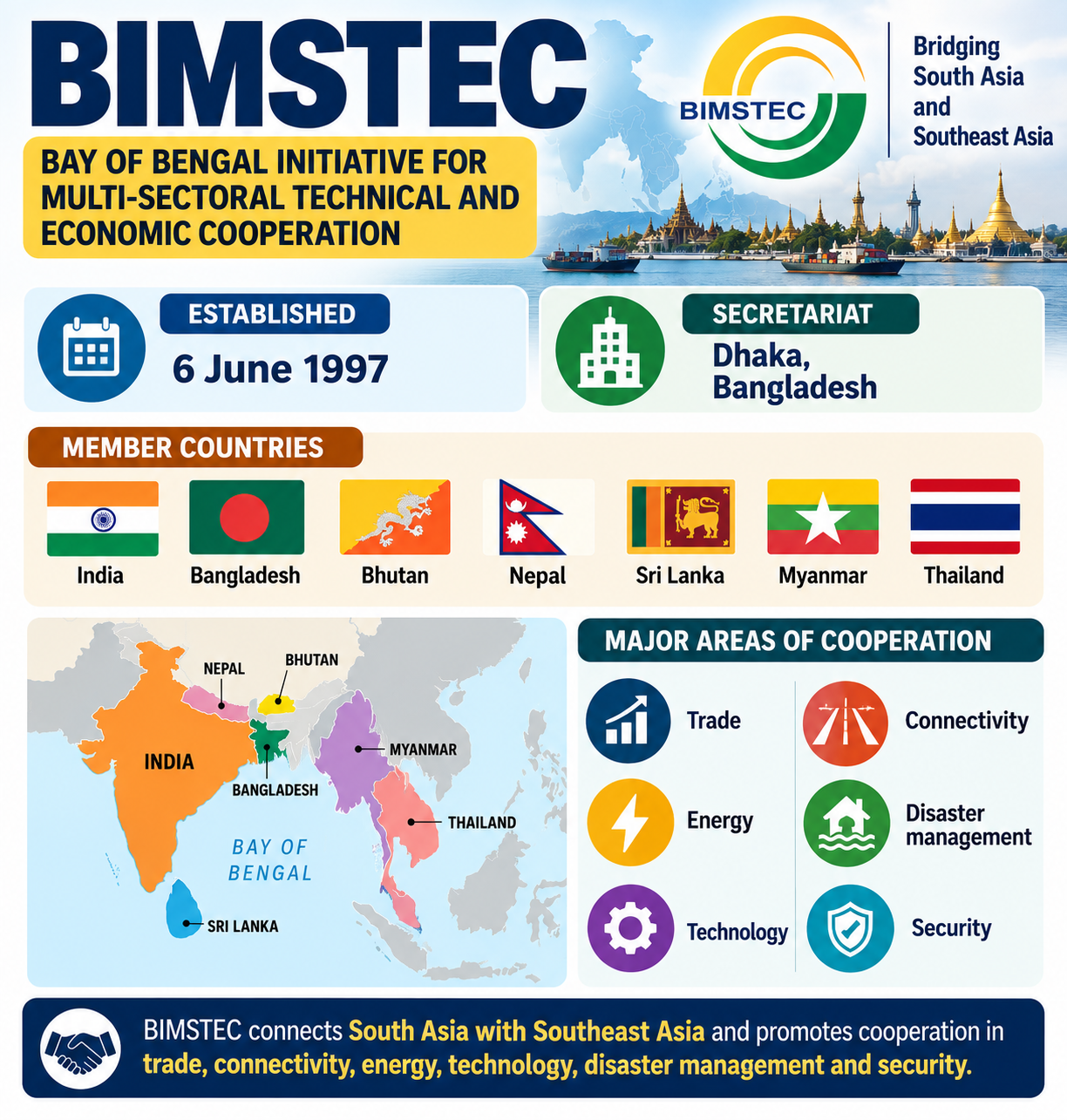
- The Bay of Bengal Initiative for Multi-Sectoral Technical and Economic Cooperation (BIMSTEC) is a regional organisation established on 6 June 1997. Its Secretariat is located in Dhaka, Bangladesh.
- Member Countries: India, Bangladesh, Bhutan, Nepal, Sri Lanka, Myanmar and Thailand.
- BIMSTEC connects South Asia with Southeast Asia and promotes cooperation in trade, connectivity, energy, technology, disaster management and security.
- The Bay of Bengal Initiative for Multi-Sectoral Technical and Economic Cooperation (BIMSTEC) is a regional organisation established on 6 June 1997. Its Secretariat is located in Dhaka, Bangladesh.
-
Background:
-
-
- The initiative to strengthen cooperation among Home Ministers emerged from BIMSTEC’s efforts to address regional security challenges. The Fourth BIMSTEC Summit (2018) in Kathmandu emphasised stronger cooperation against terrorism and transnational crime.
- The Sixth BIMSTEC Summit (2025) in Bangkok welcomed the establishment of the Home Ministers’ Meeting mechanism. The inaugural meeting in 2026 marked an important step towards institutionalising regional security cooperation.
- The initiative to strengthen cooperation among Home Ministers emerged from BIMSTEC’s efforts to address regional security challenges. The Fourth BIMSTEC Summit (2018) in Kathmandu emphasised stronger cooperation against terrorism and transnational crime.
-
Key Outcomes of the Meeting:
-
-
- Adoption of the Delhi Declaration: Member countries reaffirmed their commitment to building a secure, resilient and prosperous Bay of Bengal region.
- Counterterrorism Cooperation: The meeting emphasised intelligence sharing, prevention of terrorist financing, counter-radicalisation and cooperation among law enforcement agencies.
- Combating Organised Crime: Members highlighted coordinated action against drug trafficking, arms smuggling, money laundering and other transnational crimes.
- Human Trafficking: The declaration called for stronger cooperation in rescuing, repatriating and rehabilitating trafficking victims.
- Legal Cooperation: Members emphasised mutual legal assistance and progress towards cooperation on extradition and the transfer of sentenced persons.
- Cybersecurity and Disaster Management: The meeting highlighted capacity building to tackle cybercrime and strengthen regional disaster preparedness.
- Adoption of the Delhi Declaration: Member countries reaffirmed their commitment to building a secure, resilient and prosperous Bay of Bengal region.
-
Significance for India:
-
-
- National Security: Strengthens cooperation against cross-border terrorism, narcotics trafficking and organised crime.
- Neighbourhood First Policy: Deepens engagement with neighbouring countries.
- Act East Policy: Enhances India's connectivity and strategic engagement with Southeast Asia.
- Maritime Security: Supports a safer Bay of Bengal for trade and navigation.
- Regional Leadership: Reinforces India’s role in promoting collective security.
- National Security: Strengthens cooperation against cross-border terrorism, narcotics trafficking and organised crime.
-
Challenges:
Political differences, inadequate institutional capacity, varying legal frameworks, trust deficits and limited information sharing may hinder implementation.
Way Forward:
BIMSTEC should strengthen intelligence-sharing mechanisms, accelerate legal cooperation, conduct joint training exercises and establish measurable targets for implementing the Delhi Declaration.
Conclusion:
The First BIMSTEC Home Ministers’ Meeting represents an important step towards regional security cooperation. Its success will depend on sustained political commitment, mutual trust and effective implementation of agreed measures.



