
Context:
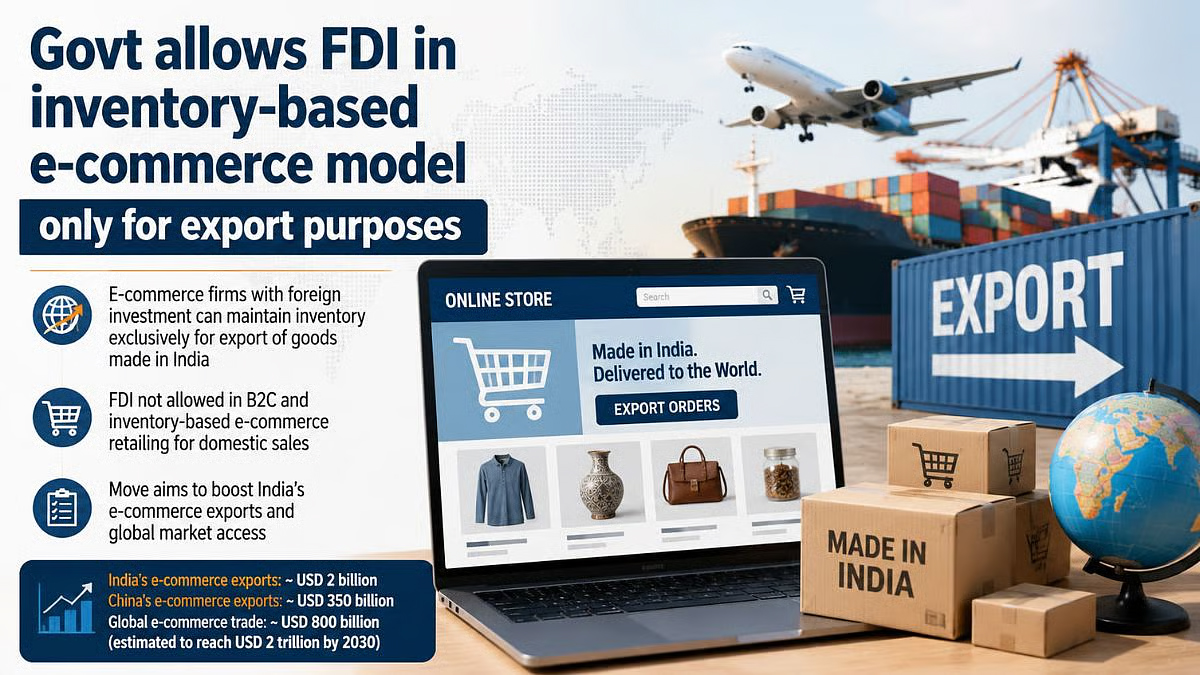
Recently, The Department for Promotion of Industry and Internal Trade (DPIIT) has allowed Foreign Direct Investment (FDI) in the inventory-based model of e-commerce, but only for the export of goods manufactured in India. The move aims to boost India's exports by providing Indian sellers, particularly MSMEs, easier access to global markets. It also comes amid tightening global trade regulations and evolving tariff measures by the United States.
Inventory-Based vs Marketplace Model:
-
-
- India's e-commerce sector operates under two distinct models:
- Inventory-Based Model: The e-commerce company owns the inventory and sells goods directly to customers.
- Marketplace Model: The e-commerce platform acts only as a digital intermediary connecting buyers and sellers, without owning inventory.
- Inventory-Based Model: The e-commerce company owns the inventory and sells goods directly to customers.
- Before this policy change, 100% FDI under the automatic route was permitted only in the marketplace model, while FDI in the inventory-based model was prohibited to protect domestic retailers and prevent unfair competition.
- India's e-commerce sector operates under two distinct models:
-
Why Has the Policy Been Changed?
-
-
- The relaxation applies exclusively to exports, ensuring that restrictions on foreign-funded inventory ownership continue in the domestic retail market. The objective is to facilitate greater exports through easier compliance, better logistics, and enhanced access to international consumers.
- Large e-commerce firms such as Amazon and Flipkart can now own inventory meant for exports, enabling them to manage export documentation, customs procedures, warehousing, and global distribution more efficiently on behalf of Indian manufacturers.
- The relaxation applies exclusively to exports, ensuring that restrictions on foreign-funded inventory ownership continue in the domestic retail market. The objective is to facilitate greater exports through easier compliance, better logistics, and enhanced access to international consumers.
-
Benefits for MSMEs:
-
-
- Micro, Small and Medium Enterprises (MSMEs) form the backbone of India's export ecosystem but often struggle with complex export procedures. The new policy offers several advantages:
- Reduces compliance and documentation burden.
- Improves access to international markets.
- Strengthens logistics and warehousing support.
- Enables economies of scale in exports.
- Enhances the global visibility of Indian products.
- Reduces compliance and documentation burden.
- This reform complements the objectives of the Foreign Trade Policy (FTP) 2023, which seeks to simplify export procedures, promote digital trade, and integrate Indian businesses into global value chains.
- Micro, Small and Medium Enterprises (MSMEs) form the backbone of India's export ecosystem but often struggle with complex export procedures. The new policy offers several advantages:
-
India's E-commerce Export Potential:
-
-
- India's e-commerce exports currently stand at approximately $5 billion, significantly lower than China's exports of around $300 billion. According to the Global Trade Research Initiative (GTRI), India's e-commerce exports have the potential to reach $350 billion by 2030.
- The new FDI policy can accelerate this growth by improving market access, reducing transaction costs, strengthening supply chains, and increasing the competitiveness of Indian products in global markets.
- India's e-commerce exports currently stand at approximately $5 billion, significantly lower than China's exports of around $300 billion. According to the Global Trade Research Initiative (GTRI), India's e-commerce exports have the potential to reach $350 billion by 2030.
-
Challenges and Concerns:
Despite its potential benefits, the policy also raises certain concerns:
-
-
- Greater dependence on foreign e-commerce platforms.
- Risk of market concentration among a few global players.
- Need to ensure that MSMEs receive equitable benefits.
- Requirement for strong regulatory oversight on competition and data governance.
- Greater dependence on foreign e-commerce platforms.
-
Conclusion:
The DPIIT's decision to permit FDI in the inventory-based e-commerce model for exports is a targeted reform that can strengthen India's export ecosystem. By reducing compliance burdens for MSMEs, improving access to global markets, and supporting emerging traceability standards, the policy has the potential to boost India's e-commerce exports while safeguarding domestic retail interests.



