
FCRA Amendment 2026: Key Changes in Foreign Funding Law
Context:
Union government is likely to introduce amendments to the Foreign Contribution (Regulation) Act (FCRA), 2010 during the ongoing session of Parliament. The proposed changes seek to enhance transparency, strengthen accountability, and safeguard national interest in the utilisation of foreign contributions by individuals and organisations.
About FCRA:
-
-
- The Foreign Contribution (Regulation) Act, 2010 regulates the acceptance and utilisation of foreign funds by NGOs, associations, and individuals in India. Its primary objective is to ensure that foreign contributions do not adversely affect national sovereignty, integrity, or internal security.
- Registration under FCRA is mandatory for any organisation to receive foreign funds.
- The Foreign Contribution (Regulation) Act, 2010 regulates the acceptance and utilisation of foreign funds by NGOs, associations, and individuals in India. Its primary objective is to ensure that foreign contributions do not adversely affect national sovereignty, integrity, or internal security.
-
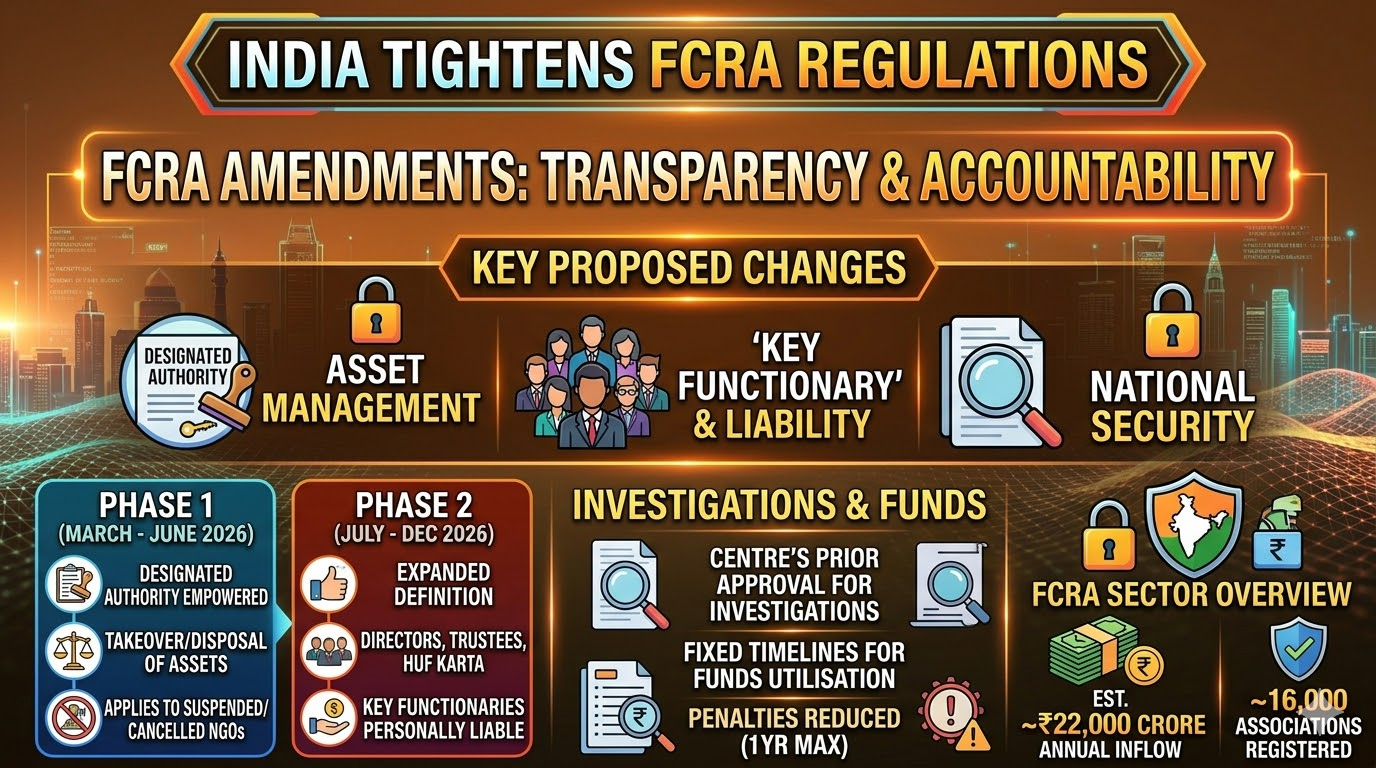
Key Proposed Amendments (FCRA Amendment Bill, 2026):
-
-
- Designated Authority for Asset Management
- Introduction of a “designated authority” empowered to take over, manage, or dispose of assets created out of foreign funds
- Applicable to NGOs whose FCRA registration is suspended, cancelled, or not renewed
- Addresses the earlier gap where the Act regulated funds but lacked a statutory framework for managing assets
- Introduction of a “designated authority” empowered to take over, manage, or dispose of assets created out of foreign funds
- Expansion of ‘Key Functionary’ Definition
- Broader definition to include:
- Directors, partners, trustees
- Karta of a Hindu Undivided Family (HUF)
- Members of governing bodies, managing committees, trade unions, or associations
- Any person responsible for management or control
- Ensures wider accountability across organisational structures
- Directors, partners, trustees
- Liability of Key Functionaries
- Key functionaries will be made legally liable for offences under the Act
- Strengthens personal accountability in case of violations
- Key functionaries will be made legally liable for offences under the Act
- Prior Approval for Investigations (Section 43 Amendment)
- Law enforcement agencies or State governments will require prior approval from the Central government before initiating investigations into FCRA-related cases
- Law enforcement agencies or State governments will require prior approval from the Central government before initiating investigations into FCRA-related cases
- Timelines for Receipt and Utilisation of Funds
- Government empowered to prescribe validity periods for receiving foreign contributions
- Fixed timelines for utilisation of funds, replacing earlier open-ended provisions
- Government empowered to prescribe validity periods for receiving foreign contributions
- Reduction in Penal Provisions
- Maximum imprisonment for offences proposed to be reduced from five years to one year
- Maximum imprisonment for offences proposed to be reduced from five years to one year
- Data and Sector Overview
- Around 16,000 associations currently registered under FCRA
- Annual foreign contribution inflow estimated at ₹22,000 crore
- Around 16,000 associations currently registered under FCRA
- Designated Authority for Asset Management
-
Rationale Behind Amendments:
-
-
- Address misuse or diversion of foreign funds
- Strengthen monitoring and enforcement mechanisms
- Fill regulatory gaps related to asset management
- Enhance accountability of individuals managing NGOs
- Ensure national security and public interest
- The amendments also reflect a continued policy trend of tightening oversight over foreign-funded entities.
- Address misuse or diversion of foreign funds
-
Significance:
-
-
- Enhanced Transparency: Clear timelines and stricter definitions improve compliance
- Accountability: Personal liability of key functionaries strengthens governance
- Regulatory Clarity: Formal framework for asset management
- National Security: Greater control over foreign influence in domestic affairs
- Enhanced Transparency: Clear timelines and stricter definitions improve compliance
-
Conclusion:
The proposed amendments to the FCRA mark a significant shift toward tighter regulation of foreign contributions in India. While the changes aim to enhance transparency, accountability, and national security, their effectiveness will depend on maintaining a balance between regulatory control and the operational autonomy of civil society organisations.



