
Context:
Amid growing concerns over repeated examination paper leaks, recently, Prime Minister Narendra Modi announced the establishment of Fast Track Courts (FTCs) to ensure the speedy trial of offenders related to paper leaks. The move complements the Public Examinations (Prevention of Unfair Means) Act, 2024, which aims to curb paper leaks and examination fraud.
What are Fast Track Courts?
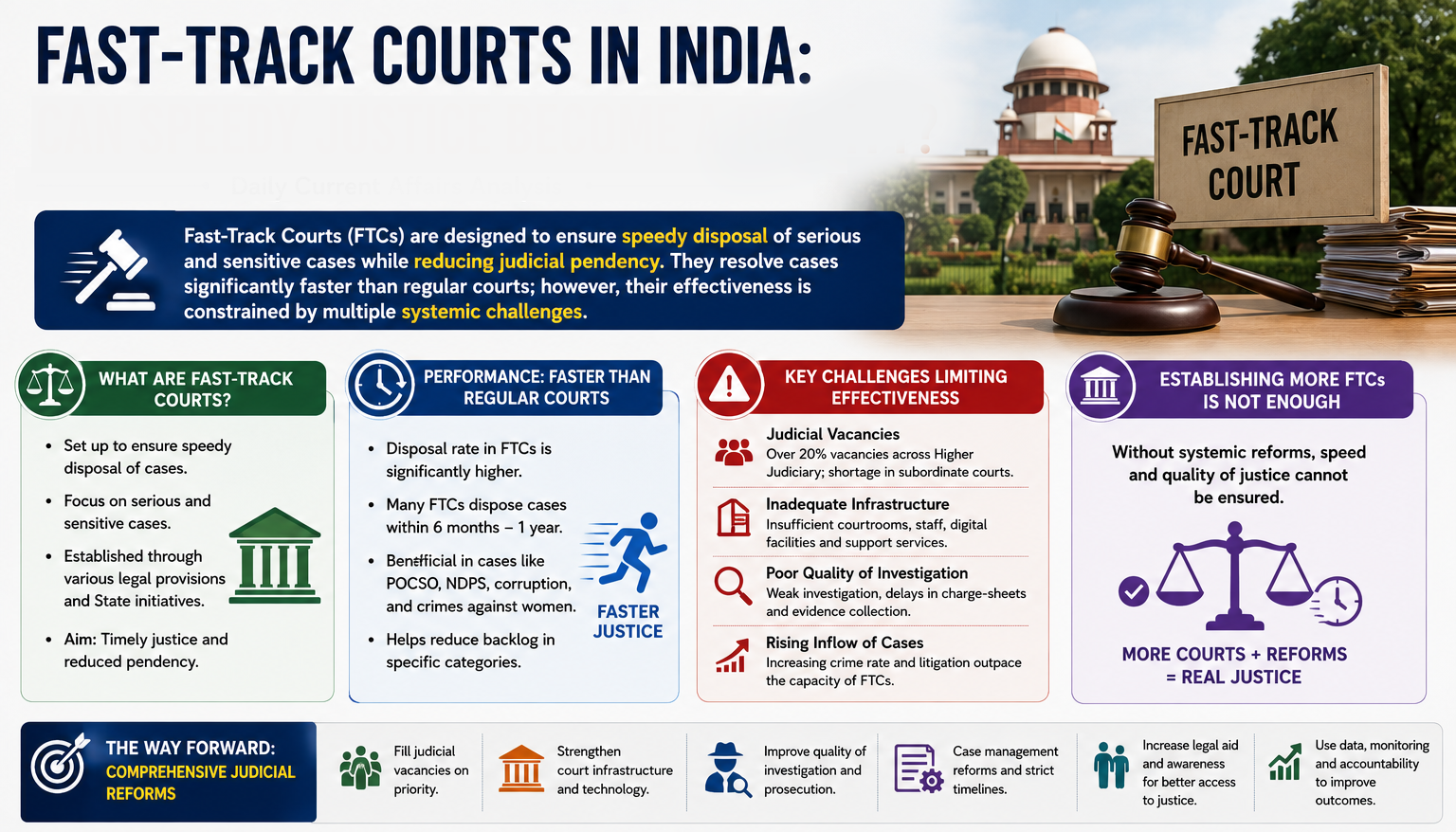
Fast Track Courts (FTCs) are special courts established to ensure the speedy disposal of specific categories of cases involving serious crimes, long-pending matters, and issues of public importance. They function within the existing judicial hierarchy, usually at the Sessions Court level, and are created through State laws or High Court notifications. The Union Government provides policy and financial support, while State Governments establish these courts in consultation with their High Courts.
Evolution of Fast Track Courts:
-
-
- The concept of FTCs was introduced by the 11th Finance Commission (2000) to reduce judicial pendency, particularly cases involving undertrial prisoners. The 14th Finance Commission (2015) recommended establishing 1,800 FTCs for heinous crimes and cases involving women, children, senior citizens, and long-pending disputes.
- In 2019, the Centre launched Fast Track Special Courts (FTSCs) under a Centrally Sponsored Scheme funded through the Nirbhaya Fund to exclusively hear rape and POCSO cases. As of April 2026, 775 FTSCs, including 398 exclusive POCSO courts, are functional across 29 States and Union Territories.
- The concept of FTCs was introduced by the 11th Finance Commission (2000) to reduce judicial pendency, particularly cases involving undertrial prisoners. The 14th Finance Commission (2015) recommended establishing 1,800 FTCs for heinous crimes and cases involving women, children, senior citizens, and long-pending disputes.
-
Significance:
-
-
- Ensures speedy justice through continuous hearings and time-bound trials.
- Helps reduce judicial pendency by allowing regular courts to focus on other cases.
- Adopts a victim-centric approach, especially in rape and POCSO cases.
- Strengthens public confidence in the justice delivery system.
- Upholds the Right to Speedy Trial, recognized under Article 21 of the Constitution.
- Ensures speedy justice through continuous hearings and time-bound trials.
-
Challenges:
Despite their importance, FTSCs face several constraints:
-
-
- Huge pendency: As of December 2025, FTSCs had 2,45,579 pending cases. In 2025, they registered 1,43,936 new cases but disposed of only 66,500, increasing the backlog from 2.04 lakh to 2.45 lakh cases.
- Shortage of judges and delays in filling vacancies.
- Inadequate infrastructure, including insufficient digital facilities and dedicated courtrooms.
- Low conviction rates in several States due to weak investigations and prosecution.
- Poor coordination among police, prosecution, and forensic agencies, leading to delays in trials.
- The FTSC scheme has only been temporarily extended until September 2026, creating uncertainty regarding long-term institutional support.
- Huge pendency: As of December 2025, FTSCs had 2,45,579 pending cases. In 2025, they registered 1,43,936 new cases but disposed of only 66,500, increasing the backlog from 2.04 lakh to 2.45 lakh cases.
-
Way Forward:
Judicial vacancies should be filled on priority, and permanent judicial posts should replace ad hoc appointments. Dedicated infrastructure, digital case management under the e-Courts Mission, and better coordination among police, prosecution, forensic laboratories, and the judiciary are essential. The Centre and States should ensure sustained funding and institutionalize FTSCs as a permanent feature of the judicial system. Expanding the FTC model to examination paper leak cases must be accompanied by adequate manpower and infrastructure to prevent further backlog.
Conclusion:
Fast Track Courts play a vital role in ensuring timely justice, but their effectiveness depends on adequate judges, infrastructure, and institutional support. Strengthening these courts is essential for reducing judicial delays and enhancing public confidence in India's justice delivery system.



