
Context:
Recently, India’s Ethanol Blended Petrol (EBP) programme has gained attention after the nationwide adoption of E20 fuel, which contains 20% ethanol and 80% petrol. Following opposition, the government stated that while E20 fuel might reduce the fuel efficiency of some vehicles by approximately 3–5%, it also offers significant benefits such as cleaner combustion, a higher octane rating, and reduced pollution.
What is Ethanol?
-
-
- Ethanol (ethyl alcohol) is a renewable biofuel produced through the fermentation of plant-based sugars and starches. It is mainly used as a fuel additive to increase petrol efficiency and reduce harmful emissions.
- Ethanol used for petrol blending requires 99%+ purity. It can be produced from sugarcane, corn, rice, grains, and agricultural waste.
- Ethanol (ethyl alcohol) is a renewable biofuel produced through the fermentation of plant-based sugars and starches. It is mainly used as a fuel additive to increase petrol efficiency and reduce harmful emissions.
-
About Ethanol Blended Petrol (EBP) Programme:
The Ethanol Blended Petrol (EBP) Programme is a flagship initiative of the Government of India aimed at reducing dependence on fossil fuels by blending ethanol with petrol and promoting cleaner energy. The programme is implemented by the Ministry of Petroleum and Natural Gas under the National Policy on Biofuels, 2018. India achieved its 20% ethanol blending (E20) target in 2025–26, five years ahead of the original deadline.
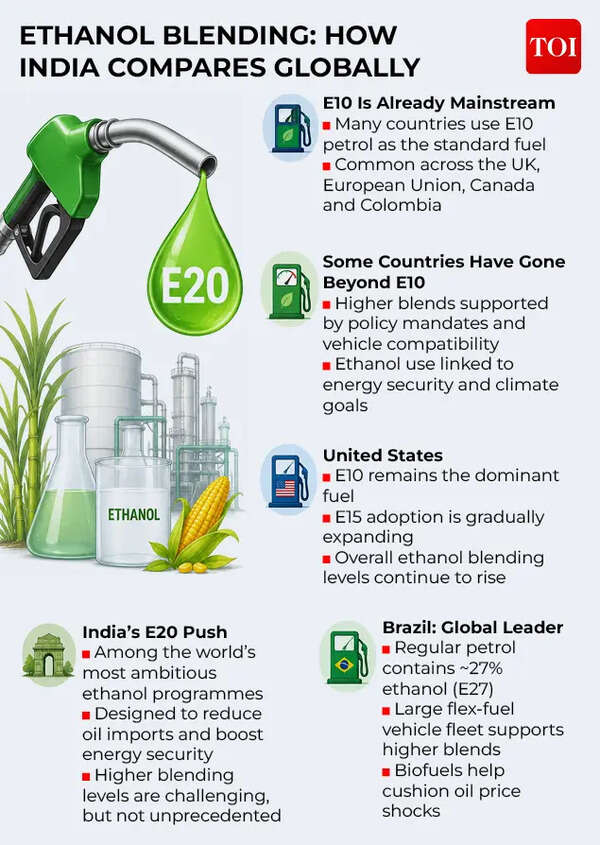
Key features:
-
-
- Launch: Introduced as a pilot project in January 2003 and expanded nationwide in 2006.
- Sources of Ethanol: Sugarcane molasses, sugarcane juice, maize, sugar beet, damaged food grains, and agricultural residues (2G ethanol).
- Major Benefits: Reduces crude oil imports, saves foreign exchange (over ₹1.4 lakh crore), increases farmers' income, lowers carbon emissions by up to 30%, and enhances India's energy security.
- Impact on Vehicles: E20 fuel is considered safe for compatible vehicles. However, some older vehicles may experience a marginal reduction of 3–5% in fuel efficiency (mileage).
- Launch: Introduced as a pilot project in January 2003 and expanded nationwide in 2006.
-
Generations of Biofuels:
-
-
- First Generation (1G)
- Produced from food crops such as sugarcane, corn, and sugar beet.
- Example: Ethanol from molasses.
- Concern: Food versus fuel debate.
- Produced from food crops such as sugarcane, corn, and sugar beet.
- Second Generation (2G)
- Produced from non-food sources like agricultural residue, bagasse, and municipal waste.
- Helps reduce stubble burning and promotes waste-to-energy solutions.
- Produced from non-food sources like agricultural residue, bagasse, and municipal waste.
- Third Generation (3G)
- Produced from algae and aquatic biomass.
- Requires less agricultural land and has high carbon absorption potential.
- Produced from algae and aquatic biomass.
- Fourth Generation (4G)
- Uses genetically modified microorganisms to develop carbon-neutral fuels.
- Uses genetically modified microorganisms to develop carbon-neutral fuels.
- First Generation (1G)
-
Benefits of Ethanol Blending:
-
-
- Energy Security: India imports more than 88% of its crude oil requirements. Ethanol blending reduces dependence on imported fossil fuels and saves foreign exchange.
- Support to Farmers: The programme creates additional markets for sugarcane, grains, and agricultural products, improving rural incomes.
- Environmental Benefits: Ethanol burns cleaner than petrol and helps reduce carbon monoxide, hydrocarbon emissions, and greenhouse gases.
- Waste Management: 2G ethanol converts agricultural waste into fuel and helps tackle crop residue burning.
- Energy Security: India imports more than 88% of its crude oil requirements. Ethanol blending reduces dependence on imported fossil fuels and saves foreign exchange.
-
Challenges:
-
-
- Lower mileage in some vehicles.
- Compatibility issues with older engines.
- Dependence on water-intensive crops like sugarcane.
- Food security concerns.
- Need for expansion of advanced biofuel technology.
- Lower mileage in some vehicles.
-
Way Forward:
India should focus on promoting 2G and 3G biofuels, developing fuel-efficient vehicles, improving ethanol infrastructure, and ensuring a balance between energy security, environmental protection, and agricultural sustainability.



