
Context:
Recently, Japan has renewed its demand for the removal of references to “enemy states” from the United Nations Charter at 81st UN General Assembly.
What is an ‘Enemy State’?
-
-
- The term originates from the Second World War era. The UN Charter was drafted in the aftermath of World War II, when the Allied Powers sought to prevent the revival of militarism in former Axis countries, particularly Germany, Italy and Japan.
- The Charter uses the term in Articles 53, 77 and 107. Under Article 53, an “enemy state” refers to a state that was an enemy of a signatory to the Charter during World War II.
- The term originates from the Second World War era. The UN Charter was drafted in the aftermath of World War II, when the Allied Powers sought to prevent the revival of militarism in former Axis countries, particularly Germany, Italy and Japan.
-
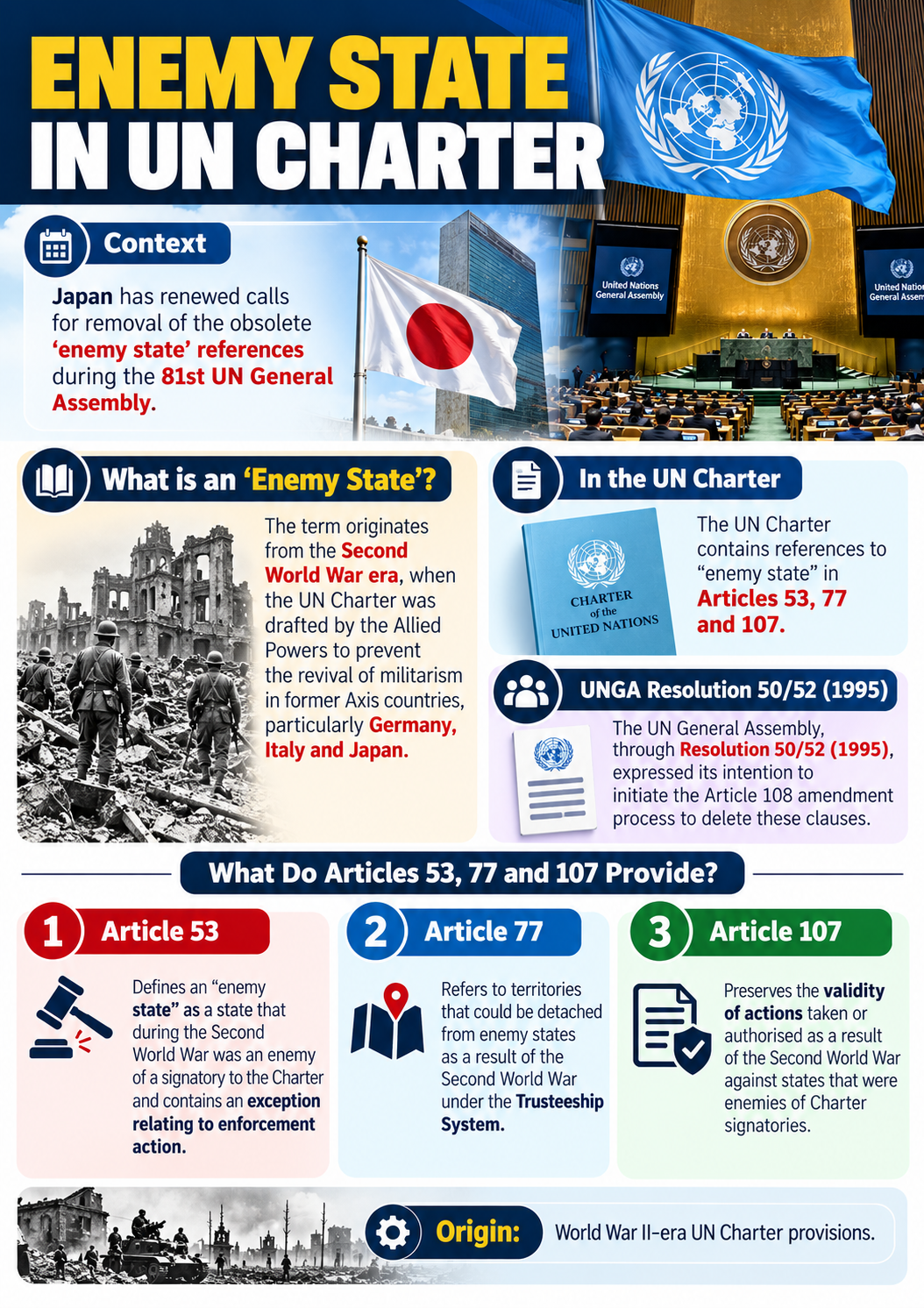
What Do Articles 53, 77 and 107 Provide?
-
-
- Article 53: It contains an exception concerning enforcement action against an “enemy state” and defines the term with reference to World War II.
- Article 77: It refers to territories that could be detached from enemy states as a consequence of World War II under the UN Trusteeship System.
- Article 107: It preserves the validity of actions taken or authorised as a consequence of World War II against states that were enemies of Charter signatories.
- Article 53: It contains an exception concerning enforcement action against an “enemy state” and defines the term with reference to World War II.
-
Thus, these provisions were essentially designed for the immediate post-war security order.
Why Does Japan Want the Clauses Removed?
-
-
- Japan argues that these provisions are obsolete because the countries originally covered by them are now UN members and participate in the organisation’s activities.
- The UN General Assembly itself recognised in 1995 that the enemy-state clauses had become obsolete and expressed an intention to delete them through the Charter amendment procedure.
- The 2005 World Summit Outcome again resolved to delete references to “enemy States” in Articles 53, 77 and 107. However, the proposed amendments have not been implemented.
- Japan argues that these provisions are obsolete because the countries originally covered by them are now UN members and participate in the organisation’s activities.
-
Why Have They Not Been Deleted?
-
-
- Amending the UN Charter requires a demanding process under Article 108. Amendments require adoption by a two-thirds majority of the General Assembly and ratification by two-thirds of UN members, including all permanent members of the Security Council.
- The five permanent members — United States, Russia, China, United Kingdom and France — therefore have a decisive role in the amendment process.
- China and Russia have continued to refer to the clauses in their diplomatic rhetoric concerning Japan, while Japan views their continued presence as inconsistent with the contemporary international order.
- Amending the UN Charter requires a demanding process under Article 108. Amendments require adoption by a two-thirds majority of the General Assembly and ratification by two-thirds of UN members, including all permanent members of the Security Council.
-
Link with UN Security Council Reform:
-
-
- Japan’s demand is part of a broader call for UNSC reform. Japan has argued that the present Council structure reflects the geopolitical realities of 1945 rather than the contemporary international system.
- It has supported expanding both permanent and non-permanent membership to make the Council more representative and legitimate.
- Japan’s demand is part of a broader call for UNSC reform. Japan has argued that the present Council structure reflects the geopolitical realities of 1945 rather than the contemporary international system.
-
India’s Relevance:
-
-
- The issue is significant for India because New Delhi has consistently supported reform of the UN Security Council and greater representation for developing countries.
- India’s case for permanent membership is linked to factors such as:
- Large population and economy.
- Contribution to UN peacekeeping.
- Growing role in global affairs.
- Representation of the developing world.
- Need to make global institutions more representative.
- Large population and economy.
- The debate over obsolete Charter provisions therefore connects with the larger question of reforming post-World War II global institutions.
- The issue is significant for India because New Delhi has consistently supported reform of the UN Security Council and greater representation for developing countries.
-
Conclusion:
The persistence of the “enemy state” clauses reflects the gap between the UN’s post-1945 institutional framework and contemporary geopolitics. Their removal, alongside broader UN Security Council reform, would raise questions about how effectively global institutions can adapt to changing international realities.



