
Context:
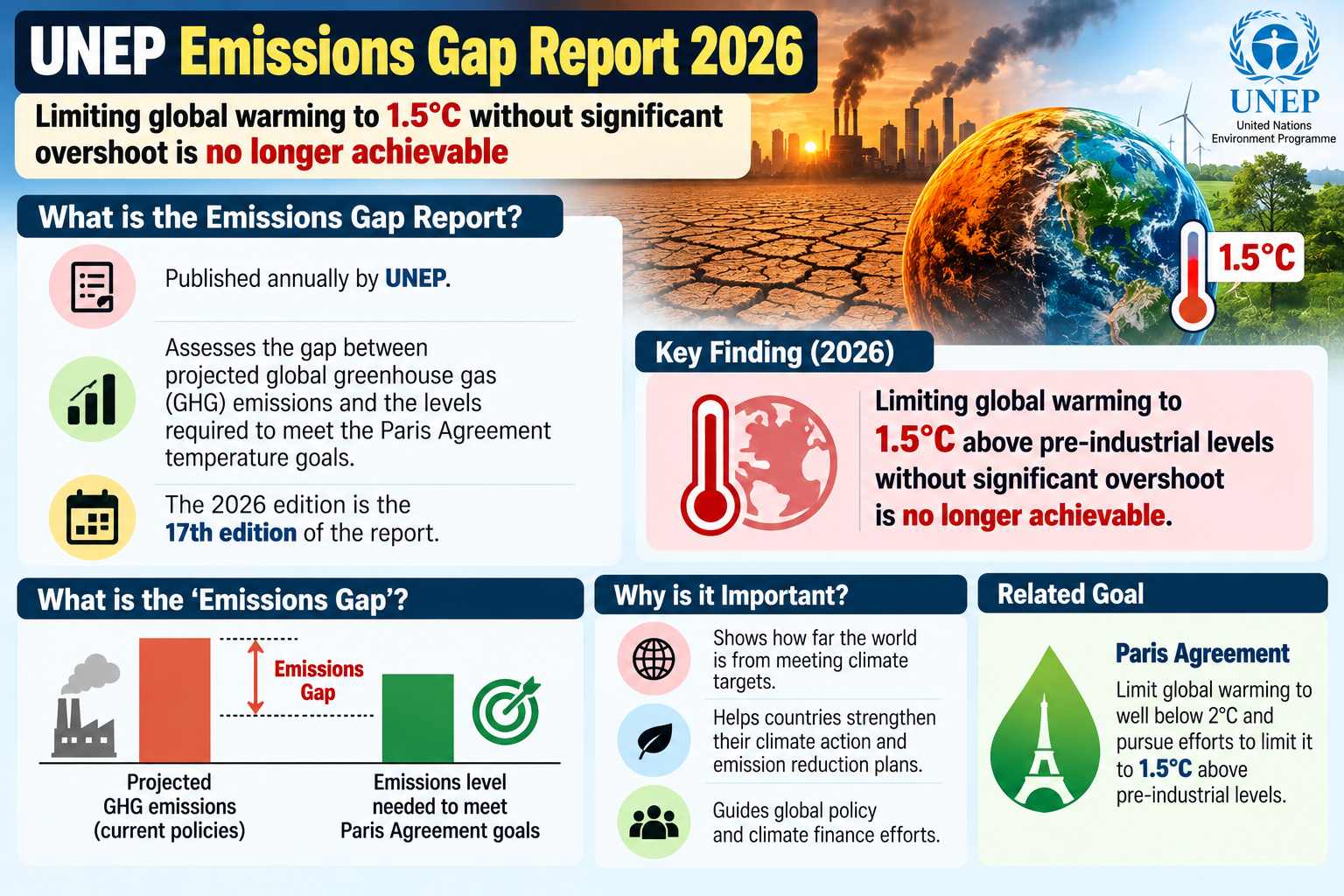
Recently, The United Nations Environment Programme (UNEP) released its Emissions Gap Report 2026, warning that limiting global warming to 1.5°C above pre-industrial levels without significant overshoot is no longer achievable.
What is the Emissions Gap Report?
Published annually by UNEP, it assesses the gap between projected global greenhouse gas (GHG) emissions and the levels required to meet the Paris Agreement temperature goals.
The 2026 edition is the 17th edition of the report.
Key Findings of the Report:
-
-
- Global emissions: GHG emissions reached 58.4 gigatonnes of CO₂ equivalent (GtCO₂e) in 2025, a marginal decline of 0.1 GtCO₂e from 2024.
- Fossil fuel emissions: CO₂ emissions from coal, oil and gas continued to rise despite the slight decline in overall emissions.
- Major contributors: G20 members, excluding the African Union, accounted for 76% of global emissions; their emissions excluding land-use change increased by 0.7% in 2025.
- Emission trends: Over the past decade, 63 countries reduced emissions, while 124 recorded increases.
- Temperature records: Global temperatures crossed the 1.5°C mark in 2024, highlighting the urgency of climate action.
- Global emissions: GHG emissions reached 58.4 gigatonnes of CO₂ equivalent (GtCO₂e) in 2025, a marginal decline of 0.1 GtCO₂e from 2024.
-
Why Is the 1.5°C Target Important?
The 1.5°C threshold under the Paris Agreement aims to limit climate risks. Exceeding it increases the likelihood of extreme heatwaves, floods, droughts, sea-level rise and biodiversity loss.
What Lies Ahead?
-
-
- To return to the 1.5°C pathway with the lowest possible overshoot, global GHG emissions must fall relative to 2025 levels by:
- 18% by 2030
- 45% by 2035
- 69% by 2040
- 18% by 2030
- Large-scale carbon dioxide removal will also be necessary to bring temperatures back to or below 1.5°C by the end of the century.
- To return to the 1.5°C pathway with the lowest possible overshoot, global GHG emissions must fall relative to 2025 levels by:
-
Challenges:
-
-
- Continued dependence on fossil fuels.
- Inadequate climate policies and emission-reduction commitments.
- Unequal historical responsibility and emissions across countries.
- Financial and technological constraints in developing nations.
- Difficulty monitoring and upgrading emission-intensive infrastructure.
- Continued dependence on fossil fuels.
-
Way Forward:
-
-
- Accelerate the transition to renewable energy and phase down fossil fuel dependence.
- Strengthen Nationally Determined Contributions (NDCs) under the Paris Agreement.
- Increase climate finance and technology transfer to developing countries.
- Promote energy efficiency, sustainable transport and forest conservation.
- Develop credible carbon-removal technologies while prioritising immediate emission cuts.
- Accelerate the transition to renewable energy and phase down fossil fuel dependence.
-
Significance for India:
India must balance climate action with development and energy security. Expanding renewable energy, improving energy efficiency, promoting green hydrogen and protecting forests can support its climate commitments. Developed countries must provide adequate finance and technology in line with climate equity and the principle of Common but Differentiated Responsibilities and Respective Capabilities (CBDR-RC).
Conclusion:
The report signals that preventing all overshoot of 1.5°C is no longer realistic. The priority must now be to minimise the extent and duration of overshoot through urgent emission cuts, international cooperation and equitable climate action.



