
Context:
A recent US Department of State report on India's investment climate has highlighted economic nationalism, regulatory uncertainty and corruption-related concerns as challenges for foreign investors. The observations are important as India seeks to attract greater Foreign Direct Investment (FDI), promote manufacturing and integrate with global value chains.
What is FDI?
-
-
- Foreign Direct Investment (FDI) is a long-term investment in which an individual or company from one country acquires a significant ownership stake, generally 10% or more, in an enterprise in another country, or establishes new business operations there.
- Unlike Foreign Portfolio Investment (FPI), which generally involves investment in financial assets without management control, FDI represents a lasting interest and a degree of influence or control over the foreign enterprise.
- Foreign Direct Investment (FDI) is a long-term investment in which an individual or company from one country acquires a significant ownership stake, generally 10% or more, in an enterprise in another country, or establishes new business operations there.
-
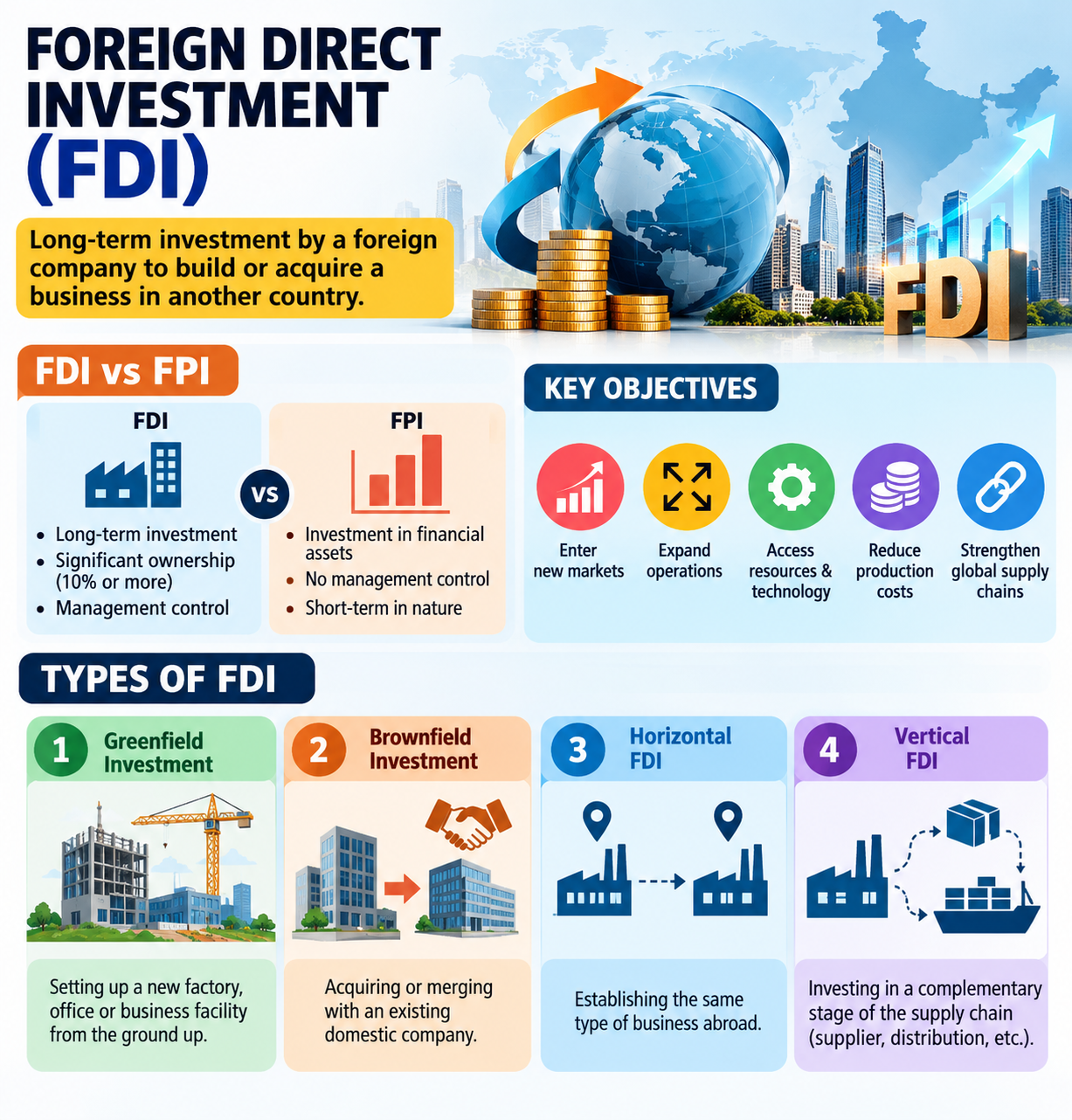
Key Objectives of FDI:
FDI enables companies to:
-
-
- Enter new markets
- Expand their international operations
- Access resources and technology
- Reduce production costs
- Strengthen global supply chains
- Enter new markets
-
Types of FDI:
-
-
- Greenfield Investment: A foreign company establishes a new factory, office or business facility from the ground up in the host country.
- Brownfield Investment: A foreign investor acquires or merges with an existing domestic company, generally through mergers and acquisitions (M&A).
- Horizontal FDI: A company establishes the same type of business abroad that it operates in its home country.
- Vertical FDI: A company invests in a complementary stage of the supply chain, such as acquiring a foreign supplier of raw materials or establishing a distribution network.
- Greenfield Investment: A foreign company establishes a new factory, office or business facility from the ground up in the host country.
-
Key Findings of the Report:
-
-
- The report noted that India allows 100% FDI through the automatic route in many sectors, while certain sensitive sectors continue to require government approval. These include areas such as defence, pharmaceuticals, private banking, multi-brand retail, media and satellites.
- The report also highlighted concerns regarding perceived differences in treatment between foreign and domestic investors and corruption risks associated with regulatory processes.
- The report noted that India allows 100% FDI through the automatic route in many sectors, while certain sensitive sectors continue to require government approval. These include areas such as defence, pharmaceuticals, private banking, multi-brand retail, media and satellites.
-
FEMA and FDI-FPI Concerns:
-
-
- The report also raised concerns regarding restrictions under the Foreign Exchange Management Act (FEMA) on concurrent FDI and FPI investments.
- According to the report, these restrictions can create additional compliance burdens for investment groups where affiliated funds have both FDI and FPI interests. It argued that such restrictions can potentially affect participation in Initial Public Offerings (IPOs).
- The report also raised concerns regarding restrictions under the Foreign Exchange Management Act (FEMA) on concurrent FDI and FPI investments.
-
Economic Nationalism:
-
-
- Economic nationalism refers to policies aimed at promoting domestic economic interests through measures such as local-content requirements, restrictions on foreign ownership and import controls.
- Such policies can promote self-reliance, domestic manufacturing and strategic autonomy, but excessive restrictions may affect competition and investment.
- Economic nationalism refers to policies aimed at promoting domestic economic interests through measures such as local-content requirements, restrictions on foreign ownership and import controls.
-
Benefits and Concerns of FDI:
-
-
- Benefits
- Employment generation
- Technology and skill transfer
- Capital formation
- Export promotion
- Integration with global value chains
- Higher productivity and economic growth
- Employment generation
- Concerns
- Foreign corporate control over domestic assets
- Regulatory and compliance challenges
- Possible pressure on domestic firms
- Profit repatriation
- Risks of excessive dependence on foreign capital
- Foreign corporate control over domestic assets
- Benefits
-
India's Reform Measures:
India has introduced Make in India, PLI schemes, FDI liberalisation, digital governance, single-window clearances and the Insolvency and Bankruptcy Code, 2016 to improve the investment climate.
Way Forward:
India needs to ensure predictable regulations, transparent taxation, faster approvals, stronger anti-corruption mechanisms and efficient dispute resolution, while safeguarding strategic sectors.
Conclusion:
The debate over economic nationalism and FDI reflects the need to balance domestic economic interests with global investment and technology. A transparent and predictable investment environment can help India attract capital while advancing Atmanirbhar Bharat, employment generation and integration with global value chains.



