
Context
The elusive Dusky Eagle-owl (Ketupa coromanda) has recently been sighted in the Phato tourism zone of the Terai West Forest Division in Uttarakhand, near the Corbett landscape, after a gap of nearly 15 years.
About Dusky Eagle-Owl:
The Dusky Eagle-owl belongs to the family Strigidae. Unlike many strictly nocturnal owl species, it is partly diurnal, meaning it may hunt during daylight, especially under cloudy conditions. 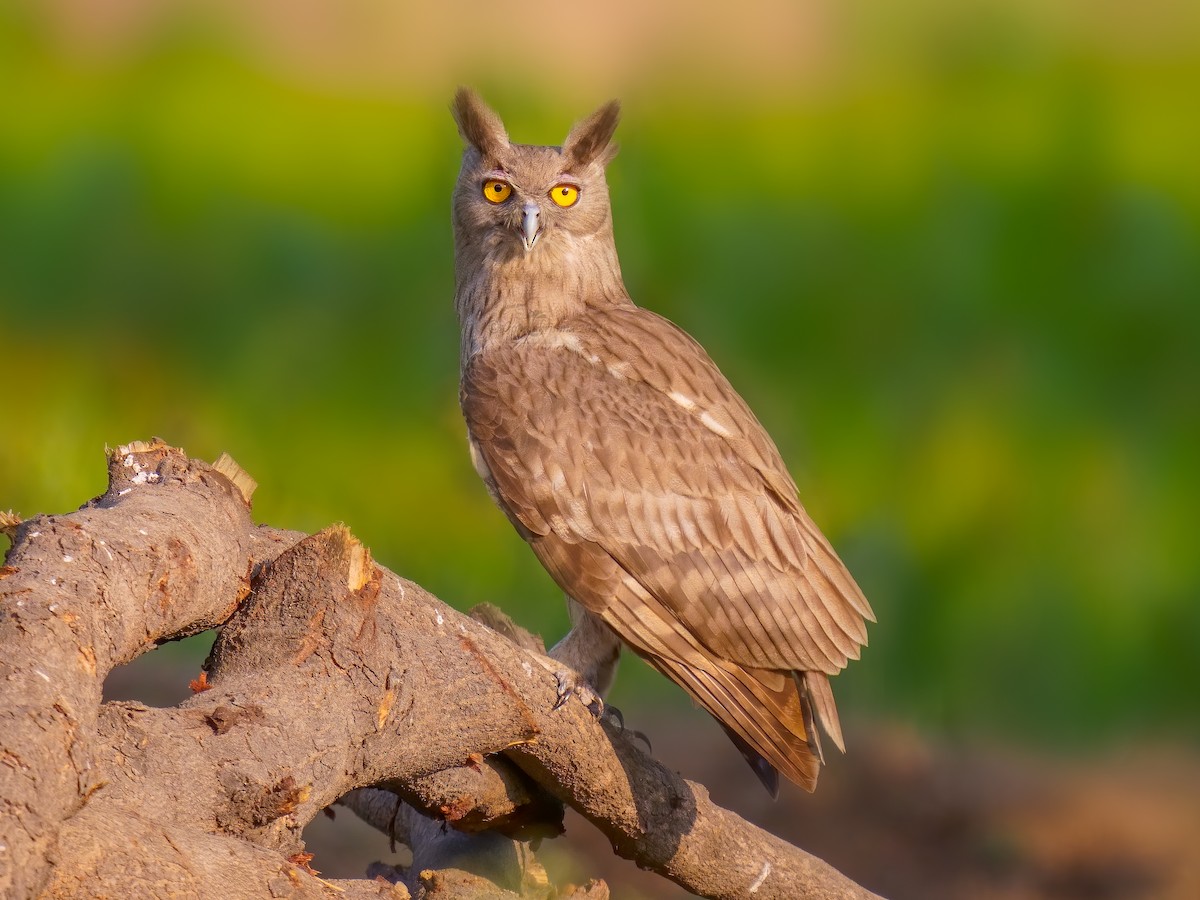
Habitat and Distribution:
- Widely distributed across South and Southeast Asia, including India, Nepal, Bangladesh, Pakistan, Myanmar and parts of Southeast Asia.
- Prefers lowland riparian forests, plantations and old-growth woodland areas close to water bodies.
- Usually found in flat terrains at elevations up to about 250 metres.
Conservation Status:
- IUCN Red List: Least Concern.
Key Characteristics
Physical Features:
- A large greyish-brown owl measuring about 48–58 cm in length with striking yellow eyes.
- Possesses long ear tufts, fine barring on its underparts, and white shoulder patches that help in camouflage.
Diet and Behaviour:
- Functions as an apex predator with a diverse diet including birds, small mammals, fish, reptiles and insects.
- Often reuses old stick nests built by other birds such as kites, vultures or eagles rather than constructing its own.
- A typical clutch contains one to three eggs.
Vocalisation:
- Its call consists of low, guttural notes that gradually increase in speed and volume before fading away.
Ecological Significance
The Dusky Eagle-owl is considered a “litmus test species” because its presence indicates a healthy and undisturbed ecosystem with a strong prey base. Its elusive nature and excellent camouflage make sightings rare even within known habitats.
The recent sighting in the Corbett landscape reflects the success of habitat protection, reduced human interference and restoration of natural corridors in Uttarakhand’s forests. It also highlights the ecological richness of the Terai region, which supports diverse wildlife beyond its well-known tiger population.
Conclusion
The reappearance of the Dusky Eagle-owl in Uttarakhand after 15 years underscores the importance of sustained conservation efforts and habitat management. Such sightings not only enhance scientific understanding of species distribution but also reinforce the need to preserve fragile forest ecosystems that sustain India’s rich biodiversity.



