
DRDO’s ULPGM-V3 Missile Trials
Context:
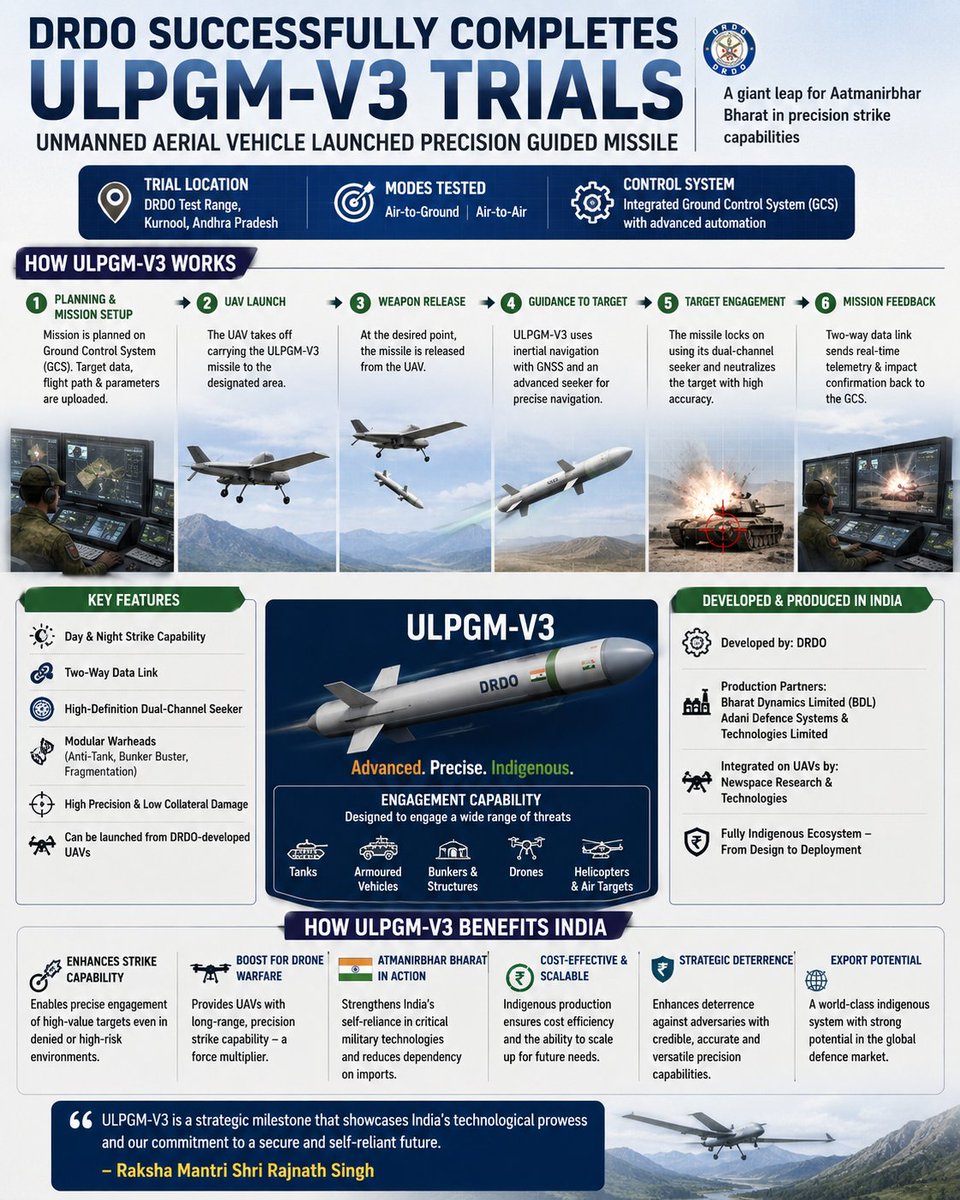
Recently, The Defence Research and Development Organisation (DRDO) has successfully completed final development trials of the Unmanned Aerial Vehicle Launched Precision Guided Missile (ULPGM-V3) at a test range near Kurnool. The system has been tested in both air-to-ground and air-to-air modes, marking a significant milestone in India’s indigenous defence capability under the Aatmanirbhar Bharat initiative.
About ULPGM-V3:
-
-
- The ULPGM-V3 stands for Unmanned Aerial Vehicle Launched Precision Guided Missile-V3, an indigenous missile system developed by India’s Defence Research and Development Organisation (DRDO).
- It is a lightweight, precision-guided missile designed to be launched from drones and unmanned aerial vehicles (UAVs). The missile is capable of engaging both ground and aerial targets with high accuracy. The latest V3 version is an upgraded variant of the earlier ULPGM-V2 system and includes improved seekers, modular warheads, and enhanced operational flexibility.
- The ULPGM-V3 stands for Unmanned Aerial Vehicle Launched Precision Guided Missile-V3, an indigenous missile system developed by India’s Defence Research and Development Organisation (DRDO).
-
Key Features of ULPGM-V3:
-
-
- The ULPGM-V3 incorporates several advanced technologies that significantly improve combat effectiveness. These include:
- High-definition dual-channel seeker
- Day-and-night operational capability
- Fire-and-forget targeting
- Two-way data link
- Post-launch target update system
- Integrated Ground Control System (GCS)
- High-definition dual-channel seeker
- The dual-channel seeker allows the missile to track targets more effectively under different environmental conditions. Meanwhile, the two-way data link enables operators to update target information even after launch, increasing battlefield flexibility.
- The ULPGM-V3 incorporates several advanced technologies that significantly improve combat effectiveness. These include:
-
About fire-and-forget” capability:
-
-
- A fire-and-forget missile can independently track and destroy its target after launch without requiring continuous operator guidance.
- Once the ULPGM-V3 locks onto a target and is launched from the UAV, the missile’s onboard guidance system takes over. This allows the launching drone to quickly reposition or retreat from hostile zones, improving survivability during combat operations.
- A fire-and-forget missile can independently track and destroy its target after launch without requiring continuous operator guidance.
-
Operational and Strategic Applications:
-
-
- The missile has been designed as a multi-role weapon system capable of attacking:
- Enemy tanks and armored vehicles
- Bunkers and fortified structures
- Helicopters
- Drones and low-flying aerial threats
- High-value tactical targets
- Enemy tanks and armored vehicles
- The missile uses modular warheads, meaning different warhead types can be selected depending on mission requirements. Some configurations include anti-armour warheads, penetration-cum-blast warheads for bunkers, and pre-fragmentation warheads for wider lethality zones.
- The missile has been designed as a multi-role weapon system capable of attacking:
-
Significance:
-
-
- The missile gives India a powerful indigenous precision-strike weapon suitable for modern battlefield environments. It enhances:
- Tactical drone warfare capability
- Precision strike operations
- Anti-armour warfare
- Border surveillance strike readiness
- Air-defense against drones and helicopters
- Tactical drone warfare capability
- The ability to launch precision-guided missiles from UAVs is especially valuable in high-risk combat zones where manned aircraft may face greater danger. Defense experts see ULPGM-V3 as part of India’s broader shift toward network-centric and unmanned warfare systems.
- The missile gives India a powerful indigenous precision-strike weapon suitable for modern battlefield environments. It enhances:
-
About DRDO:
The Defence Research and Development Organisation is India’s premier defence research agency under the Ministry of Defence, established in 1958. It operates a large network of laboratories across India and plays a central role in developing indigenous military technologies.
Mandate of DRDO:
-
-
- Design and development of advanced defence systems
- Achieving self-reliance in critical military technologies
- Reducing dependence on imports in defence equipment
- Strengthening India’s strategic and technological autonomy
- Design and development of advanced defence systems
-
Conclusion:
The ULPGM-V3 trials mark a major step in India’s indigenous precision strike capability and Aatmanirbhar Bharat in defence. By integrating UAV platforms with advanced missile systems and a strong domestic industrial base, India is advancing towards next-generation warfare readiness while strengthening national security and export potential.



