
Context:
Recently, the Defence Research and Development Organisation (DRDO) successfully conducted a salvo launch of two Pralay missiles in quick succession from the same launcher off the Odisha coast. This marked a significant milestone in the ongoing user evaluation trials and demonstrated the system’s operational robustness.
About the Pralay Missile:
Pralay is an indigenously developed, solid-propellant, quasi-ballistic surface-to-surface missile designed to deliver high-precision conventional strikes against a range of tactical targets. It effectively bridges the capability gap between short-range ballistic missiles and cruise missile systems within India’s evolving defence architecture.
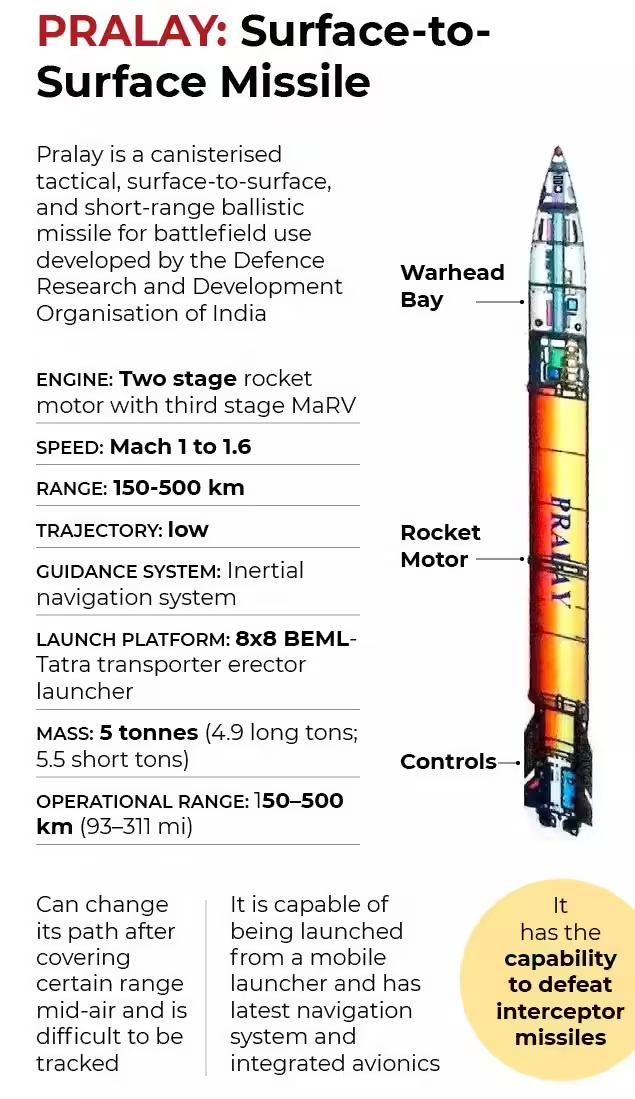
Key Characteristics:
-
- Type: Quasi-ballistic surface-to-surface missile (SRBM)
- Propulsion: Two-stage solid-propellant system, ensuring rapid launch readiness and high reliability
- Trajectory: Quasi-ballistic flight profile enabling in-flight manoeuvrability and interception avoidance, thereby challenging adversary air-defence systems
- Range: Approximately 150–500 km, depending on payload configuration
- Guidance: Advanced navigation and guidance systems enabling high-precision targeting
- Warhead Flexibility: Capable of carrying multiple types of conventional warheads, enhancing mission adaptability
- Salvo Launch Capability: Demonstrated ability to fire multiple missiles in quick succession from the same launcher, significantly improving saturation strike potential
- Type: Quasi-ballistic surface-to-surface missile (SRBM)
Aim and Strategic Objectives:
-
- Rapid Precision Strike Capability: To provide the Indian Army and the Indian Air Force with a quick-response, high-accuracy conventional strike weapon capable of neutralising high-value tactical targets.
- Enhanced Tactical Deterrence: To strengthen battlefield deterrence through credible conventional precision strikes, thereby lowering reliance on nuclear escalation for deterrence signalling.
- Operational Readiness: To improve force preparedness by integrating a mobile, reliable, and swiftly deployable missile platform suited for dynamic and high-intensity conflict scenarios.
- Rapid Precision Strike Capability: To provide the Indian Army and the Indian Air Force with a quick-response, high-accuracy conventional strike weapon capable of neutralising high-value tactical targets.
Significance of the Recent Salvo Test:
The successful salvo launch of two Pralay missiles from the same launcher during user evaluation trials at the Integrated Test Range, Chandipur, off the Odisha coast, represents a major operational milestone. Both missiles followed their intended trajectories and met all mission objectives, validating the system’s reliability, accuracy, and readiness for induction.
Why It Matters?
-
- Operational Validation: Confirms Pralay’s performance under realistic operational conditions, paving the way for its early induction into the armed forces.
- Strengthened Conventional Deterrence: Augments India’s conventional missile arsenal by providing a credible and flexible response option against evolving regional threats.
- Atmanirbhar Bharat: Reinforces India’s indigenous missile development capabilities and supports national objectives of defence self-reliance.
- Operational Validation: Confirms Pralay’s performance under realistic operational conditions, paving the way for its early induction into the armed forces.
Broader Strategic Context:
The Pralay missile adds depth and flexibility to India’s tactical strike capabilities, complementing systems such as BrahMos while fulfilling the role of a conventionally armed, medium-range ballistic missile. Its development aligns with India’s broader strategic emphasis on credible deterrence, precision conventional warfare, and technological self-sufficiency.
Conclusion:
The successful salvo launch of the Pralay missile underscores India’s advancing missile technology and significantly strengthens the country’s conventional strike posture. With its high precision, rapid response capability, and operational flexibility, Pralay is poised to become a key component of India’s tactical deterrence framework. As the system moves closer to operational induction, it stands as a strong testament to India’s growing defence manufacturing capability and strategic autonomy.



