
Context:
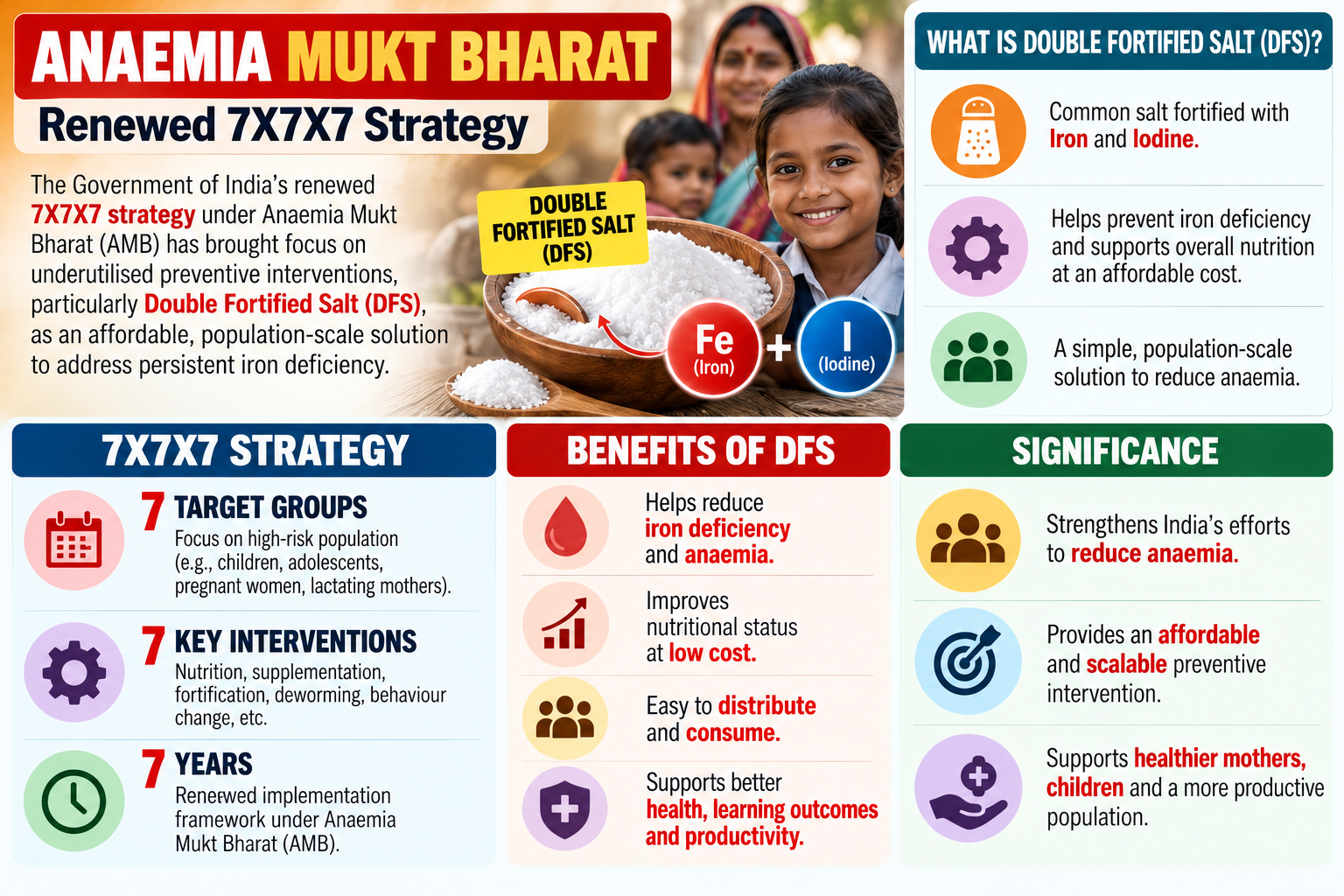
In recent times, The Government of India’s renewed 7X7X7 strategy under Anaemia Mukt Bharat (AMB) has brought renewed focus on underutilised preventive interventions, particularly Double Fortified Salt (DFS), as an affordable, population-scale solution to address persistent iron deficiency and strengthen India’s efforts to reduce anaemia.
What Is Anaemia?
Anaemia is a condition characterised by insufficient haemoglobin or healthy red blood cells, reducing the oxygen-carrying capacity of blood. Iron deficiency is a major cause, although folate and vitamin B12 deficiencies, infections, blood loss, and genetic disorders also contribute. Anaemia affects maternal and child health, learning outcomes, economic productivity, and overall human development.
What Is Double Fortified Salt (DFS)?
-
-
- DFS is edible salt fortified with both iron and iodine. Iron supports haemoglobin production and helps prevent iron-deficiency anaemia, while iodine prevents iodine-deficiency disorders such as goitre and impaired neurodevelopment.
- Since salt is consumed regularly across income groups and geographical regions, DFS offers a practical means of delivering micronutrients at population scale while complementing supplementation and dietary diversification.
- DFS is edible salt fortified with both iron and iodine. Iron supports haemoglobin production and helps prevent iron-deficiency anaemia, while iodine prevents iodine-deficiency disorders such as goitre and impaired neurodevelopment.
-
Potential and Significance of DFS:
-
-
- India's Universal Salt Iodisation programme provides an established foundation, with approximately 95% of households consuming iodised salt. DFS is reportedly reaching around 76 million people across four states through government safety-net programmes.
- Evidence from trials in Bengaluru, Darjeeling, and Punjab, alongside implementation experience in Uttar Pradesh, indicates potential improvements in iron status and consumer acceptability when appropriate formulations are used. A global review cited in the article suggests that DFS may reduce anaemia by up to 21%.
- At an estimated annual cost of ₹14–₹20 per person, DFS offers an affordable preventive intervention. Existing salt-processing facilities, fortification technologies, and laboratory infrastructure can facilitate large-scale production and quality monitoring.
- India's Universal Salt Iodisation programme provides an established foundation, with approximately 95% of households consuming iodised salt. DFS is reportedly reaching around 76 million people across four states through government safety-net programmes.
-
Existing Regulatory and Institutional Framework:
-
-
- The Food Safety and Standards Authority of India (FSSAI) establishes applicable standards for fortified foods, including DFS. The Anaemia Mukt Bharat strategy follows the 7X7X7 approach, covering seven beneficiary groups, seven interventions, and seven institutional mechanisms.
- PM POSHAN and Anganwadi Services provide platforms for improving child and maternal nutrition. The Public Distribution System (PDS) offers a further opportunity to extend affordable DFS access to vulnerable households. The precise procurement and implementation requirements should be verified against current programme guidelines.
- The Food Safety and Standards Authority of India (FSSAI) establishes applicable standards for fortified foods, including DFS. The Anaemia Mukt Bharat strategy follows the 7X7X7 approach, covering seven beneficiary groups, seven interventions, and seven institutional mechanisms.
-
Major Challenges and Bottlenecks:
-
-
- The principal barriers to wider adoption are institutional and operational. DFS integration into the PDS remains uneven because implementation, financing, and procurement depend significantly on state-level decisions.
- Limited retail availability and price premiums may constrain household access. Inadequate formulation or packaging can cause discolouration and undesirable flavours, while moisture and chemical interactions may affect nutrient stability.
- Public health communication must also balance fortification with sodium reduction and ensure appropriate clinical screening for haemoglobinopathies such as thalassaemia and sickle cell disease.
- The principal barriers to wider adoption are institutional and operational. DFS integration into the PDS remains uneven because implementation, financing, and procurement depend significantly on state-level decisions.
-
Conclusion:
Double Fortified Salt offers India an affordable and scalable opportunity to address iron and iodine deficiencies. Building on the success of Universal Salt Iodisation, nationwide DFS adoption could accelerate progress towards Anaemia Mukt Bharat and the vision of Viksit Bharat 2047. Strong political commitment, adequate financing, quality assurance, and last-mile delivery are essential to convert its technological potential into measurable public health gains.



