
Context:
Recently, Disability rights organisations have raised concerns over the proposed disability classification for Census 2027. The National Platform for the Rights of the Disabled (NPRD) argues that the proposed nine-category framework does not adequately capture the 21 specified disabilities recognised under the Rights of Persons with Disabilities (RPwD) Act, 2016.
Proposed Nine Categories:
The proposed framework includes seeing, hearing, speech, mobility, intellectual disability, mental illness, acid attack, chronic neurological disease and blood disorder. Six categories broadly continue the 2011 Census classification, with “mental retardation” renamed “intellectual disability”. The three new additions are acid attack, chronic neurological disease and blood disorder.
Major Concerns:
-
-
- Activists point out that several disabilities recognised under the RPwD Act may not receive separate representation. These include autism spectrum disorder, specific learning disabilities, dwarfism, leprosy-cured persons and multiple disabilities.
- They have also questioned the clubbing of distinct conditions. Cerebral palsy, muscular dystrophy, multiple sclerosis and Parkinson’s disease may be grouped under “chronic neurological disease”, while haemophilia, thalassemia and sickle-cell disease may be grouped under “blood disorder”.
- Such broad classification could cause an undercount of specific disability groups, affecting policy formulation, programme design, budgetary allocation and monitoring of government schemes.
- Activists point out that several disabilities recognised under the RPwD Act may not receive separate representation. These include autism spectrum disorder, specific learning disabilities, dwarfism, leprosy-cured persons and multiple disabilities.
-
About RPwD Act, 2016:
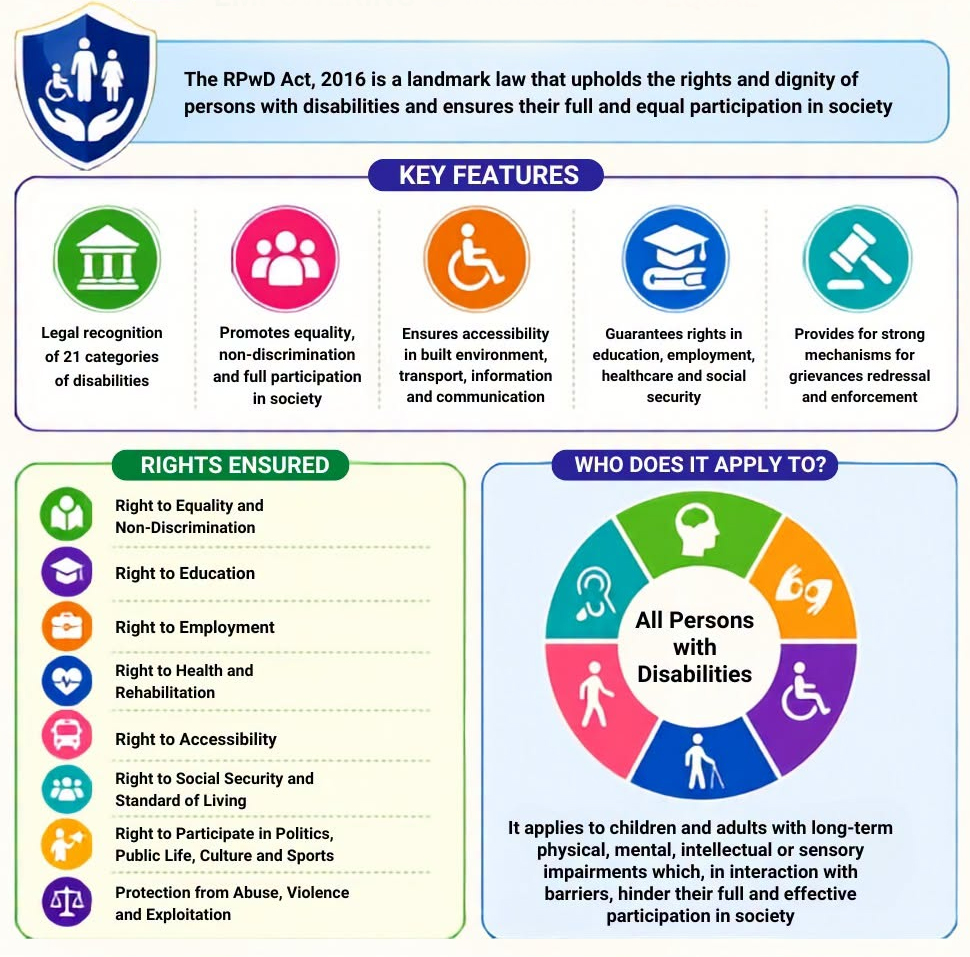
The RPwD Act, 2016 replaced the Persons with Disabilities Act, 1995 and was enacted in line with India's obligations under the UN Convention on the Rights of Persons with Disabilities (UNCRPD). It expanded the recognised categories from 7 to 21 specified disabilities and adopts a rights-based approach based on equality, dignity, non-discrimination and participation.
Key Provisions:
-
- 21 specified disabilities: Covers diverse physical, intellectual, mental, neurological and blood-related conditions.
- Reservation: Provides 5% reservation in higher educational institutions and 4% reservation in government employment for persons with benchmark disabilities.
- Accessibility: Promotes removal of physical, transportation and digital barriers through accessibility and universal design.
- Non-discrimination: Prohibits discrimination and provides for reasonable accommodation.
- Disability certification: The Disability Certificate and Unique Disability ID (UDID) system facilitates access to government benefits and services.
- 21 specified disabilities: Covers diverse physical, intellectual, mental, neurological and blood-related conditions.
Significance:
Accurate census enumeration is essential for determining the population profile, prevalence and specific needs of persons with disabilities. If particular disabilities remain statistically invisible, targeted welfare programmes and resource allocation may not adequately address their requirements.
Way Forward:
The disability questionnaire should ideally individually capture all 21 specified disabilities under the RPwD Act. Wider consultation with persons with disabilities, rights organisations and domain experts can help create a more accurate and inclusive framework.
Conclusion:
Census 2027 should reflect the progress made in disability rights law rather than perpetuate broad or outdated classifications. Aligning census enumeration with the RPwD Act can improve data quality, strengthen evidence-based policymaking and advance inclusive, accessible and rights-based development.



