
Digital Safety Shield: Telangana’s AI-Based Crisis Intervention Model
Context:
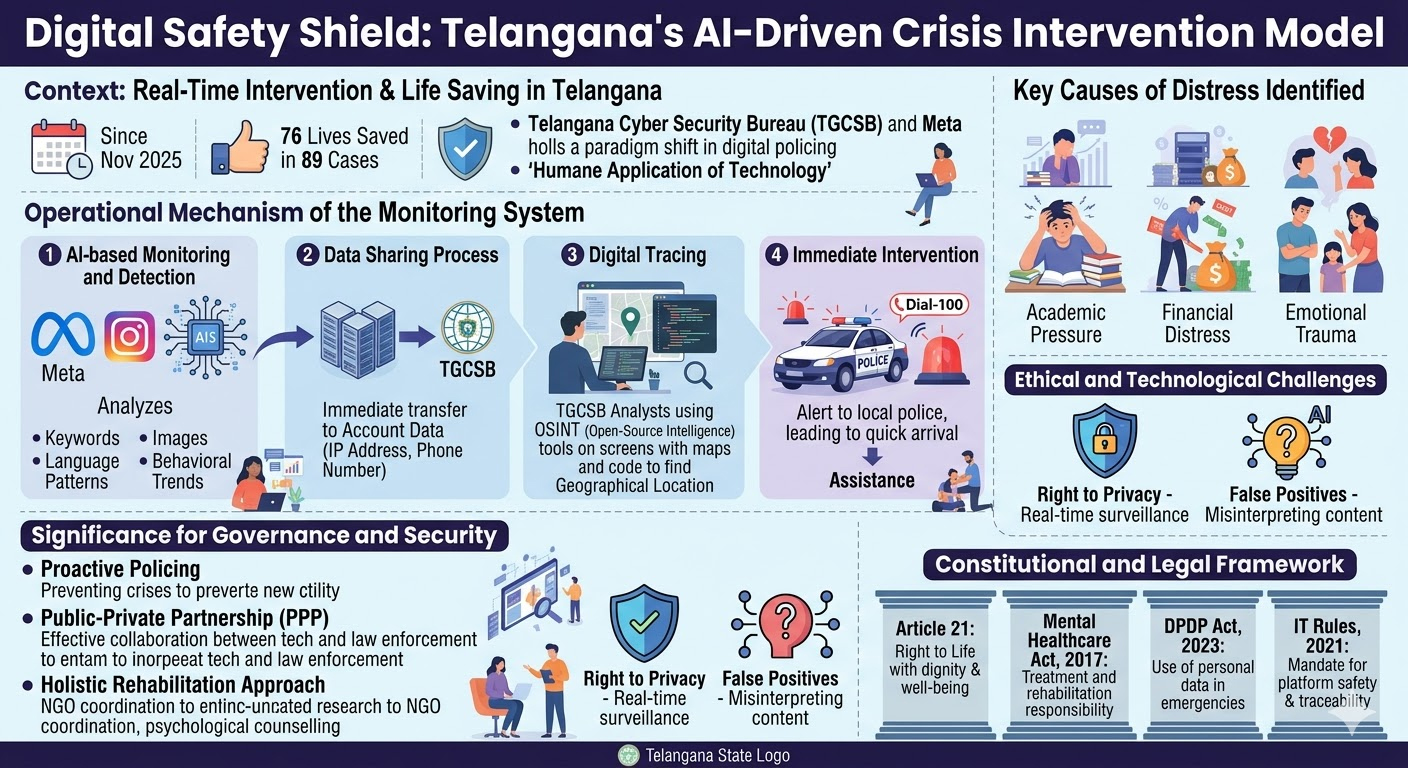
The Telangana Cyber Security Bureau (TGCSB), in collaboration with Meta, has developed an advanced Artificial Intelligence (AI)-based monitoring system capable of identifying suicide or distress signals (SOS) on social media platforms. According to the Telangana Socio-Economic Outlook 2026, since November 2025, this system has enabled timely intervention in 76 out of 89 cases, successfully saving lives. This initiative has emerged as a significant milestone in the domain of digital policing in the state.
Operational Mechanism of the Monitoring System:
The system operates on the principles of “Early Warning” and “Real-Time Response.” Its functioning can be understood through the following stages:
-
-
- AI-based Monitoring and Detection: Algorithms active on Meta’s platforms (Facebook and Instagram) continuously analyze user activities. They assess keywords, language patterns, images, audio-visual cues, and behavioral trends to identify suicidal tendencies.
- Data Sharing Process: Upon detection of a suspicious or high-risk post, Meta immediately shares essential account-related information (such as IP address and phone number) with TGCSB’s social media unit.
- Digital Tracing: TGCSB analysts utilize Open-Source Intelligence (OSINT) tools to determine the precise geographical location of the individual.
- Immediate Intervention: Based on the information received, alerts are instantly sent to local police and Dial-100 patrol units, enabling them to reach the individual within minutes and provide necessary assistance.
- AI-based Monitoring and Detection: Algorithms active on Meta’s platforms (Facebook and Instagram) continuously analyze user activities. They assess keywords, language patterns, images, audio-visual cues, and behavioral trends to identify suicidal tendencies.
-
Key Causes of Distress:
-
-
- According to the report, the causes behind the crisis among rescued individuals were diverse:
- Academic Pressure: Stress arising from competition and examinations
- Financial Distress: Debt or economic insecurity
- Emotional Trauma: Relationship breakdowns or family conflicts
- Academic Pressure: Stress arising from competition and examinations
- According to the report, the causes behind the crisis among rescued individuals were diverse:
-
Significance for Governance and Security:
-
-
- Proactive Policing: This model marks a shift from traditional reactive policing to a preventive approach, aiming to avert crises before they escalate.
- Successful Public-Private Partnership (PPP): It exemplifies effective collaboration between technology companies and law enforcement agencies, prioritizing the protection of human life.
- Holistic Rehabilitation Approach: TGCSB extends beyond immediate rescue by coordinating with NGOs to provide long-term psychological counselling and rehabilitation support to affected individuals.
- Proactive Policing: This model marks a shift from traditional reactive policing to a preventive approach, aiming to avert crises before they escalate.
-
Ethical and Technological Challenges:
Despite its effectiveness, the system faces certain challenges:
-
-
- Right to Privacy: Real-time surveillance and data sharing raise concerns regarding individual privacy, necessitating robust data protection safeguards.
- False Positives: AI algorithms may sometimes misinterpret satire, artistic expression, or general emotional content as distress signals, leading to unnecessary deployment of resources.
- Right to Privacy: Real-time surveillance and data sharing raise concerns regarding individual privacy, necessitating robust data protection safeguards.
-
Constitutional and Legal Framework:
-
-
- This model is aligned with India’s existing legal and constitutional provisions:
- Article 21 (Right to Life): The Supreme Court has interpreted the right to life to include the right to live with dignity and mental well-being. This system reinforces this fundamental right through technological intervention.
- Mental Healthcare Act, 2017: The Act decriminalizes suicide attempts and places responsibility on the state for treatment and rehabilitation, which aligns with TGCSB’s counselling initiatives.
- Digital Personal Data Protection (DPDP) Act, 2023: The Act permits the use of personal data without explicit consent in emergency situations involving life protection or public health.
- Information Technology Rules, 2021: These rules mandate intermediaries like Meta to ensure traceability and identify crisis signals, thereby enhancing platform safety.
- Article 21 (Right to Life): The Supreme Court has interpreted the right to life to include the right to live with dignity and mental well-being. This system reinforces this fundamental right through technological intervention.
- This model is aligned with India’s existing legal and constitutional provisions:
-
Conclusion:
Telangana’s AI-driven model represents a compelling example of the humane application of technology in the digital age. It demonstrates that with effective coordination between technology and governance, artificial intelligence can evolve from a mere tool into a life-saving mechanism.



