
Context:
Recently, the Indian Space Research Organisation (ISRO) has confirmed, based on experimental data, that interplanetary dust particles (IDPs) strike Earth’s upper atmosphere at a rate of approximately one particle every 1,000 seconds (≈16 minutes). This discovery is based on observations made by the sciDust EXperiment (DEX), India’s first indigenous cosmic dust detector, launched aboard the XPoSat mission.
About Dust EXperiment (DEX):
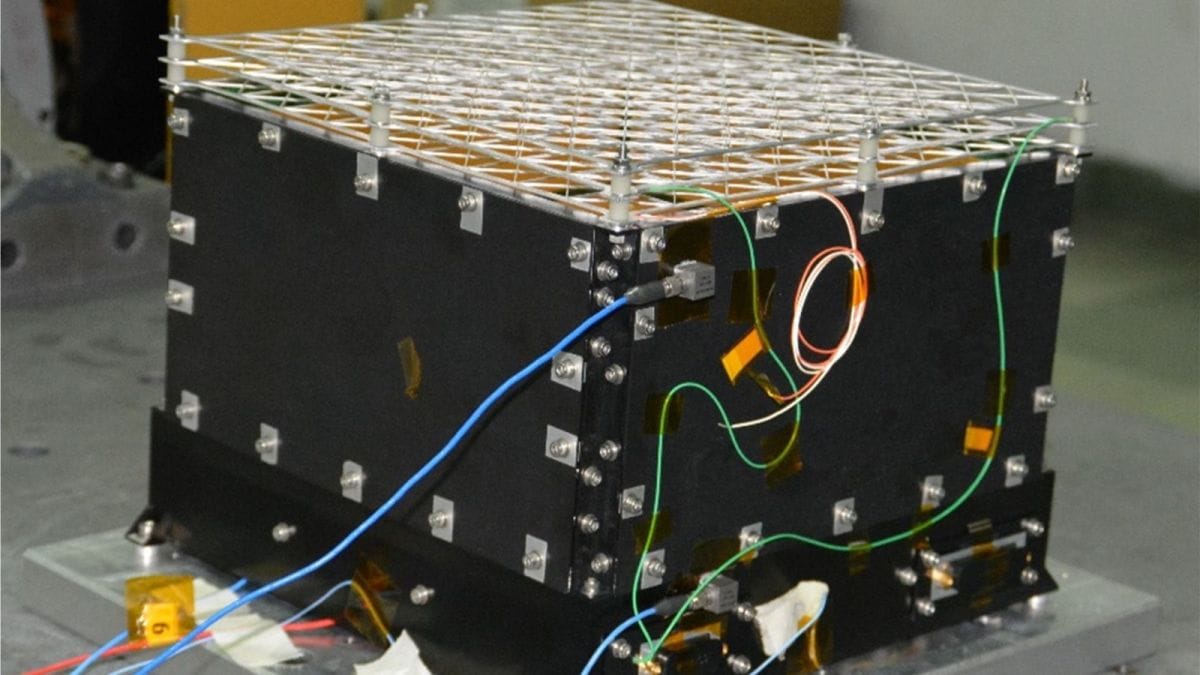
DEX is a compact 3 kg scientific instrument developed by the Physical Research Laboratory (PRL), Ahmedabad. It was deployed on the PSLV Orbital Experimental Module (POEM) during the PSLV-C58 XPoSat mission, launched on 1 January 2024.
Working Principle:
DEX operates using a hypervelocity impact detector, designed to sense microscopic space dust particles entering Earth’s vicinity at extremely high speeds.
Detection Data:
Operating at an altitude of approximately 350 km with a 140° wide field of view, DEX recorded dust impacts between January and February 2024. The data confirmed persistent micro-particle impacts occurring roughly every 1,000 seconds, validating continuous dust flux in near-Earth space.
About Interplanetary Dust Particles (IDPs):
-
-
- Interplanetary Dust Particles are microscopic fragments originating from comets, asteroids, meteoroids, and other celestial bodies. These particles form part of a thin dust layer in near-Earth space and are occasionally visible as shooting stars when they burn up during atmospheric entry.
- Despite their minute size, these particles travel at hypervelocity speeds, making them capable of causing serious damage to spacecraft, satellites, and future human missions upon impact.
- Interplanetary Dust Particles are microscopic fragments originating from comets, asteroids, meteoroids, and other celestial bodies. These particles form part of a thin dust layer in near-Earth space and are occasionally visible as shooting stars when they burn up during atmospheric entry.
-
Why This Discovery Matters?
-
-
- Enhancing Space Environment Understanding:
- Safeguarding Spacecraft and Satellites
- Enhancing Space Environment Understanding:
-
Scientific and Strategic Impact:
-
-
- Planetary Science: Data on IDPs help scientists understand the formation of the early Solar System and the evolution of planetary atmospheres.
- Space Weather Monitoring: Continuous monitoring of dust flux is closely linked to space weather forecasting, which is vital for protecting communication, navigation, and Earth observation satellites.
- First-of-its-Kind Achievement: The successful deployment and operation of DEX marks a significant milestone in indigenous space science instrumentation, showcasing India’s growing capabilities in advanced space research technologies.
- Planetary Science: Data on IDPs help scientists understand the formation of the early Solar System and the evolution of planetary atmospheres.
-
Conclusion:
ISRO’s confirmation that interplanetary dust particles strike Earth’s upper atmosphere approximately every 16 minutes represents not only a major scientific achievement but also a strategic enabler for future space missions, including human spaceflight and interplanetary exploration.



