
Demographic Transition in India and the SRS 2024 Report
Context:
Recently, the Office of the Registrar General and Census Commissioner of India released the Sample Registration System (SRS) Statistical Report 2024. The report indicates that India is undergoing a rapid demographic transition.
Key Findings of the SRS 2024 Report:
Total Fertility Rate (TFR)
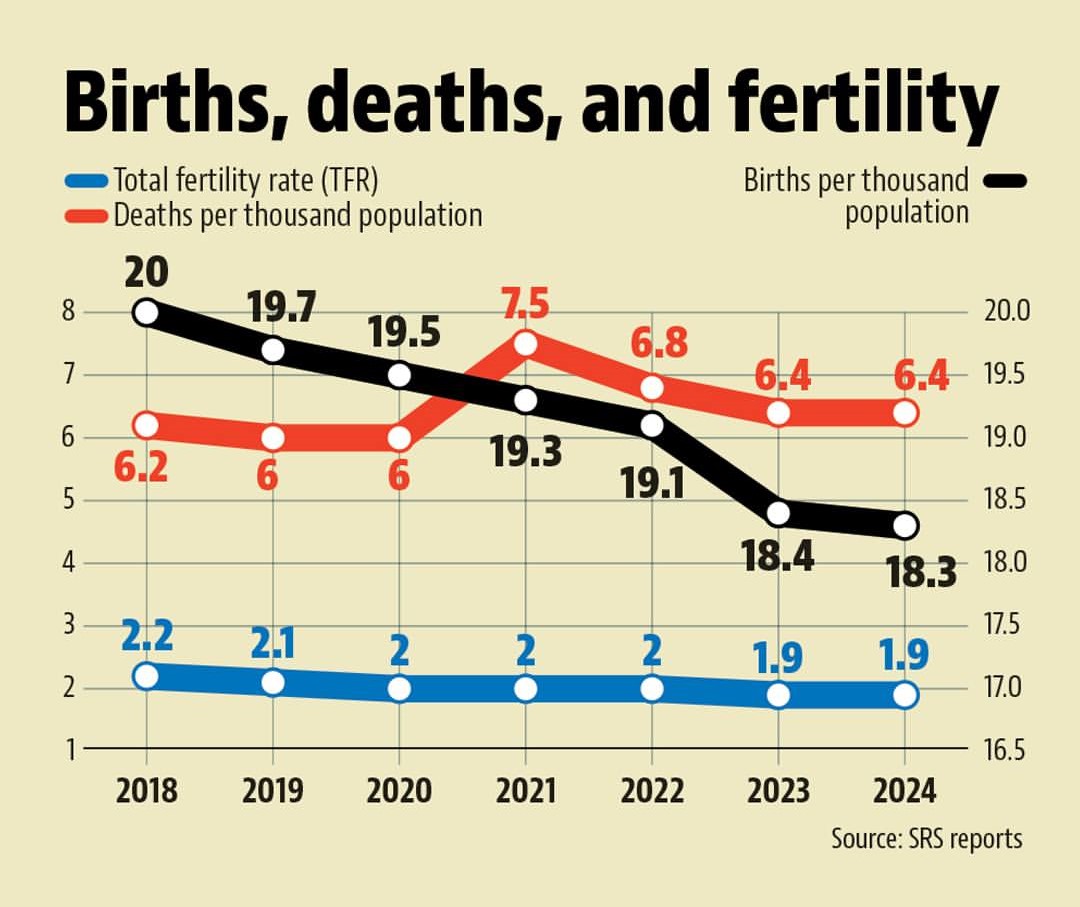
India’s Total Fertility Rate has declined to 1.9, indicating that the country is gradually moving towards a low-fertility society. This is below the replacement level of 2.1.
Crude Birth Rate (CBR)
The country’s birth rate has shown a continuous decline.
• A decade ago, it was 21, which has now decreased to 18.3 per 1,000 population.
• The birth rate in urban areas (14.7) is significantly lower than in rural areas (20.2).
Infant Mortality Rate (IMR)
Due to improvements in healthcare services, the IMR has declined to 24 per 1,000 live births.
• A decline of 6 points has been recorded over the last five years.
Under-Five Mortality Rate (U5MR)
The mortality rate of children below five years of age in the country has declined to 28.
Crude Death Rate (CDR)
The death rate remains stable at 6.4 per 1,000 persons.
However, it is still slightly higher than the pre-COVID level.
Sex Ratio at Birth (SRB)
A marginal improvement has been recorded during the period 2022–24.
• It has now reached 918 girls per 1,000 boys.
Regional Disparities and State-Level Variations:
Demographic changes are not uniform across different states of India.
Leading States
• Southern states such as Kerala and Tamil Nadu are leading the demographic transition.
• Kerala has the lowest IMR in the country at just 8.
• Tamil Nadu recorded an IMR of 11.
Challenging States
• Despite healthcare improvements, Madhya Pradesh continues to have a high IMR of 35 and U5MR of 41.
• Bihar and some northern states still have a TFR above the national average.
These regional disparities reflect inequalities in healthcare, education, and social development.
Meaning of Demographic Transition:
Demographic transition refers to the process in which:
• Both birth rates and death rates gradually decline
• Population growth rate slows down
• The proportion of elderly population begins to rise
India is currently entering the advanced stage of this transition.
Administrative and Policy Implications:
Crisis of Demographic Dividend
The decline of TFR to 1.9 may reduce the proportion of working-age population in the future.
• Dependency on the elderly population will increase
• Pressure on social security systems will rise
• Government will need to focus on skill development and employment generation
Rural-Urban Health Inequality
• IMR in rural areas (27) remains significantly higher than in urban areas (17).
• This highlights the need to strengthen the National Health Mission (NHM) and primary healthcare services.
Challenge of Ageing Population
Low fertility rates will lead to a rapid rise in the elderly population in the future.
This will require:
• Expansion of pension systems
• Development of geriatric healthcare services
• Strengthening of social security frameworks
Major Government Initiatives:
• National Health Mission (NHM)
• Ayushman Bharat Scheme
• Poshan Abhiyaan
• Mission Indradhanush
• Janani Suraksha Yojana
• National Population Policy
These initiatives have played an important role in improving maternal and child health indicators.
Key Definitions and Concepts:
-
-
- Infant Mortality Rate (IMR): Infant Mortality Rate refers to the number of deaths of children below one year of age per 1,000 live births. It is an important indicator of the health system and socio-economic development.
- Crude Birth Rate (CBR): Crude Birth Rate refers to the number of live births occurring per 1,000 population in a year.
- Total Fertility Rate (TFR): Total Fertility Rate refers to the average number of children a woman is expected to give birth to during her lifetime.
- Neonatal Mortality Rate (NMR): Neonatal Mortality Rate refers to the number of deaths of infants within 28 days of birth per 1,000 live births.
- Infant Mortality Rate (IMR): Infant Mortality Rate refers to the number of deaths of children below one year of age per 1,000 live births. It is an important indicator of the health system and socio-economic development.
-
Conclusion:
The SRS 2024 Report indicates that India is entering the phase of population stabilization. Policymakers must focus on healthcare quality, reducing regional disparities, addressing ageing population challenges, and effectively utilizing the demographic dividend for inclusive and sustainable development.



