
Delimitation 2011 Census & Women’s Reservation in India
Context:
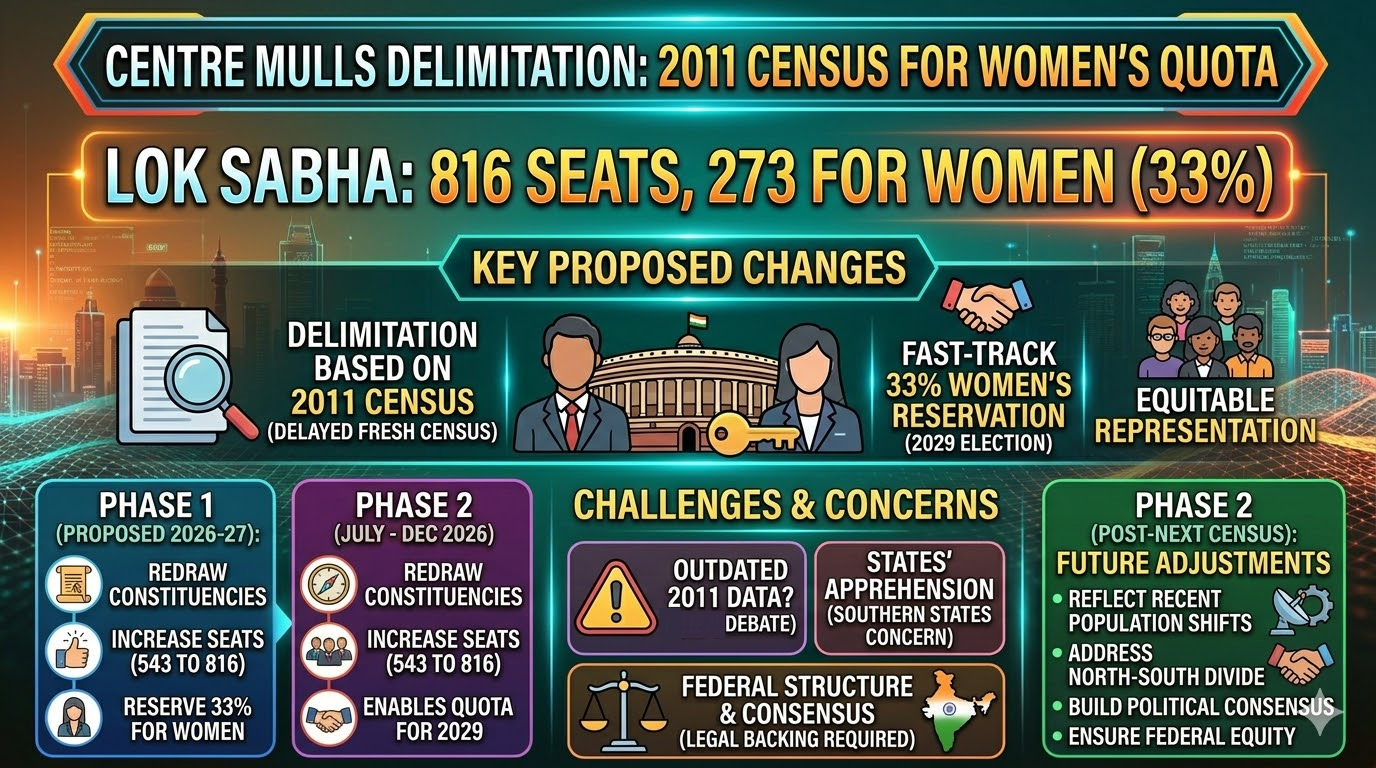
Recently, Union government indicated that it would bring an amendment Bill proposing a delimitation exercise based on the 2011 Census, to ensure the implementation of the Women’s Reservation Act, 2023 ahead of the 2029 Lok Sabha election. Under the proposed amendments, the number of Lok Sabha seats is expected to increase from 543 to 816, with 273 seats reserved for women.
About Women’s Reservation:
-
-
- The Women’s Reservation Act, passed in 2023, mandates 33% reservation for women in the Lok Sabha, State Legislative Assemblies and National capital Delhi. However, its implementation is contingent upon two critical processes: the completion of the next Census and a subsequent delimitation exercise.
- Delimitation refers to the redrawing of electoral constituency boundaries to reflect population changes. It ensures equitable representation by adjusting seats in proportion to population shifts across regions.
- The Women’s Reservation Act, passed in 2023, mandates 33% reservation for women in the Lok Sabha, State Legislative Assemblies and National capital Delhi. However, its implementation is contingent upon two critical processes: the completion of the next Census and a subsequent delimitation exercise.
-
Why the 2011 Census?
-
-
- The government is exploring the possibility of using the 2011 Census data instead of waiting for fresh Census figures, which have been delayed. This move could fast-track the implementation of the women’s quota, potentially enabling its rollout before the 2029 general elections.
- However, this proposal raises concerns. Many experts argue that relying on outdated population data may distort representation, especially in rapidly growing urban and peri-urban regions.
- The government is exploring the possibility of using the 2011 Census data instead of waiting for fresh Census figures, which have been delayed. This move could fast-track the implementation of the women’s quota, potentially enabling its rollout before the 2029 general elections.
-
Political and Federal Concerns:
-
-
- Southern states have expressed apprehension about delimitation based on population figures. States that have successfully implemented population control measures fear losing parliamentary representation relative to northern states with higher population growth.
- This has revived the long-standing North-South divide debate, with critics arguing that population-based delimitation could penalize states that performed better on demographic indicators.
- Southern states have expressed apprehension about delimitation based on population figures. States that have successfully implemented population control measures fear losing parliamentary representation relative to northern states with higher population growth.
-
Constitutional and Legal Dimensions:
-
-
- As per Article 82 of the Constitution, the next delimitation exercise was originally to be conducted based on the first Census after 2026. However, the proposed amendments may allow the use of 2011 Census data, enabling the redrawing of constituencies without waiting for the completion of a fresh Census. The proposals may also include expansion of State Legislative Assemblies.
- Any such move would require legal backing and political consensus, given its far-reaching implications.
- As per Article 82 of the Constitution, the next delimitation exercise was originally to be conducted based on the first Census after 2026. However, the proposed amendments may allow the use of 2011 Census data, enabling the redrawing of constituencies without waiting for the completion of a fresh Census. The proposals may also include expansion of State Legislative Assemblies.
-
Way Forward:
The government needs to strike a delicate balance between boosting women's political representation and maintaining fairness and federal equity. To move forward, it could build consensus among states before delimitation, ensure transparent seat allocation and reservation processes, and speed up Census-related tasks for future adjustments, paving the way for more inclusive representation.
Conclusion:
While the intent to operationalize women’s reservation is widely welcomed, the method and timing of delimitation remain contentious. The decision to rely on 2011 Census data could expedite reform but may also deepen political fault lines unless handled with broad consultation and transparency.



