
Why in news:
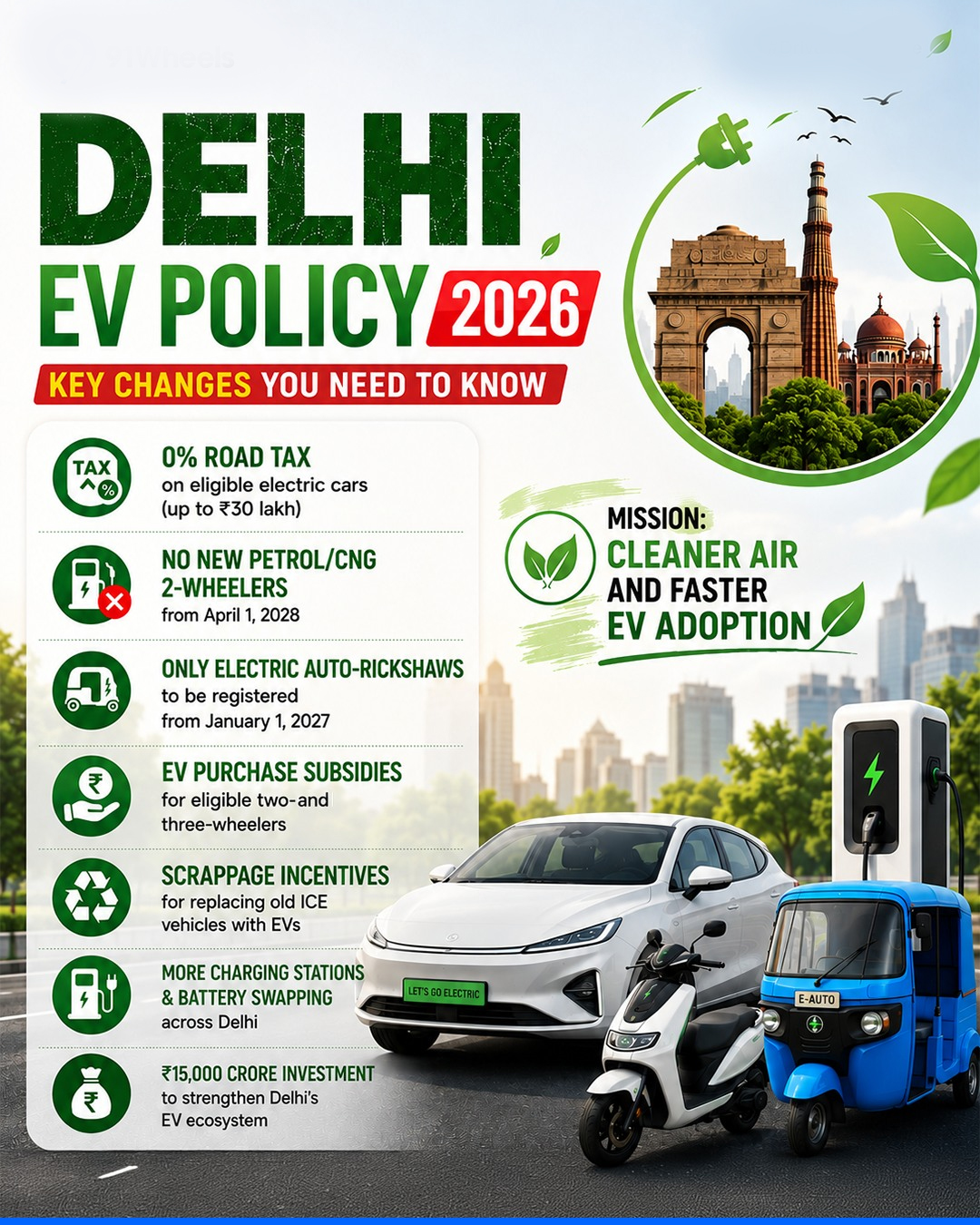
Recently, The Delhi Government has approved the Delhi EV Policy 2026, marking a significant shift towards clean mobility. Under the policy, no new petrol motorcycles and scooters will be registered after 31 March 2028, while new CNG auto-rickshaw registrations will stop after December 2026.
Major Provisions of the Delhi EV Policy 2026:
-
-
- No registration of new petrol motorcycles and scooters after 31 March 2028.
- Registration of new CNG auto-rickshaws ends after December 2026.
- From April 2028, all newly registered two- and three-wheelers must be electric.
- Target of 30% electrification of Delhi's vehicle fleet by 2030.
- ₹15,000 crore allocated for EV incentives and charging infrastructure.
- Purchase incentives:
- Up to ₹30,000 for electric two-wheelers.
- Up to ₹50,000 for electric three-wheelers.
- Up to ₹30,000 for electric two-wheelers.
- Scrappage incentives for old BS-IV and older vehicles.
- Focus on pure Battery Electric Vehicles (BEVs) over strong hybrid vehicles.
- No registration of new petrol motorcycles and scooters after 31 March 2028.
-
Why is the Government Promoting EVs?
According to the Commission for Air Quality Management (CAQM), vehicular emissions contribute nearly 23% of Delhi's PM2.5 pollution during winter, making transport the city's largest pollution source. As two-wheelers constitute around 67% of Delhi's vehicle stock, their electrification can significantly reduce emissions, improve public health, decrease dependence on fossil fuels, and support India's climate commitments.
Role of EVs and Public Transport:
Electric vehicles produce zero tailpipe emissions, thereby reducing particulate matter (PM2.5), nitrogen oxides (NOx), carbon monoxide, and greenhouse gases. However, EV adoption must be complemented by efficient public transport, including electric buses, metro expansion, cycling infrastructure, and better last-mile connectivity to reduce traffic congestion and private vehicle dependence.
Why is Delhi's Air Pollution Always in News?
Delhi experiences persistent air pollution due to vehicular emissions, road and construction dust, industrial activities, biomass burning, waste burning, and seasonal stubble burning in neighbouring states. Winter conditions such as temperature inversion, low wind speed, and fog trap pollutants close to the surface, causing hazardous air quality.
Geographical Factors and Public Health:
Located in the Indo-Gangetic Plain, Delhi is a landlocked city surrounded by Haryana and Uttar Pradesh. The absence of sea breeze and poor atmospheric dispersion worsen pollution levels. Prolonged exposure to polluted air leads to asthma, chronic respiratory diseases, cardiovascular disorders, and premature deaths, with children and the elderly being the most vulnerable.
Role of Institutions and Technology:
The Central Pollution Control Board (CPCB) and CAQM monitor air quality and coordinate pollution control measures. Technology such as real-time air quality monitoring, satellite-based surveillance, AI-enabled forecasting, and smart traffic management can improve pollution control and policy implementation.
Conclusion:
The Delhi EV Policy 2026 is a landmark initiative towards sustainable urban mobility. While electric mobility can substantially reduce transport-related pollution, lasting improvements in Delhi's air quality require integrated action through cleaner public transport, stronger regulatory enforcement, regional cooperation, technological innovation, and active citizen participation.



