
Context:
The Delhi Government has decided to declare human rabies a notifiable disease under the Epidemic Diseases Act, 1897. The move aims to strengthen disease surveillance, ensure timely reporting, and facilitate prompt treatment of this fatal yet preventable disease.
About Rabies:
Rabies is a viral zoonotic disease, primarily transmitted through dog bites. While it is almost invariably fatal once clinical symptoms appear, it is entirely preventable through timely administration of post-exposure prophylaxis (PEP). The decision aligns with India’s broader objective of eliminating dog-mediated human rabies deaths.
Background:
-
-
- Rabies has historically been under-reported in India due to weak surveillance systems, resulting in significant data gaps and delayed medical intervention. Despite the availability of anti-rabies vaccines (ARV) and rabies immunoglobulin (RIG), many bite victims fail to receive timely treatment, leading to avoidable fatalities.
- Declaring rabies a notifiable disease will legally mandate all public and private health facilities to report suspected, probable, and confirmed cases to designated health authorities. This will enable accurate data collection, rapid public health response, and identification of high-risk areas, thereby helping to reduce mortality.
- Rabies has historically been under-reported in India due to weak surveillance systems, resulting in significant data gaps and delayed medical intervention. Despite the availability of anti-rabies vaccines (ARV) and rabies immunoglobulin (RIG), many bite victims fail to receive timely treatment, leading to avoidable fatalities.
-
Key Provisions of the Move:
-
-
- Once the notification is enforced, all healthcare providers in Delhi will be required to immediately report every case of human rabies to the appropriate authorities. The reporting mechanism will be integrated with the Integrated Disease Surveillance Programme (IDSP) to enable real-time monitoring and trend analysis.
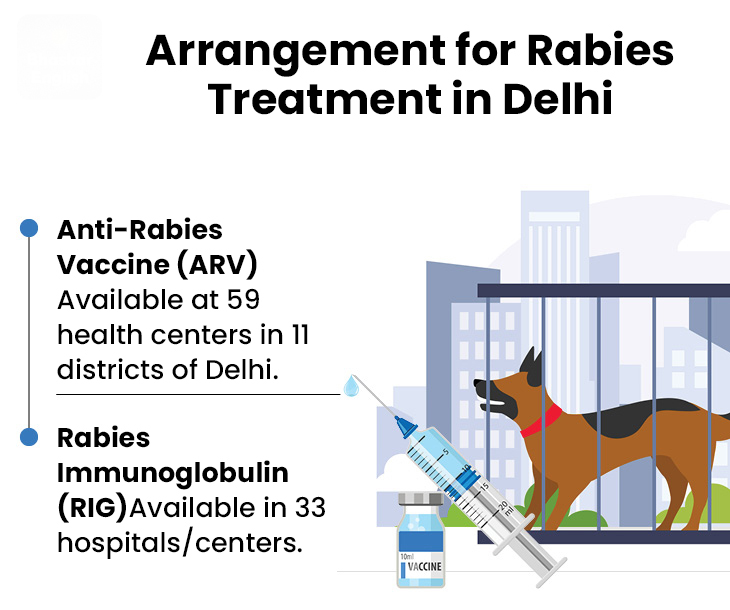
- Currently, Delhi provides anti-rabies vaccines at 59 health facilities and rabies immunoglobulin at 33 designated centres, significantly strengthening post-exposure care. In addition, the government plans to implement a State Action Plan for Rabies Elimination (SAPRE), adopting a “One Health” approach that integrates public health, veterinary services, and local bodies.
- Once the notification is enforced, all healthcare providers in Delhi will be required to immediately report every case of human rabies to the appropriate authorities. The reporting mechanism will be integrated with the Integrated Disease Surveillance Programme (IDSP) to enable real-time monitoring and trend analysis.
-
About the Epidemic Diseases Act, 1897:
The Epidemic Diseases Act is a colonial-era legislation enacted on February 4, 1897, initially to control the bubonic plague in Bombay. The Act empowers state governments to take extraordinary measures during epidemics, including issuing regulations on public behaviour, conducting inspections, enforcing quarantines, and implementing containment strategies.
Significance and Challenges:
-
- Public Health Surveillance: Mandatory notification will generate robust epidemiological data, enabling evidence-based policymaking, targeted interventions, and efficient resource allocation.
- Timely Treatment: Prompt reporting facilitates early administration of PEP, which is critical to preventing rabies-related deaths, and improves coordination between human and animal health systems.
- Rabies Elimination Goals: The measure supports national and global targets to eliminate dog-mediated human rabies through integrated vaccination, prevention, and public awareness efforts.
- Public Health Surveillance: Mandatory notification will generate robust epidemiological data, enabling evidence-based policymaking, targeted interventions, and efficient resource allocation.
Challenges include ensuring compliance among private healthcare providers, maintaining uninterrupted vaccine and RIG supply chains, and improving public awareness regarding early reporting of animal bites and timely treatment.
Conclusion:
Declaring human rabies a notifiable disease in Delhi represents a proactive and preventive public health intervention. It strengthens disease surveillance, enables timely medical and administrative responses, and reduces avoidable deaths. The decision reflects evidence-based policymaking, integrated health action, and a strong commitment to safeguarding public health against a lethal yet preventable disease.



