
Context:
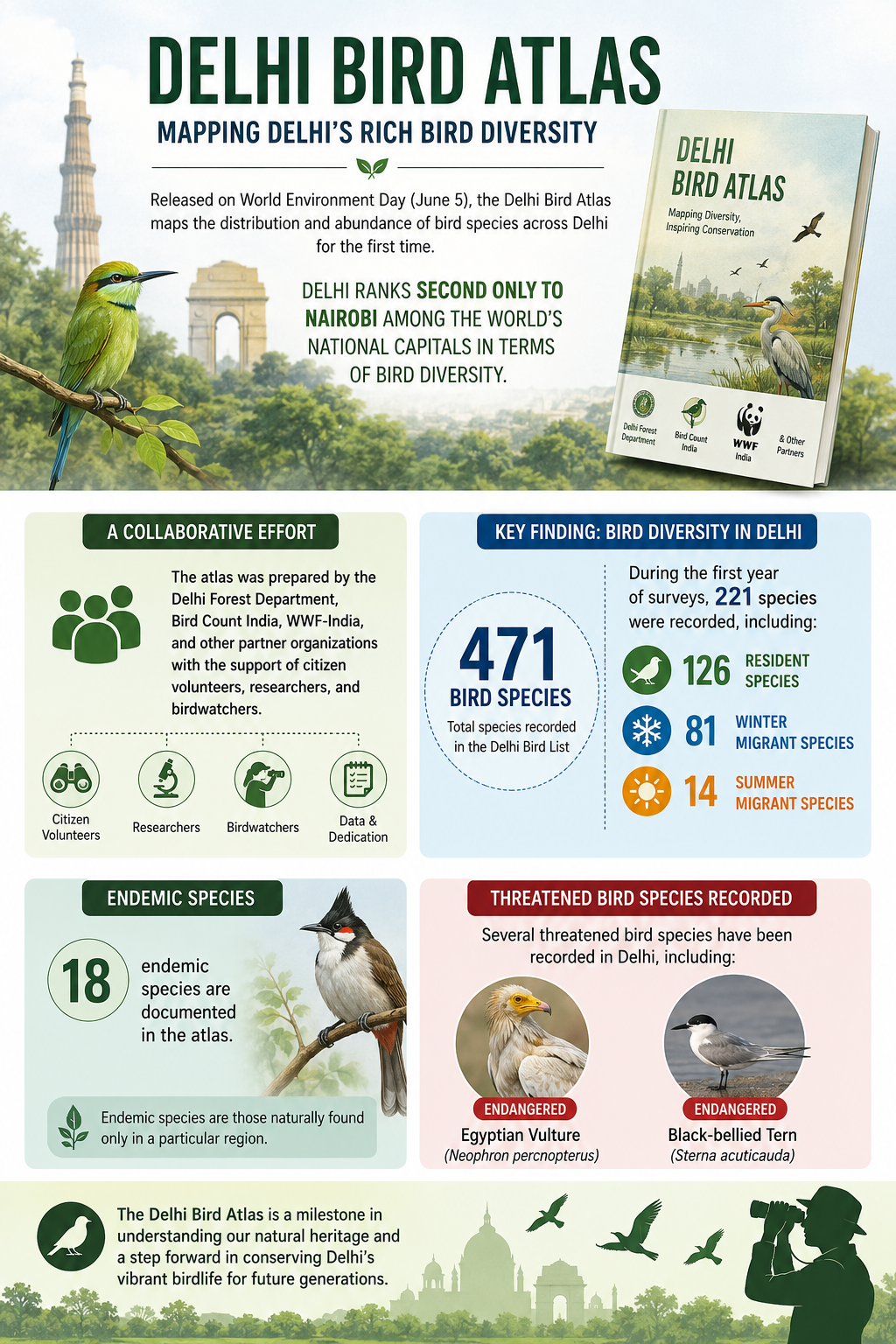
Recently, The Delhi Bird Atlas, released on World Environment Day (June 5), has mapped the distribution and abundance of bird species across Delhi for the first time. The report places Delhi second only to Nairobi among the world's national capitals in terms of bird diversity.
Key Findings of the Delhi Bird Atlas:
-
-
-
- The atlas was prepared by the Delhi Forest Department, Bird Count India, WWF-India, and other partner organizations with the support of citizen volunteers, researchers, and birdwatchers.
- According to the report, the Delhi Bird List now includes 471 bird species.
- During the first year of surveys, 221 species were recorded, including:
- 126 resident species
- 81 winter migrant species
- 14 summer migrant species
- 126 resident species
- The atlas also documents 18 endemic species.
- In addition, several threatened bird species have been recorded, including the Endangered Egyptian Vulture and the Black-bellied Tern.
- The atlas was prepared by the Delhi Forest Department, Bird Count India, WWF-India, and other partner organizations with the support of citizen volunteers, researchers, and birdwatchers.
-
-
Why is Delhi Rich in Bird Diversity?
Delhi's exceptional bird diversity is primarily due to its unique geographical location.
-
-
-
- The city is situated at the confluence of the Aravalli landscape, Yamuna floodplains, wetlands and the Central Asian Flyway (CAF).
- The Central Asian Flyway is one of the world's major migratory bird routes, through which millions of birds undertake seasonal migrations.
- Delhi's proximity to the Western Himalayas further facilitates seasonal bird movements.
- As a result, Delhi serves as an important habitat for both resident and migratory bird species.
- The city is situated at the confluence of the Aravalli landscape, Yamuna floodplains, wetlands and the Central Asian Flyway (CAF).
-
-
About Grassland Bird Census in Kaziranga:
Kaziranga National Park in Assam conducted its first-ever grassland bird census in 2025. The survey recorded 43 grassland bird species, including one Critically Endangered, two Endangered, and six Vulnerable species as per the IUCN Red List. A notable achievement was the discovery of a breeding colony of the endangered Finn's Weaver, a species endemic to the Brahmaputra floodplains.
Why is the Kaziranga National Park famous?
-
-
-
- Covering 42,996 ha, Kaziranga National Park is located in the State of Assam. It is the single largest undisturbed and representative area in the Brahmaputra Valley floodplain.
- It is a UNESCO World Heritage Site recognised in 1985. It is renowned for its significant population of one-horned rhinoceroses. Kaziranga National Park is India’s second-largest butterfly habitat with 446 species.
- Covering 42,996 ha, Kaziranga National Park is located in the State of Assam. It is the single largest undisturbed and representative area in the Brahmaputra Valley floodplain.
-
-
Significance for Conservation:
Both the Delhi Bird Atlas and Kaziranga's grassland bird census highlight the importance of scientific monitoring in biodiversity conservation. They provide crucial data for habitat management, conservation planning, and protection of threatened species. The findings also underscore the need to conserve wetlands, grasslands, and urban green spaces that support rich avian diversity.
Conclusion:
The Delhi Bird Atlas and Kaziranga bird census demonstrate India's growing commitment to biodiversity conservation. Protecting critical habitats such as the Yamuna floodplains and Brahmaputra grasslands will be essential for safeguarding bird populations and maintaining ecological balance in the face of increasing environmental pressures.
What is the Delhi Bird Atlas?
The Delhi Bird Atlas is the first comprehensive mapping of bird distribution and abundance across Delhi, released on World Environment Day 2026.
What is the Central Asian Flyway (CAF)?
The Central Asian Flyway is a major migratory route connecting Arctic and Central Asian breeding grounds with wintering areas in South Asia. Delhi lies along this flyway, attracting thousands of migratory birds every year.
What geographical factors contribute to Delhi's high bird diversity?
Delhi's bird diversity is due to the convergence of:
-
-
-
- The Aravalli Ridge ecosystem,
- Yamuna floodplains and wetlands,
- Proximity to the Western Himalayas, and
- Its location on the Central Asian Flyway.
- The Aravalli Ridge ecosystem,
-
-
Which are the major birding hotspots in Delhi?
Important bird habitats include:
-
-
-
- Okhla Bird Sanctuary
- Yamuna Biodiversity Park
- Sunder Nursery
- Delhi Ridge
- Okhla Bird Sanctuary
-
-



