
Context:
India’s major religious and cultural festival, Deepavali, has been inscribed in the UNESCO Representative List of the Intangible Cultural Heritage of Humanity for the year 2025. This decision was announced during the 20th session of UNESCO’s Intergovernmental Committee, held in New Delhi, where representatives of 194 member countries participated. Deepavali has now become India’s 16th element to be included in this prestigious list. The inscription significantly strengthens India’s soft power and enhances its cultural diplomacy at the global level.
Significance of Deepavali’s Inscription:
-
- Deepavali is the most widely celebrated festival in India. It symbolizes the victory of light over darkness, good over evil, and knowledge over ignorance. It is not merely a religious event; Deepavali reflects the cultural diversity, social harmony, and core civilizational values of Indian society.
- Its inclusion in UNESCO’s list reinforces its global cultural identity, indicating that the festival continues to flourish as a living cultural expression, not only within India but also across the international community.
- Deepavali is the most widely celebrated festival in India. It symbolizes the victory of light over darkness, good over evil, and knowledge over ignorance. It is not merely a religious event; Deepavali reflects the cultural diversity, social harmony, and core civilizational values of Indian society.
Importance of Being Inscribed in the UNESCO List:
· Global Recognition and Preservation: Deepavali’s inscription grants the festival international recognition and supports efforts related to documentation, preservation, and safeguarding of its traditional practices. Through UNESCO’s framework, guidance on best practices, safeguarding strategies, and access to resources become available.
· Cultural Diplomacy and India’s Soft Power: The inclusion strengthens India’s soft power and enhances its standing in global cultural diplomacy.
It boosts India’s representation as a custodian of diverse cultural traditions and promotes international respect for Indian civilization and its practices.
· Tourism and Local Economy: Global recognition of Deepavali is expected to promote cultural tourism, benefitting local artisans, craft communities, small industries, and festival-related economic activities. This, in turn, supports the preservation of traditional craftsmanship and cultural arts.
UNESCO’s Intangible Cultural Heritage (ICH) List:
-
- UNESCO’s ICH list includes cultural practices, skills, festivals, oral traditions, performing arts, social practices, and traditional knowledge systems that are transmitted across generations without a physical form, yet remain central to cultural identity.
- These elements represent living traditions, not material objects.
The aim of the Representative List is to raise awareness about the importance of cultural diversity and ensure the safeguarding of such traditions.
- UNESCO’s ICH list includes cultural practices, skills, festivals, oral traditions, performing arts, social practices, and traditional knowledge systems that are transmitted across generations without a physical form, yet remain central to cultural identity.
UNESCO broadly classifies ICH elements into five domains:
1. Oral traditions and expressions
2. Performing arts
3. Social practices, rituals, and festive events
4. Knowledge related to nature and the universe
5. Traditional craftsmanship
These categories highlight practices that strengthen cultural identity, community participation, and social continuity.
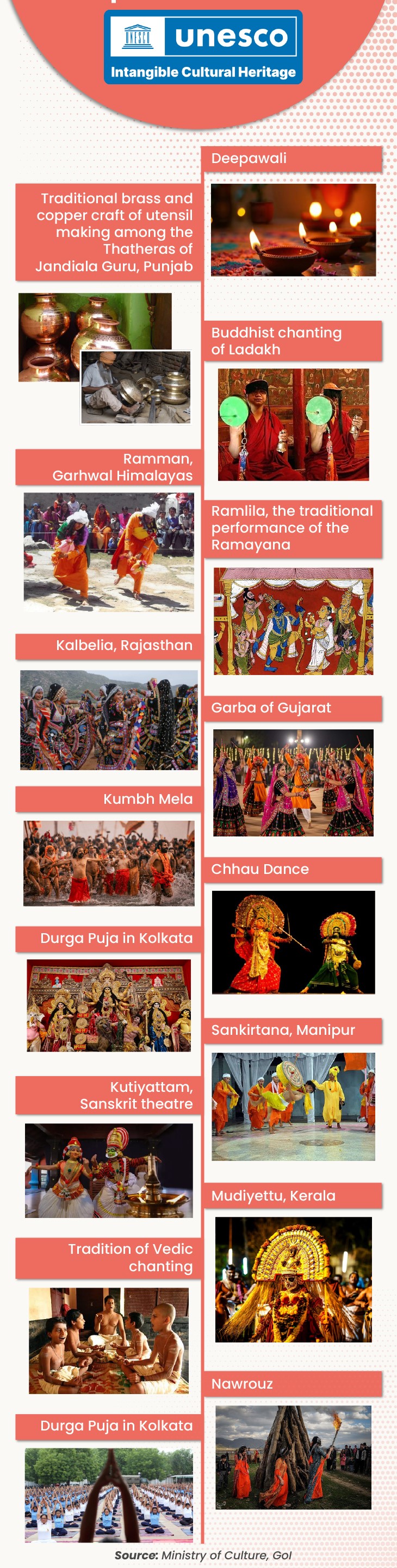
India’s Elements in UNESCO’s ICH List:
|
No. |
Element |
Category/Type |
|
1 |
Kutiyattam |
Sanskrit Theatre (Performing Arts) |
|
2 |
Tradition of Vedic Chanting |
Oral/Religious Tradition |
|
3 |
Ramlila |
Socio-religious Performance |
|
4 |
Ramman |
Religious Festival/Ritual |
|
5 |
Chhau Dance |
Folk Dance/Performing Art |
|
6 |
Kalbelia Folk Songs and Dance |
Folk Dance |
|
7 |
Mudiyettu, Kerala |
Ritual Theatre/Dance |
|
8 |
Buddhist Chanting of Ladakh |
Religious Expression |
|
9 |
Sankirtana of Manipur |
Ritual Singing/Dancing |
|
10 |
Thatheras of Jandiala Guru |
Traditional Craftsmanship |
|
11 |
Navroz |
Festival (Parsi Community) |
|
12 |
Yoga |
Socio-physical-spiritual Practice |
|
13 |
Kumbh Mela |
Religious-Social Festival |
|
14 |
Durga Puja of Kolkata |
Socio-religious Festival |
|
15 |
Garba of Gujarat |
Folk Dance/Festive Event |
|
16 |
Deepavali |
Festival/Socio-religious Expression |
Conclusion:
Deepavali’s inclusion in UNESCO’s Intangible Cultural Heritage List is a significant milestone that recognizes India’s rich cultural heritage and vibrant traditions at the global stage. It highlights India’s commitment to preserving cultural diversity and strengthens international cultural dialogue. The move enhances India’s soft power and underscores the global relevance of its living traditions.



