
Context:
Recently, Prime Minister Narendra Modi dedicated three important sections of the Western Dedicated Freight Corridor (WDFC) covering 326 route kilometres and developed at a cost of over ₹20,700 crore.
What are Dedicated Freight Corridors?
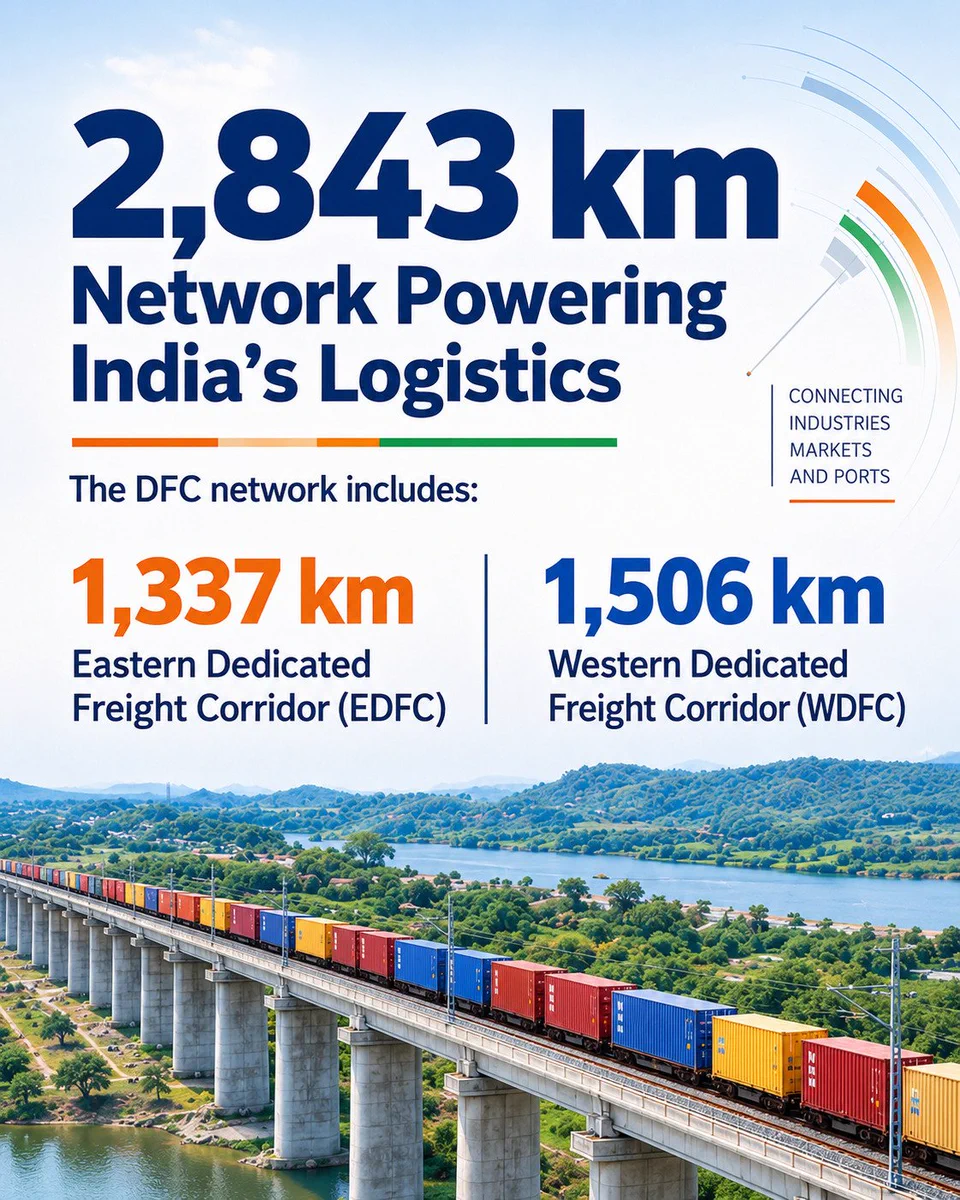
Dedicated Freight Corridors are specialised railway routes designed exclusively for freight trains. They allow heavier and longer trains to operate at higher speeds without competing with passenger services for railway capacity.
India’s two major operational corridors are:
|
Feature |
Eastern DFC |
Western DFC |
|
Length |
1,337 km |
1,506 km |
|
Route |
Ludhiana–Sonnagar |
Dadri–JNPT |
|
Major focus |
Coal and bulk freight |
Containers and EXIM cargo |
|
Key regions |
Northern and eastern India |
Northern and western India |
|
Major benefit |
Coal movement and industrial connectivity |
Port connectivity and container movement |
The Dedicated Freight Corridor Corporation of India Limited (DFCCIL), under the Ministry of Railways, is responsible for developing and operating these corridors. DFCCIL describes the DFC programme as a flagship heavy-haul railway infrastructure initiative connecting inland regions with ports.
About inaugurated WDFC:
-
-
- The newly inaugurated WDFC sections are:
- New Sanand (North)–New Makarpura
- New Umbergaon–New Saphale
- New Saphale–New JNPT
- New Sanand (North)–New Makarpura
- The direct connectivity with Jawaharlal Nehru Port Authority (JNPA) will facilitate faster EXIM cargo movement, reduce logistics costs and help decongest Mumbai’s conventional railway network.
- The newly inaugurated WDFC sections are:
-
Key Features of Western Dedicated Freight Corridor (WDFC):
-
-
- Double-stack container trains: The WDFC supports high-capacity double-stack container operations.
- Higher axle loads: Enables movement of heavier freight trains.
- Higher speed: Dedicated tracks permit faster freight movement.
- Decongestion: Freight traffic shifts away from conventional passenger routes.
- Multimodal connectivity: Better integration of railways with ports, roads and logistics hubs.
- Double-stack container trains: The WDFC supports high-capacity double-stack container operations.
-

Significance:
-
-
- Lower Logistics Costs: Faster and more reliable rail freight can reduce transportation and inventory costs, improving India’s competitiveness.
- Boost to EXIM Trade: Direct connectivity with western ports facilitates smoother movement of containers and export-import cargo.
- Decongestion of Rail Network: Shifting freight to dedicated routes frees capacity on conventional railway lines for passenger and additional freight services.
- Industrial Development: Better connectivity between production centres, markets and ports can encourage industrial corridors and regional economic development.
- Environmental Benefits: Greater use of rail for freight can reduce dependence on road transport, fuel consumption and transport-related emissions.
- Lower Logistics Costs: Faster and more reliable rail freight can reduce transportation and inventory costs, improving India’s competitiveness.
-
India’s Freight Performance:
Indian Railways’ freight loading has increased significantly—from 1,098 million tonnes in 2014-15 to around 1,670 million tonnes in 2025-26. This indicates the growing importance of railways in India’s logistics ecosystem.
Other Government Initiatives:
-
-
- National Logistics Policy (2022): Integrated approach to reducing logistics costs.
- PM GatiShakti: Multimodal infrastructure planning through a GIS-based platform.
- Unified Logistics Interface Platform (ULIP): Digital integration of logistics-related systems.
- Multi-Modal Logistics Parks: Integrated warehousing and transportation infrastructure.
- Gati Shakti Multi-Modal Cargo Terminals: Modernisation of freight terminals.
- Private wagon investment schemes: Encouraging specialised freight wagons.
- National Logistics Policy (2022): Integrated approach to reducing logistics costs.
-
Challenges:
-
-
- High dependence on road-based freight transport.
- Last-mile and first-mile connectivity gaps.
- Fragmented logistics ecosystem.
- Inadequate cold-chain and warehousing infrastructure.
- Land acquisition and project execution delays.
- Need for better integration among rail, road, ports and waterways.
- High dependence on road-based freight transport.
-
Way Forward:
-
-
- India should focus on end-to-end multimodal logistics, rather than merely expanding railway capacity. Greater integration of DFCs with ports, MMLPs, industrial corridors, warehouses and digital logistics platforms is essential.
- The proposed Dankuni–Surat East-West Dedicated Freight Corridor, announced in Union Budget 2026, can further strengthen east-west freight connectivity.
- India should focus on end-to-end multimodal logistics, rather than merely expanding railway capacity. Greater integration of DFCs with ports, MMLPs, industrial corridors, warehouses and digital logistics platforms is essential.
-
Conclusion:
The DFC network marks a shift towards a faster, specialised and efficient freight railway system. By reducing transit time, logistics costs and congestion while improving port connectivity, DFCs can strengthen India’s manufacturing, exports and supply chains and support the vision of a globally competitive logistics economy.



