
Context:
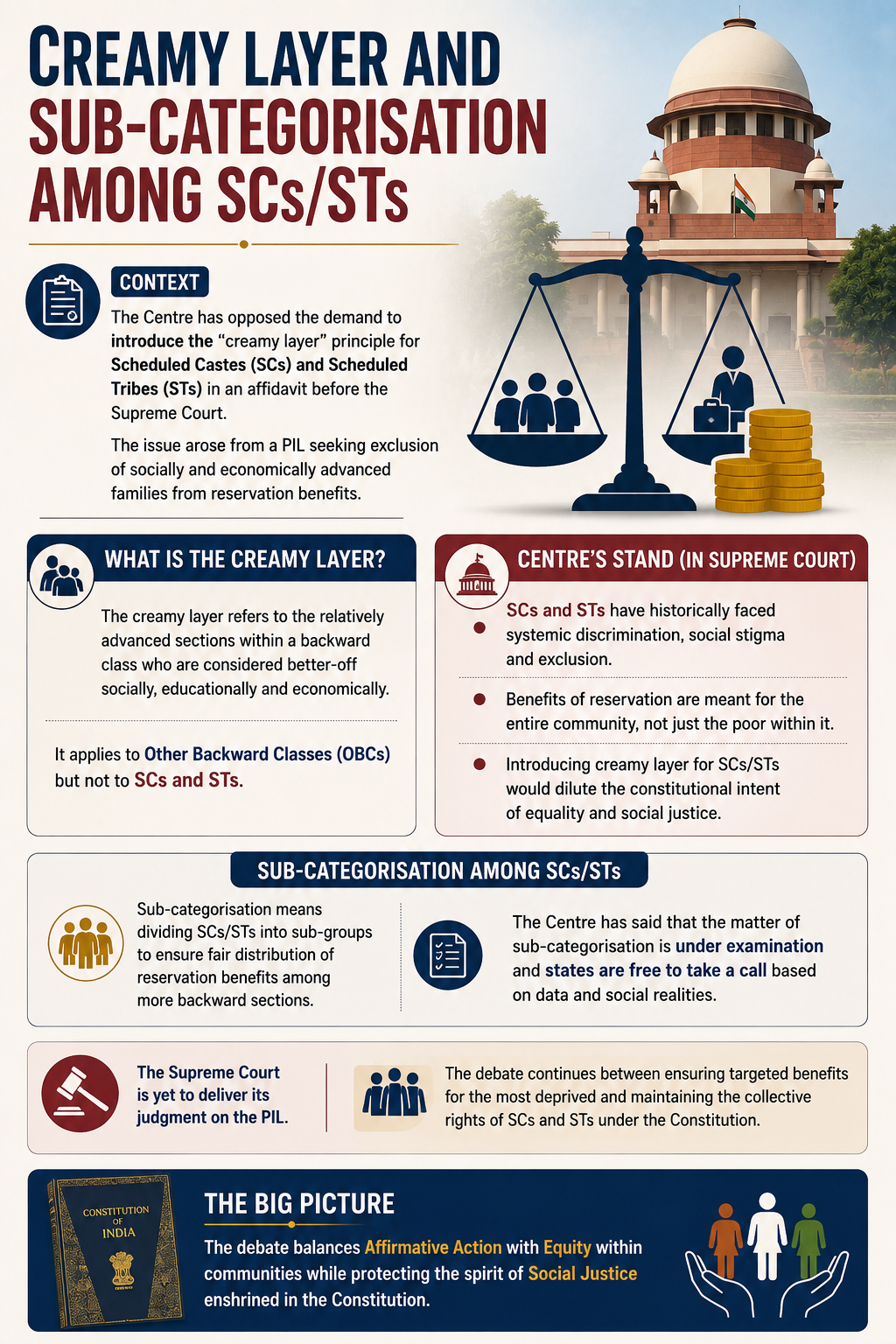
Recently, The Centre has opposed the demand to introduce the “creamy layer” principle for Scheduled Castes (SCs) and Scheduled Tribes (STs) in an affidavit before the Supreme Court. The issue arose from a PIL seeking exclusion of socially and economically advanced families from reservation benefits.
What is the Creamy Layer?
The creamy layer refers to relatively advanced sections within a backward class who are excluded from reservation benefits. The principle was introduced for Other Backward Classes (OBCs) by the Supreme Court in the Indra Sawhney judgment (1992). The Court had held that the creamy-layer principle was applicable to OBCs and did not extend it to SCs and STs.
Why Does the Centre Oppose It for SCs/STs?
The Centre argues that SCs and STs face disadvantages fundamentally different from economic backwardness. SCs have historically suffered from untouchability, caste discrimination and social exclusion, while STs face disadvantages arising from geographical isolation, distinct cultures and historical backwardness. Therefore, economic advancement alone cannot establish that caste- or community-based disadvantage has disappeared.
Sub-Categorisation of SCs/STs:
-
-
- Sub-categorisation means dividing a broad reserved category into smaller groups to ensure equitable distribution of reservation benefits. In its 2024 judgment in State of Punjab v. Davinder Singh, a seven-judge Constitution Bench permitted sub-classification within SCs/STs, subject to constitutional safeguards and empirical evidence.
- It aims to ensure that relatively underrepresented and more disadvantaged communities do not remain deprived while benefits are concentrated among better-represented groups.
- Sub-categorisation means dividing a broad reserved category into smaller groups to ensure equitable distribution of reservation benefits. In its 2024 judgment in State of Punjab v. Davinder Singh, a seven-judge Constitution Bench permitted sub-classification within SCs/STs, subject to constitutional safeguards and empirical evidence.
-
Fraught History of Sub-Categorisation:
The issue has been controversial because some States have argued that certain SC communities have received a disproportionate share of reservation benefits. Critics, however, fear that internal classification could fragment SCs and encourage political manipulation. Further, Articles 341 and 342 provide a constitutional mechanism for identifying SCs and STs, with Parliament having the power to alter the notified lists.
Creamy Layer vs Sub-Categorisation:
|
Creamy Layer |
Sub-Categorisation |
|
Excludes advanced individuals/families |
Distributes benefits among sub-groups |
|
Focuses on social/economic advancement |
Focuses on relative backwardness |
|
Primarily associated with OBCs |
Increasingly debated for SCs/STs |
|
Reduces eligible beneficiaries |
Reallocates benefits within the category |
Arguments For and Against:
-
-
- For creamy layer: It can prevent elite capture, promote inter-generational equity and ensure that reservation reaches the most disadvantaged.
- Against: Caste discrimination may persist despite economic advancement; reservation is not merely an anti-poverty measure; and income cannot fully capture social stigma.
- For creamy layer: It can prevent elite capture, promote inter-generational equity and ensure that reservation reaches the most disadvantaged.
-
Way Forward:
A balanced approach requires reliable caste and socio-economic data, transparent criteria, periodic review and constitutional safeguards. Economic criteria should not be treated as the sole measure of caste-based disadvantage.
Conclusion:
The debate reflects the larger challenge of achieving substantive equality. The objective should be to ensure that affirmative action reaches those who remain structurally disadvantaged while preserving the constitutional commitment to social justice.



