
Context:
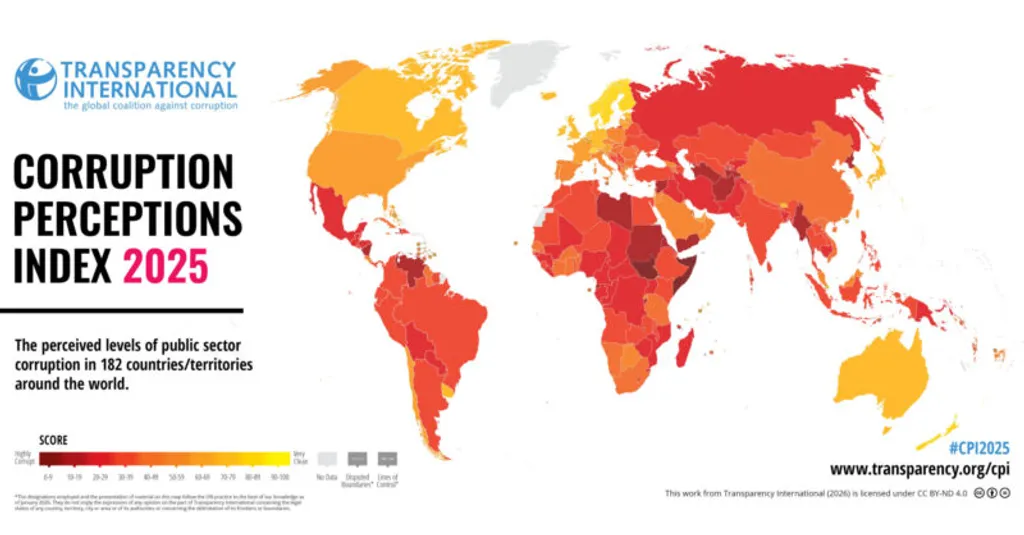
In the latest Corruption Perceptions Index (CPI) 2025, released by the Berlin-based civil society organisation Transparency International, India has been ranked 91st out of 182 countries and territories, securing a score of 39 on a scale of 0–100. A score of 0 indicates a highly corrupt public sector, while a score of 100 indicates a very clean one.
What the CPI Measures:
-
-
- The CPI evaluates perceived public sector corruption using assessments from 13 independent sources, including the World Bank, the World Economic Forum, and other research organisations. These assessments reflect the perceptions of experts and business leaders regarding the extent of corruption in public institutions and governance systems.
- The 2025 report highlights that more than two-thirds of countries score below 50, underscoring that corruption perceptions remain high globally. The global average CPI score declined to 42, marking a worrying trend of stagnation or deterioration in anti-corruption outcomes worldwide.
- The CPI evaluates perceived public sector corruption using assessments from 13 independent sources, including the World Bank, the World Economic Forum, and other research organisations. These assessments reflect the perceptions of experts and business leaders regarding the extent of corruption in public institutions and governance systems.
-
India’s Performance: Incremental Improvement Amid Structural Challenges:
-
-
- India’s ranking at 91st represents an improvement of five places compared to the previous CPI and a one-point increase in its score from last year. While this indicates modest perceptual gains, the ranking remains below the global average and points to persistent structural concerns regarding transparency and accountability in the public sector.
- Experts note that the slow pace of improvement partly reflects bureaucratic opacity, political influence in decision-making processes, and uneven enforcement of anti-corruption laws. Corruption, therefore, continues to be viewed as a systemic governance issue rather than a series of isolated incidents.
- The CPI report also flags India among countries that pose high risks for journalists reporting on corruption, where media personnel may face threats or violence while pursuing investigative reporting. This factor can potentially weaken transparency and accountability mechanisms.
- India’s ranking at 91st represents an improvement of five places compared to the previous CPI and a one-point increase in its score from last year. While this indicates modest perceptual gains, the ranking remains below the global average and points to persistent structural concerns regarding transparency and accountability in the public sector.
-
Institutional and Legal Framework in India:
India has developed a robust anti-corruption architecture comprising statutory bodies and legal instruments:
|
Institution / Law |
Purpose / Mandate |
|
Lokpal and Lokayuktas Act, 2013 |
Establishes ombudsman bodies to investigate corruption complaints against public functionaries at the Centre and in the states, respectively. |
|
Central Vigilance Commission (CVC) |
Apex supervisory body overseeing vigilance administration across central government departments. |
|
Central Bureau of Investigation (CBI) |
Premier federal investigative agency handling anti-corruption and related cases. |
|
Prevention of Corruption Act, 1988 (amended 2018) |
Core legislation penalising bribery; the 2018 amendment criminalised bribe-giving in addition to bribe-taking. |
|
Prevention of Money Laundering Act (PMLA), 2002 |
Enables the prevention of money laundering and the confiscation of proceeds of crime. |
|
Whistle Blowers Protection Act, 2014 |
Provides protection to individuals reporting corruption against retaliation. |
This multi-tiered framework aims to strengthen accountability and enhance legal deterrence against corrupt practices.
Conclusion:
The CPI 2025 ranking suggests that while India has achieved modest perceptual gains, corruption remains a structural governance challenge. Bridging the gap between policy intent and effective implementation, reinforcing institutional autonomy, and fostering ethical public service values are essential to improving both the perception and reality of transparency and accountability. Comprehensive and sustained efforts in these areas will be crucial to enhancing India’s global integrity standing and strengthening public trust in democratic governance.



