
Context:
Recently, The Global Coral Reef Monitoring Network (GCRMN) released its seventh Status of Coral Reefs of the World.
What are Coral Reefs?
-
-
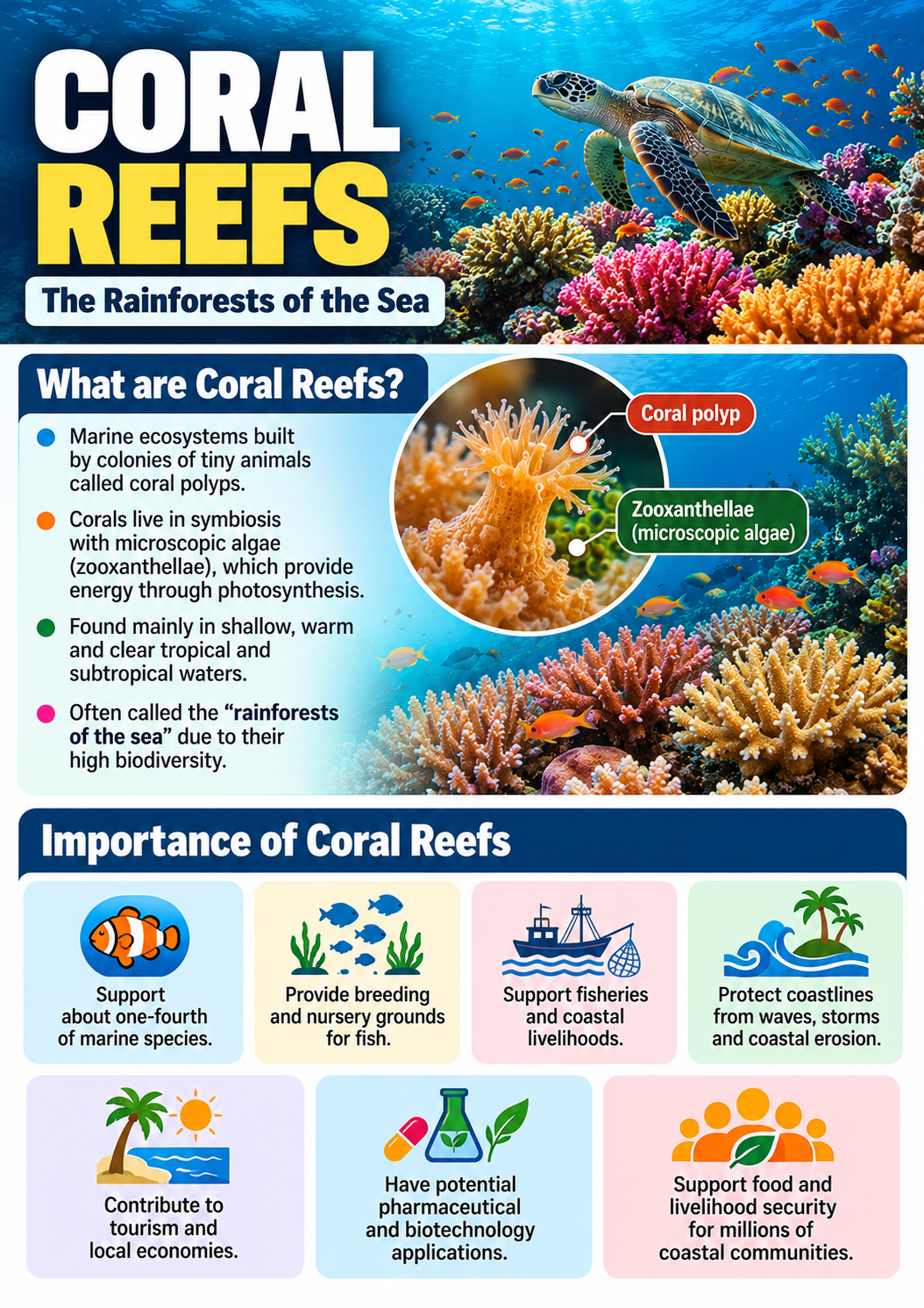
- Coral reefs are marine ecosystems built primarily by colonies of tiny animals called coral polyps. Reef-building corals live in symbiotic association with microscopic algae called zooxanthellae, which provide much of the energy required by corals through photosynthesis.
- Coral reefs are mainly found in shallow, warm and clear tropical and subtropical waters.
- They are often described as the “rainforests of the sea” because of their exceptionally high biodiversity.
- Coral reefs are marine ecosystems built primarily by colonies of tiny animals called coral polyps. Reef-building corals live in symbiotic association with microscopic algae called zooxanthellae, which provide much of the energy required by corals through photosynthesis.
-
Importance of Coral Reefs:
-
-
- Support around one-fourth of marine species despite occupying a very small fraction of the ocean floor.
- Provide breeding and nursery grounds for fish.
- Support fisheries and coastal livelihoods.
- Protect coastlines from waves, storms and coastal erosion.
- Contribute to tourism and local economies.
- Have potential pharmaceutical and biotechnology applications.
- Support food and livelihood security for millions of coastal communities.
- Support around one-fourth of marine species despite occupying a very small fraction of the ocean floor.
-
Key Findings of the report:
-
-
- The report found that global hard coral cover has declined by about 9.5% compared with the 1980–2009 reference period. Major disturbances are now occurring every 4–6 years, instead of roughly once a decade, leaving less time for reef recovery and increasing the risk of sustained degradation.
- Marine heatwaves are the strongest driver of coral decline, with sea-surface temperatures over coral reefs rising by about 0.81°C between 1985 and 2025. Heat stress causes corals to expel their symbiotic algae (zooxanthellae), leading to bleaching.
- The fourth global mass bleaching event began in 2023, peaked in heat stress during 2024 and likely continued into 2025. Major global bleaching events have occurred in 1998–99, 2010–11, 2016–17 and 2023–24.
- In 2024, 87% of reefs experienced unprecedented heat stress, while over 40% faced heat stress linked to mortality risk. The Caribbean was particularly affected, with average hard coral cover falling to 7.1% in 2024, while the ROPME Sea Area witnessed about a 50% decline between 2020 and 2024, with coral cover around 15%. Australia and the Pacific also recorded moderate declines.
- The report found that global hard coral cover has declined by about 9.5% compared with the 1980–2009 reference period. Major disturbances are now occurring every 4–6 years, instead of roughly once a decade, leaving less time for reef recovery and increasing the risk of sustained degradation.
-
Implications for India:
-
-
- India's major coral reef ecosystems are located in the Gulf of Mannar, Gulf of Kachchh, Lakshadweep and Andaman & Nicobar Islands. They support fisheries, tourism, biodiversity and coastal protection.
- Indian reefs face both climate-related threats and local pressures such as pollution, sedimentation, overfishing and coastal development.
- India's major coral reef ecosystems are located in the Gulf of Mannar, Gulf of Kachchh, Lakshadweep and Andaman & Nicobar Islands. They support fisheries, tourism, biodiversity and coastal protection.
-
Way Forward:
-
-
- Rapid reduction in greenhouse-gas emissions.
- Strengthening Marine Protected Areas.
- Controlling coastal pollution and destructive fishing.
- Promoting coral restoration and conservation.
- Strengthening long-term scientific monitoring.
- Protecting climate-resilient reefs.
- Rapid reduction in greenhouse-gas emissions.
-
Conclusion:
The coral reef crisis reflects the combined impact of global climate change and local ecological pressures. Ensuring reef survival requires simultaneous climate mitigation, sustainable coastal management and ecosystem restoration.



