
Constitution (131st Amendment) Bill, 2026
Context:
Recently, the Constitution (131st Amendment) Bill, 2026, which was part of a larger delimitation and electoral reform package, was defeated in the Lok Sabha. The Bill sought to enable redistribution of Lok Sabha seats based on the 2011 Census and facilitate the implementation of women’s reservation in legislatures.
Background and Objectives:
The legislative package aimed to achieve two major objectives:
-
-
- Implementation of 33% women’s reservation in Parliament and State Assemblies (targeted for 2029 elections)
- Application of the principle of “one person, one vote, one value” through delimitation based on updated population data
- Implementation of 33% women’s reservation in Parliament and State Assemblies (targeted for 2029 elections)
-
Key proposals included:
-
-
- Redistribution of Lok Sabha constituencies based on 2011 Census
- Expansion of Lok Sabha strength from present levels to around 850 seats
- Ensuring uniform increase in representation across States
- Redistribution of Lok Sabha constituencies based on 2011 Census
-
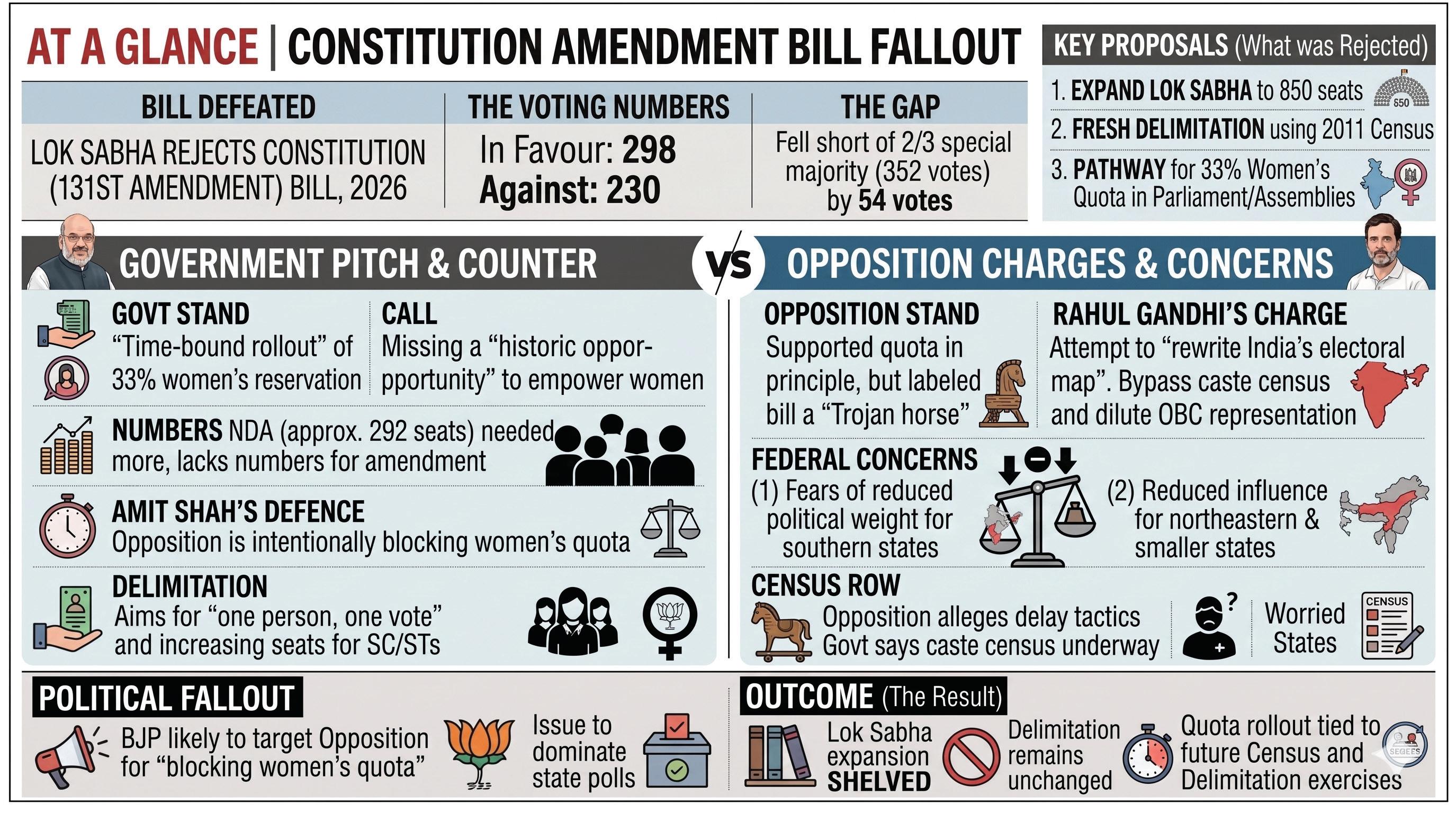
Key Outcomes of the Bill’s Defeat:
-
-
- The Bill failed to achieve the required two-thirds majority in Lok Sabha, leading to its rejection.
- Consequently, the associated delimitation package was also stalled.
- The government had proposed increasing Lok Sabha strength and implementing women’s reservation through this framework, but the plan remains pending.
- The Bill failed to achieve the required two-thirds majority in Lok Sabha, leading to its rejection.
-
Key Issues in Debate:
-
-
- Federal Concerns: Opposition argued that delimitation based on population could reduce representation of certain States, especially in southern India.
- North–South Divide Allegation: Government rejected claims of regional bias, asserting equal representation of all States.
- Women’s Reservation Linkage: Opposition criticised linking women’s quota to delimitation exercise.
- “One Person, One Vote” Principle: Government defended the Bill citing population imbalance due to freeze based on the 1971 Census.
- Federal Concerns: Opposition argued that delimitation based on population could reduce representation of certain States, especially in southern India.
-
Implications:
-
-
- Delay in Delimitation: Fresh redrawing of constituencies remains stalled.
- Women’s Reservation Uncertainty: Implementation timeline remains unclear.
- Federal Sensitivities Intensified: Debate over representation vs regional balance continues.
- Policy Vacuum: Electoral reform agenda faces uncertainty without consensus.
- Delay in Delimitation: Fresh redrawing of constituencies remains stalled.
-
About Constitutional Amendment Bill:
-
-
- Under Article 368 of the Constitution, a Constitution Amendment Bill follows a special and rigid procedure as it can be introduced in either House of Parliament and requires a special majority, i.e., majority of the total membership of the House and two-thirds of members present and voting, with no provision of a joint sitting in case of disagreement between the two Houses.
- After passage in Parliament, it requires the assent of the President and in certain cases affecting federal provisions, ratification by at least half of the State Legislatures is also necessary. The Indian Constitution thus provides a balanced amendment process that combines rigidity with flexibility to preserve the basic structure while allowing necessary changes in governance.
- Amendments related to delimitation are particularly significant as they affect the representation of States in the Lok Sabha and the federal balance between the Union and States. Under Articles 81 and 82, delimitation is carried out after every Census.
- Under Article 368 of the Constitution, a Constitution Amendment Bill follows a special and rigid procedure as it can be introduced in either House of Parliament and requires a special majority, i.e., majority of the total membership of the House and two-thirds of members present and voting, with no provision of a joint sitting in case of disagreement between the two Houses.
-
Conclusion:
The defeat of the 131st Constitutional Amendment Bill, 2026 reflects the complexities of constitutional amendments involving federal structure, electoral representation, and social justice measures. It highlights the importance of Article 368 procedure, special majority requirement, and political consensus in shaping major constitutional reforms in India.



