
Context:
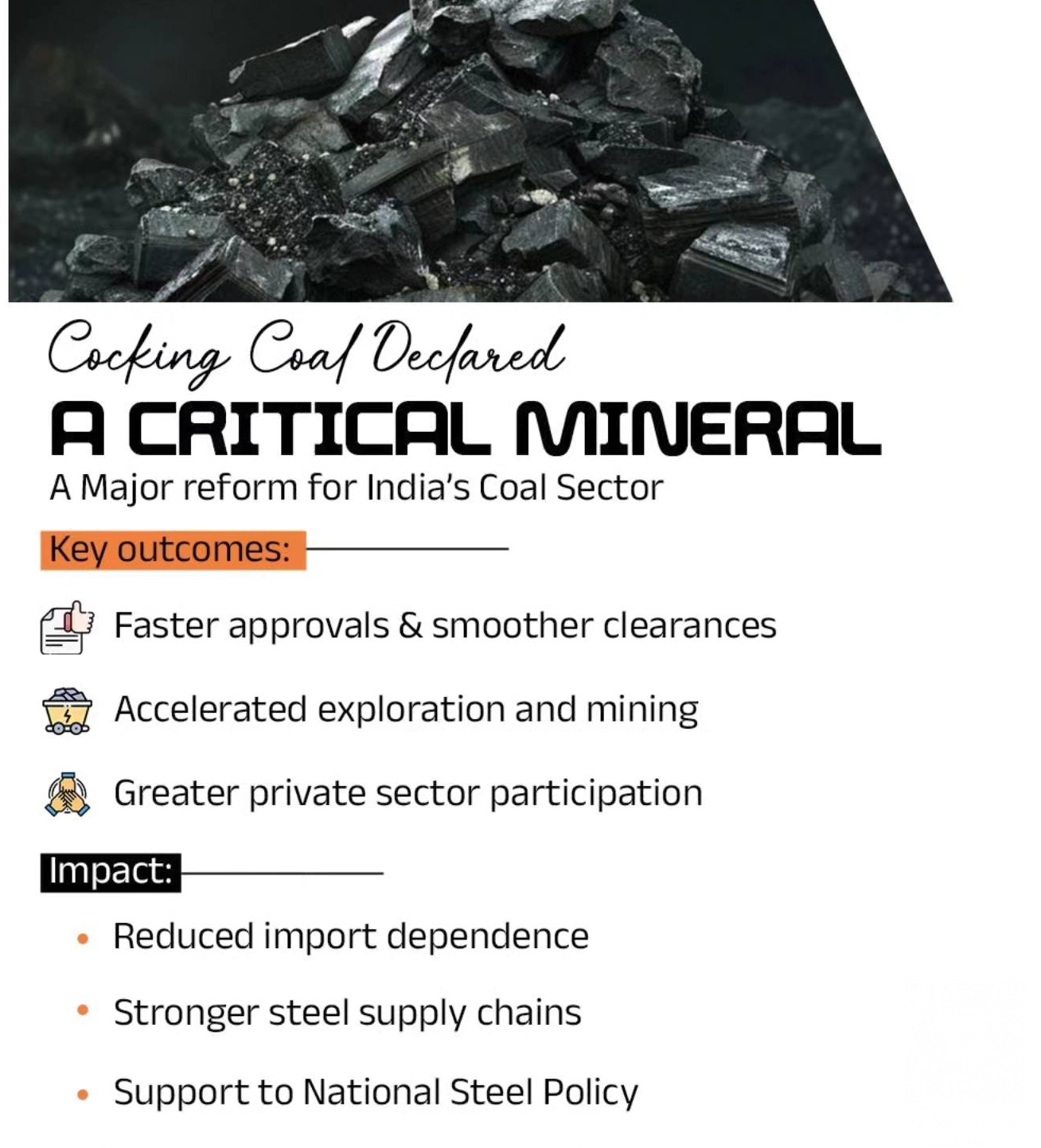
On 29 January 2026, the Government of India notified coking coal as a Critical and Strategic Mineral under the Mines and Minerals (Development and Regulation) Act, 1957 (MMDR Act). This decision aligns with the government’s vision of Aatmanirbhar Bharat and Viksit Bharat 2047, aiming to strengthen domestic mineral security and reduce import dependence in strategic sectors like steel production.
Key Highlights of the Notification:
-
- The notification was based on recommendations from the High-Level Committee on Implementation of Viksit Bharat Goals (HLC-VB) and policy inputs from NITI Aayog.
- Coking coal is critical for the domestic steel sector, ensuring industrial continuity and strategic self-reliance.
- India has 37.37 billion tonnes of coking coal resources, primarily in Jharkhand, with reserves in Madhya Pradesh, West Bengal, and Chhattisgarh.
- Despite domestic reserves, 95% of coking coal demand is met through imports, increasing from 51.20 MT (2020–21) to 57.58 MT (2024–25), resulting in significant foreign exchange outgo.
- The notification was based on recommendations from the High-Level Committee on Implementation of Viksit Bharat Goals (HLC-VB) and policy inputs from NITI Aayog.
Legal & Policy Implications:
-
- Section 11C of MMDR Act empowered the Central Government to amend the First Schedule, adding “Coking Coal” in Part D (Critical & Strategic Minerals).
- Benefits include:
- Faster approvals and ease of doing business for mining operations.
- Exemption from public consultation for mining of critical minerals.
- Utilisation of degraded forest land for compensatory afforestation.
- Encouragement of private sector investment in exploration, beneficiation, and technology adoption.
- Faster approvals and ease of doing business for mining operations.
- Royalties, auction premiums, and statutory payments continue to accrue to State Governments, maintaining federal fiscal balance.
- Section 11C of MMDR Act empowered the Central Government to amend the First Schedule, adding “Coking Coal” in Part D (Critical & Strategic Minerals).
Strategic Rationale:
-
- Reducing import dependence strengthens supply chain resilience for steel and allied industries.
- Supports National Steel Policy and promotes a self-reliant industrial ecosystem.
- Potential to generate employment across mining, logistics, and steel value chains.
- Aligns with India’s broader focus on critical minerals, such as Lithium, Cobalt, Nickel, Graphite, essential for defense, EVs, and high-tech industries.
- Reducing import dependence strengthens supply chain resilience for steel and allied industries.
About Critical & Strategic Minerals Framework:
-
- India has identified 30 critical minerals essential for economic development, national security, and clean energy transition.
- These Minerals support EVs, renewable energy, electronics, aerospace, and defense sectors.
- India has identified 30 critical minerals essential for economic development, national security, and clean energy transition.
MMDR Act, 1957 – Key Features:
-
- Governs mining leases, mineral exploration, and resource management while balancing environmental safeguards.
- Differentiates between major minerals (Central control) and minor minerals (State control).
- Provides reconnaissance permits, prospecting licenses, and mining leases.
- Recent reforms:
- Auction regime (2015) to ensure transparency.
- Critical minerals provision (2023) for exclusive Central Government auctions.
- Exploration License (2023) for deep-seated mineral exploration.
- Institutional frameworks like NMET and DMF for exploration and community development.
- Auction regime (2015) to ensure transparency.
- Governs mining leases, mineral exploration, and resource management while balancing environmental safeguards.
Significance of the Notification:
1. Enhances national mineral security.
2. Boosts private investment and adoption of advanced mining technologies.
3. Reduces import dependency, saving foreign exchange.
4. Promotes employment generation and regional development.
5. Strengthens the vision of Viksit Bharat 2047 through industrial self-reliance.



