
Context:
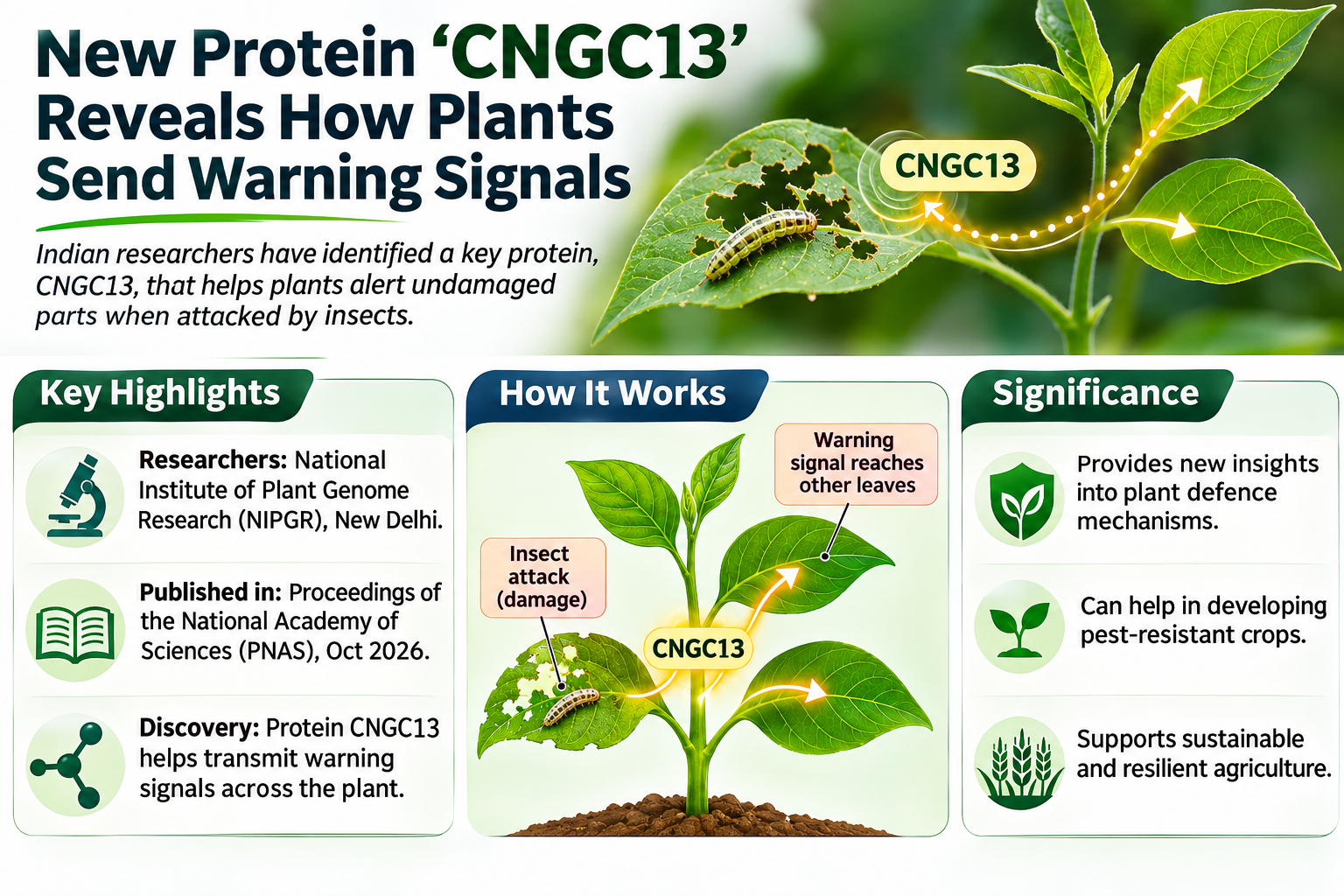
Researchers at the National Institute of Plant Genome Research (NIPGR), New Delhi, have identified a previously uncharacterised protein, CNGC13, that helps plants transmit warning signals from an insect-damaged leaf to undamaged parts of the plant. The findings, published in the Proceedings of the National Academy of Sciences (PNAS) in October 2026, provide fresh insights into plant defence mechanisms and could contribute to the development of pest-resistant crops.
How Do Plants Communicate Danger?
-
-
- Unlike animals, plants cannot move away from threats and do not possess a nervous system. However, they have sophisticated signalling mechanisms that allow them to detect damage and activate defensive responses. When insects chew a leaf, the plant initiates signals involving calcium ions, reactive oxygen species and hormones such as jasmonic acid. These signals activate defence-related genes, strengthen cell walls and help protect against further damage and pathogens.
- Earlier research highlighted glutamate receptor-like channels (GLRs) as important components of plant-wide danger signalling. The new study identifies CNGC13, a calcium channel located mainly in the plant's vascular tissues, particularly the xylem and phloem, as another important component of this communication system.
- Unlike animals, plants cannot move away from threats and do not possess a nervous system. However, they have sophisticated signalling mechanisms that allow them to detect damage and activate defensive responses. When insects chew a leaf, the plant initiates signals involving calcium ions, reactive oxygen species and hormones such as jasmonic acid. These signals activate defence-related genes, strengthen cell walls and help protect against further damage and pathogens.
-
Key Findings of the Study:
-
-
- The researchers examined Arabidopsis thaliana, a widely used model plant, and compared normal plants with mutant varieties lacking the CNGC13 gene. They found that larvae of Spodoptera litura (tobacco cutworm) gained significantly more weight when feeding on mutant plants, indicating reduced insect resistance. Restoring the gene helped recover the normal defence response.
- The study also found that CNGC13 activity increased within 15 minutes of wounding. Fluorescent imaging showed that calcium signals reached distant leaves in approximately 90 seconds in normal plants, compared with around 150 seconds in most mutant plants. Mutant plants also produced lower levels of jasmonic acid and certain glucosinolate breakdown products in distant leaves. These findings suggest that CNGC13 helps coordinate rapid, systemic defence responses.
- The researchers examined Arabidopsis thaliana, a widely used model plant, and compared normal plants with mutant varieties lacking the CNGC13 gene. They found that larvae of Spodoptera litura (tobacco cutworm) gained significantly more weight when feeding on mutant plants, indicating reduced insect resistance. Restoring the gene helped recover the normal defence response.
-
Significance for Agriculture and Food Security:
-
-
- Insect pests account for approximately 20% of global annual crop losses, and climate change may intensify pest-related threats. Crop protection remains heavily dependent on chemical insecticides, which can contribute to environmental pollution, pesticide resistance and harm to non-target organisms.
- Understanding plant signalling pathways could help scientists develop crops with stronger inbuilt resistance. It may also support the development of targeted, environmentally sustainable crop-protection technologies and reduce dependence on chemical pesticides.
- Insect pests account for approximately 20% of global annual crop losses, and climate change may intensify pest-related threats. Crop protection remains heavily dependent on chemical insecticides, which can contribute to environmental pollution, pesticide resistance and harm to non-target organisms.
-
Conclusion:
The identification of CNGC13 highlights the complexity of plant communication and defence. By understanding how plants detect and transmit danger signals, scientific research can contribute to more resilient crops, sustainable agriculture and long-term food security.



