
Context:
China’s recent test of a sea-based Intercontinental Ballistic Missile (ICBM) has raised concerns about the changing strategic environment in the Indo-Pacific region. The test demonstrates China’s expanding nuclear capabilities and its efforts to strengthen its second-strike capability through submarine-based nuclear forces. This development has important implications for India, the United States, and other regional powers.
Key Highlights of the Missile Test:
-
-
- China conducted its first known sea-based long-range ballistic missile test in international waters on July 6. The missile was launched from a Chinese submarine, most likely a Ju Lang-2 (JL-2) or advanced Ju Lang-3 (JL-3) submarine-launched ballistic missile (SLBM).
- The missile travelled around 7,300 km before landing in the Southern Pacific Ocean. It carried a dummy warhead and passed over several Exclusive Economic Zones (EEZs). The test showed China’s growing ability to deploy nuclear weapons through submarines and strengthen its nuclear triad.
- China conducted its first known sea-based long-range ballistic missile test in international waters on July 6. The missile was launched from a Chinese submarine, most likely a Ju Lang-2 (JL-2) or advanced Ju Lang-3 (JL-3) submarine-launched ballistic missile (SLBM).
-
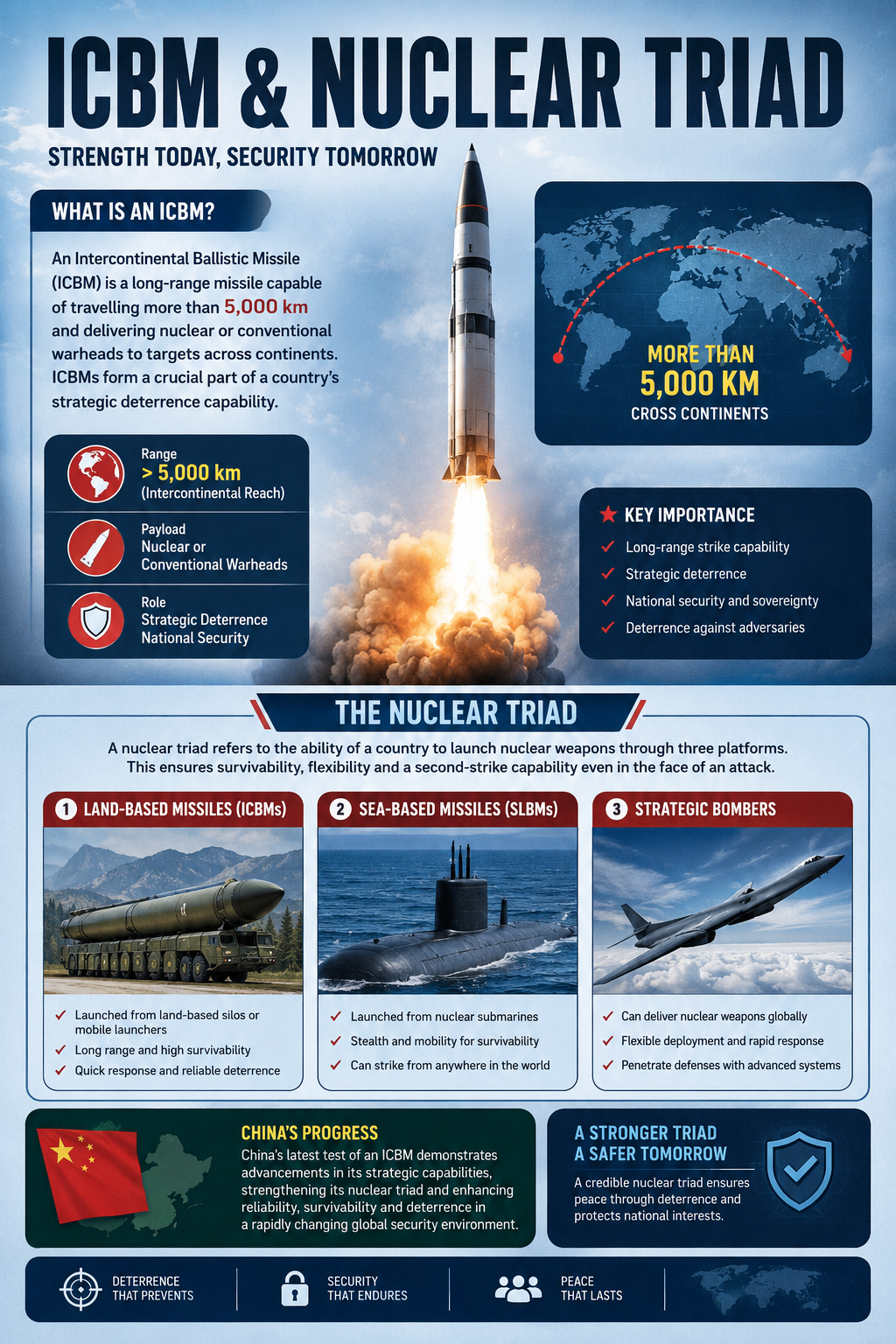
About Intercontinental Ballistic Missile (ICBM):
An ICBM is a long-range missile capable of travelling more than 5,000 km and delivering nuclear or conventional warheads. These missiles form a crucial part of a country’s strategic deterrence capability.
Nuclear Triad:
A nuclear triad refers to the ability of a country to launch nuclear weapons through three platforms:
-
-
- Land-based missiles (ICBMs)
- Sea-based missiles (SLBMs carried by nuclear submarines)
- Strategic bombers
- China’s latest test indicates progress in developing a more reliable nuclear triad.
- Land-based missiles (ICBMs)
-
What is Second-Strike Capability?
Second-strike capability refers to the ability of a country to survive an enemy’s first nuclear attack and still retaliate. Nuclear submarines play a major role because they are difficult to detect and destroy.
Significance of China’s Nuclear Expansion:
China has traditionally followed a minimum nuclear deterrence policy. However, recent developments indicate a shift towards a larger and more advanced nuclear posture.
The test highlights:
-
-
- Improvement in submarine-based nuclear forces
- Development of advanced missile technology
- Greater emphasis on early-warning and counter-strike capabilities
- China’s ambition to project itself as a major global power
- Improvement in submarine-based nuclear forces
-
Implications for the Indo-Pacific Region:
-
-
- China’s missile advancement may increase strategic competition in the Indo-Pacific. The United States may need to strengthen its missile defence systems and increase focus on East Asia.
- For regional countries such as Japan, Australia, and India, China’s growing nuclear and naval capabilities create concerns about regional stability and the possibility of an arms race.
- China’s missile advancement may increase strategic competition in the Indo-Pacific. The United States may need to strengthen its missile defence systems and increase focus on East Asia.
-
Implications for India:
The test highlights the widening strategic gap between India and China. India needs to strengthen its nuclear deterrence and maritime security capabilities.
Important steps include:
-
-
- Development of longer-range submarine-launched missiles such as K-5 and K-6
- Expansion of the nuclear-powered ballistic missile submarine (SSBN) fleet
- Improvement of anti-submarine warfare capabilities
- Strengthening seabed domain awareness in the Indian Ocean Region
- Development of longer-range submarine-launched missiles such as K-5 and K-6
-
Treaty of Rarotonga and Nuclear-Free Zones:
The missile landed in an area covered by the Treaty of Rarotonga, which establishes the South Pacific Nuclear Free Zone. The treaty prohibits nuclear explosive testing and deployment of nuclear weapons in the region. However, missile tests without nuclear warheads are not considered nuclear explosions.
Way Forward:
India should focus on maintaining a credible minimum deterrence posture by strengthening its nuclear triad, improving maritime surveillance, and enhancing cooperation with Indo-Pacific partners.
Conclusion:
China’s sea-based ICBM test reflects its growing nuclear capabilities and changing strategic priorities. While it strengthens China’s second-strike capability, it also increases security challenges in the Indo-Pacific. India must continue developing advanced defence technologies and maritime capabilities to maintain strategic stability and protect its national interests.



