
Chandrayaan-3 ‘Hop’ Experiment Reveals Moon’s Subsurface Layers
Context:
Recently, data obtained from the “Hop Experiment” conducted by the Vikram Lander of the Chandrayaan-3 mission near the Moon’s south pole has provided new insights into the structure of the Moon’s regolith (dust and rocky surface). The mission revealed that the Moon’s upper surface is not uniform; rather, it consists of different layers within just a few centimeters of depth. This study was published in The Astrophysical Journal based on data collected by the ChaSTE instrument.
About Chandrayaan-3 Mission:
Chandrayaan-3 is India’s third lunar mission launched in 2023 from Satish Dhawan Space Centre. It achieved the first successful soft landing near the lunar south pole.
The mission included:
-
- Vikram lander and Pragyan rover
- One lunar day operational life (~14 Earth days)
- Focus on surface composition, seismic activity, and thermal studies
- Vikram lander and Pragyan rover
The south pole is scientifically important due to possible water ice deposits.
What is the ‘Hop’ Experiment?
-
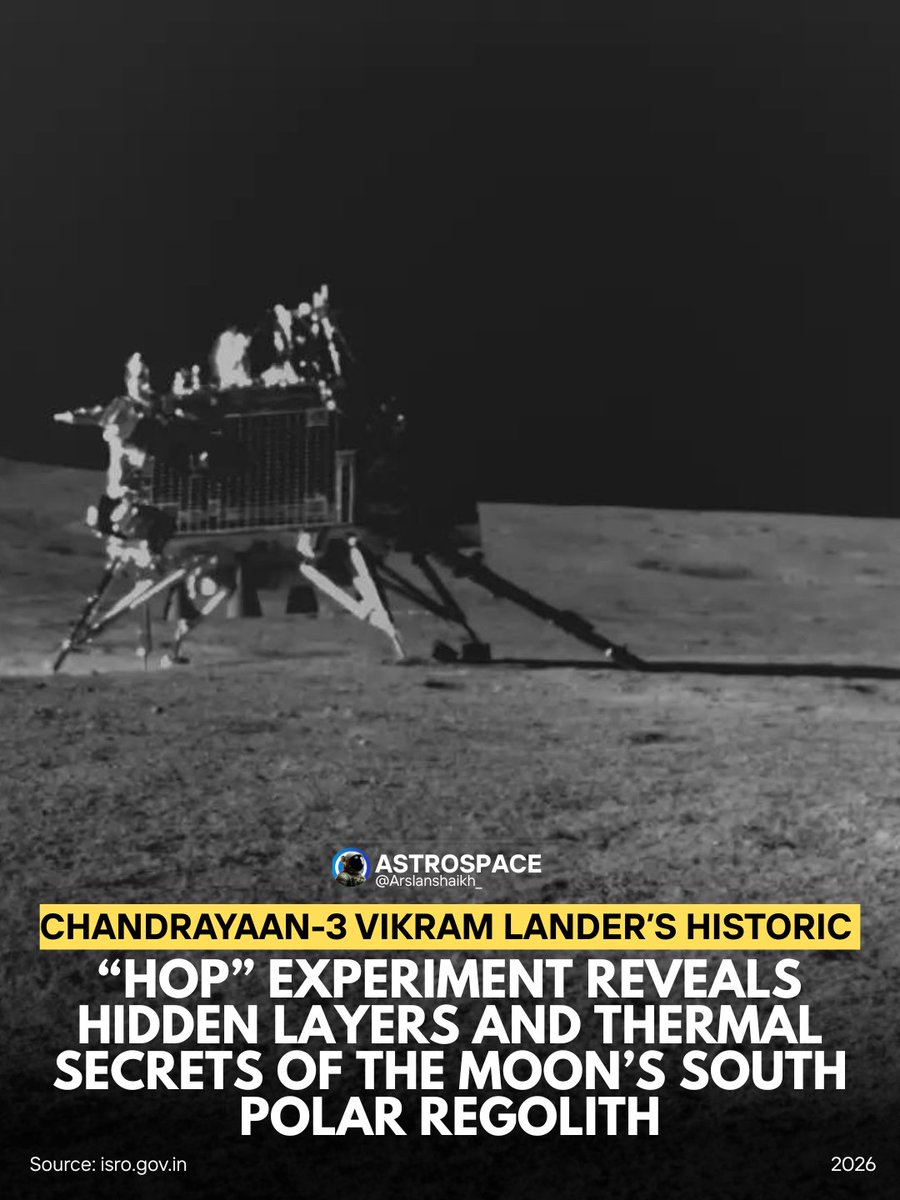
- The Hop Experiment, or “Hop Test,” was a historic and successful test conducted by the Indian Space Research Organisation through the Chandrayaan-3 mission’s Vikram Lander on the surface of the Moon.
- Under this experiment, after the primary soft landing of Chandrayaan-3, scientists reignited the lander’s engines on the lunar surface. As a result, the Vikram Lander briefly “hopped” about 40 centimeters into the air and then performed another safe soft landing at a new location approximately 30 to 50 centimeters away from its original landing spot.
- The Hop Experiment, or “Hop Test,” was a historic and successful test conducted by the Indian Space Research Organisation through the Chandrayaan-3 mission’s Vikram Lander on the surface of the Moon.
Key Scientific Findings:
Two Distinct Subsurface Layers: Data from the ChaSTE instrument showed:
-
-
- A loose, porous upper layer
- A denser compact layer below 2–6 cm depth
This indicates sharp changes in physical and thermal properties within a very shallow depth.
- A loose, porous upper layer
-
Regolith Disturbance by Rocket Plume
The lander’s exhaust displaced around 3 cm of surface material. This exposure allowed instruments to study previously buried layers, providing direct evidence of plume–soil interaction on the Moon.
Extreme Thermal Gradient
Measurements revealed:
-
-
- Temperature drops of nearly 60°C within 10 cm depth
- Very low thermal conductivity of lunar soil
This is critical for future habitat and thermal protection design.
- Temperature drops of nearly 60°C within 10 cm depth
-
About ChaSTE:
-
-
- The ChaSTE (Chandra’s Surface Thermophysical Experiment) instrument was mounted on the Vikram lander. It consisted of a rod-shaped probe with temperature sensors placed at multiple depths and a heater at its tip.
- ChaSTE penetrated the lunar surface and recorded temperature changes, heat flow, and soil resistance. After the hop maneuver disturbed the surface, ChaSTE measured the altered regolith conditions, helping scientists compare the fluffy upper layer with the compacted layer underneath.
- The ChaSTE (Chandra’s Surface Thermophysical Experiment) instrument was mounted on the Vikram lander. It consisted of a rod-shaped probe with temperature sensors placed at multiple depths and a heater at its tip.
-
Significance of Findings:
Scientific Importance: The results improve understanding of lunar soil formation, impact history, and subsurface structure. They provide the first fine-scale thermal and density profile of the Moon’s near-surface region.
Technological Importance: The hop experiment validates:
-
-
- Controlled surface lift-off capability
- Precision thruster use on extraterrestrial surfaces
- Behaviour of regolith under engine exhaust
- Controlled surface lift-off capability
-
Strategic Importance: The findings support future lunar missions, including:
-
-
- Human landing missions
- Lunar base construction
- Sample return missions
- Human landing missions
-
They strengthen India’s position in global space exploration and deep-space research.
Conclusion:
The Chandrayaan-3 hop experiment has transformed into a major scientific breakthrough, revealing the Moon’s layered subsurface structure within centimetres. It enhances understanding of lunar geology and provides critical inputs for future exploration, strengthening India’s capabilities in advanced space science and planetary missions.



