
Context:
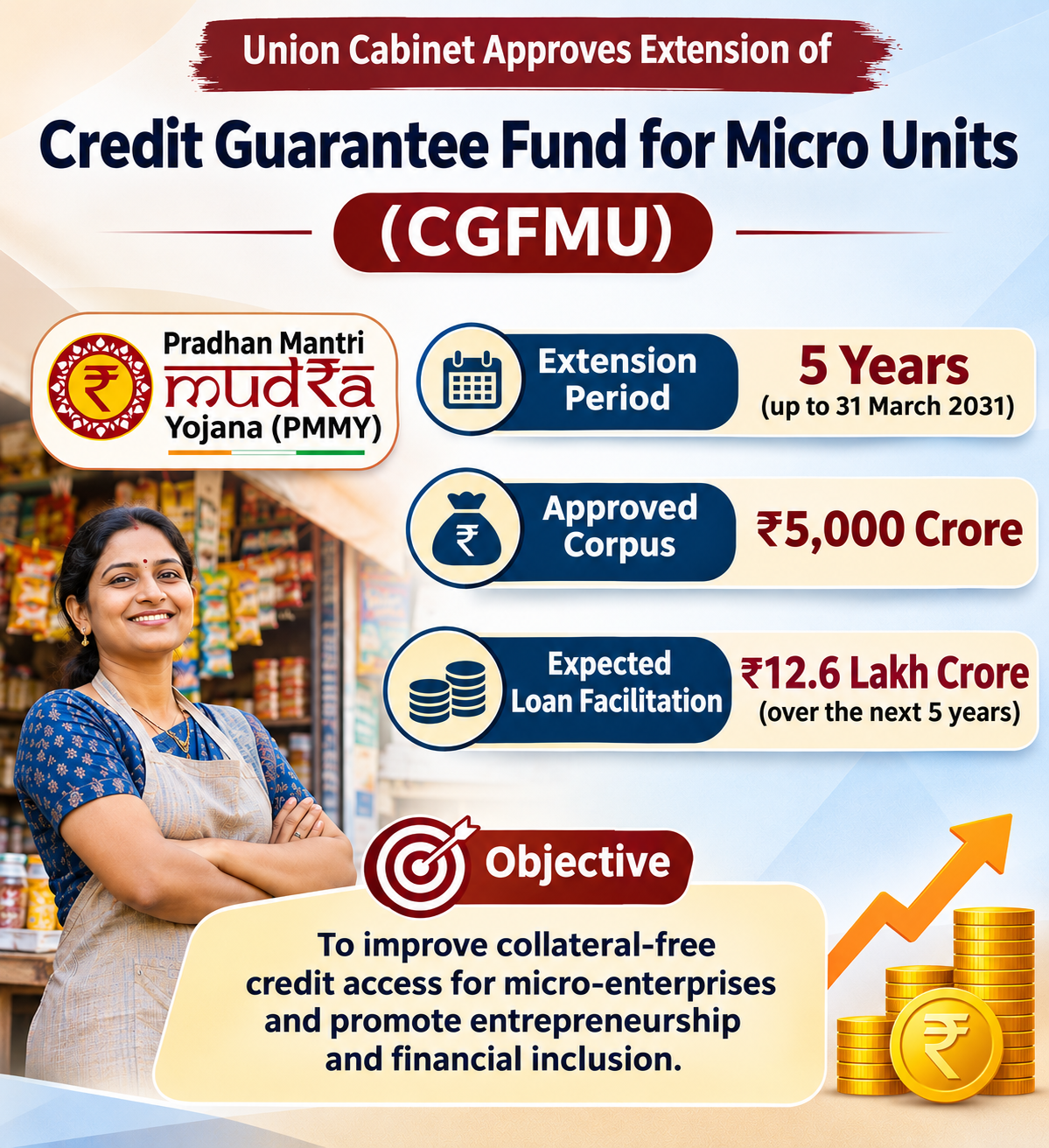
Recently, the Union Cabinet approved the continuation of the Credit Guarantee Fund for Micro Units (CGFMU) for another five years, up to 31 March 2031. The government approved a corpus of ₹5,000 crore, which is expected to facilitate ₹12.6 lakh crore in loans under the Pradhan Mantri Mudra Yojana (PMMY) over the next five years. The objective is to improve collateral-free credit access for micro-enterprises and promote entrepreneurship and financial inclusion.
About Credit Guarantee Fund for Micro Units:
The Credit Guarantee Fund for Micro Units was launched in January 2016 under the Pradhan Mantri Mudra Yojana. It is implemented through the National Credit Guarantee Trustee Company Limited (NCGTC), under the Ministry of Finance. The scheme provides guarantee coverage to lending institutions against eligible loan defaults, encouraging banks and financial institutions to provide collateral-free loans to micro-enterprises that lack sufficient assets or security.
Key Features of the Extended Scheme:
-
-
- The scheme has been extended for five years (2026–27 to 2030–31) with an approved corpus of ₹5,000 crore and an expected credit facilitation of ₹12.6 lakh crore. The guarantee fee for eligible PMMY loans has been reduced from 1% to 0.75% per annum. It also covers eligible Mudra loans up to ₹20 lakh, Jan Dhan overdraft facilities up to ₹10,000 and eligible Self-Help Group loans ranging from ₹10 lakh to ₹20 lakh.
- As of September 2026, more than 60.36 crore loans had been sanctioned under PMMY, amounting to approximately ₹43.34 lakh crore. The extended CGFMU is expected to facilitate an additional ₹12.6 lakh crore in credit over five years.
- The scheme has been extended for five years (2026–27 to 2030–31) with an approved corpus of ₹5,000 crore and an expected credit facilitation of ₹12.6 lakh crore. The guarantee fee for eligible PMMY loans has been reduced from 1% to 0.75% per annum. It also covers eligible Mudra loans up to ₹20 lakh, Jan Dhan overdraft facilities up to ₹10,000 and eligible Self-Help Group loans ranging from ₹10 lakh to ₹20 lakh.
-
Connection with Pradhan Mantri Mudra Yojana:
PMMY was launched on 8 April 2015 to provide institutional credit to micro and small non-corporate, non-farm enterprises. Its four categories are Shishu (up to ₹50,000), Kishor (₹50,001–₹5 lakh), Tarun (₹5–10 lakh) and Tarun Plus (₹10–20 lakh). Tarun Plus was introduced in October 2024 for entrepreneurs who successfully repaid previous Tarun loans.
Significance and Challenges:
The extension will strengthen financial inclusion, promote first-generation entrepreneurs, generate employment, support women-led businesses and strengthen the MSME sector. It will also reduce dependence on informal moneylenders. However, challenges such as loan defaults, inadequate financial literacy, uneven banking access and limited entrepreneurial skills remain.
Way Forward:
The government should strengthen financial literacy, improve responsible digital lending, expand banking facilities in rural areas and provide market linkages and entrepreneurship training. Effective monitoring of loan utilisation and repayment is essential for sustainable growth.
Conclusion:
The extension of CGFMU is an important step towards strengthening micro-enterprises through institutional finance. Its success will depend on responsible lending, effective monitoring and improved financial literacy, contributing to the vision of Atmanirbhar Bharat and Viksit Bharat @2047.