
Context:
The Union Government has rejected claims that the newly notified definition of the Aravalli Hills and Ranges is intended to facilitate large-scale mining. The government clarified that over 90% of the Aravalli region will remain protected, in accordance with a Supreme Court of India–approved framework. This framework includes a pause on fresh mining leases across Delhi, Haryana, Rajasthan, and Gujarat until a comprehensive and scientifically grounded management plan is finalised.
About the Aravalli Mountain Range:
-
-
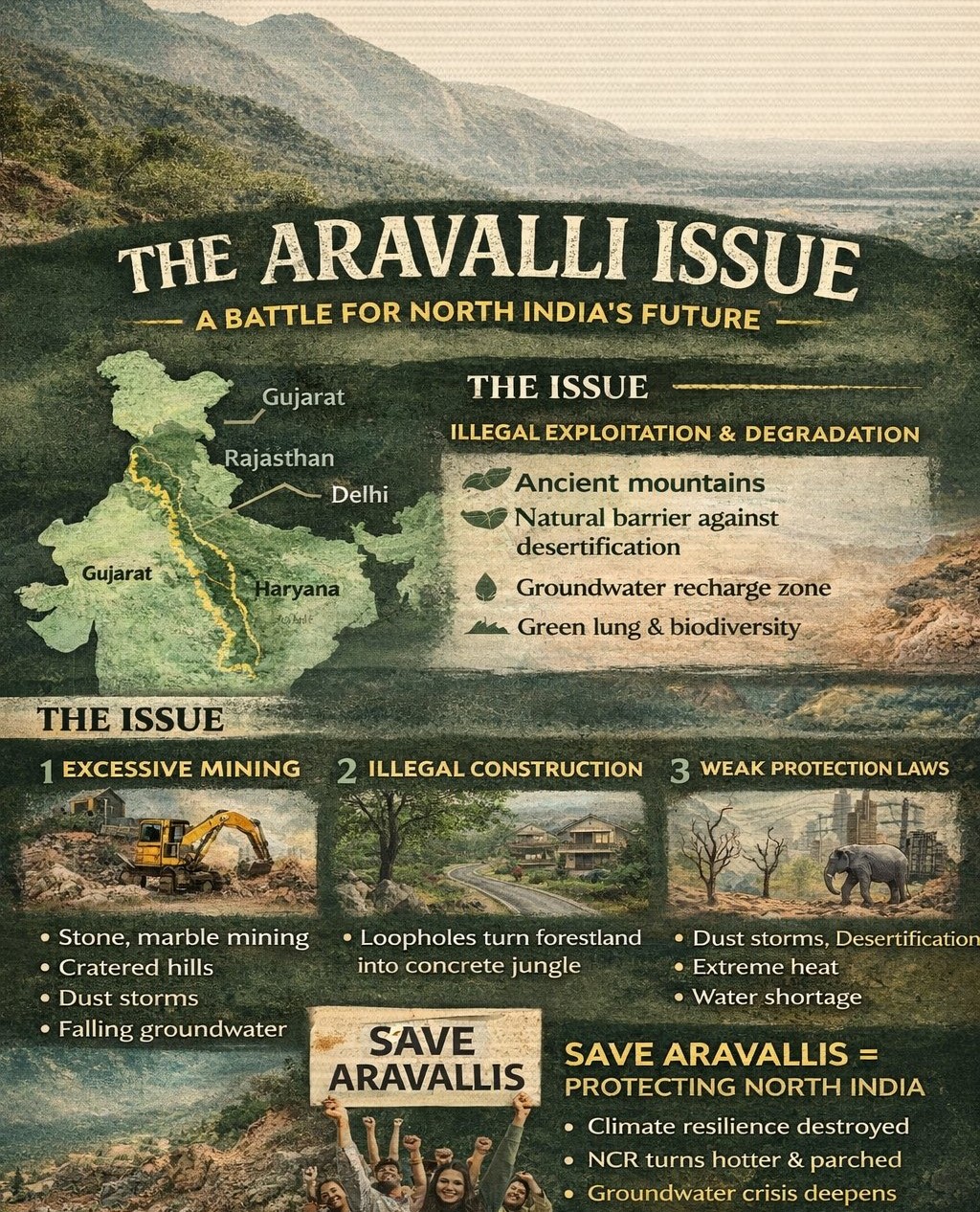
- One of the oldest mountain systems in the world, estimated to be nearly two billion years old, stretching approximately 650 km from Delhi to Gujarat.
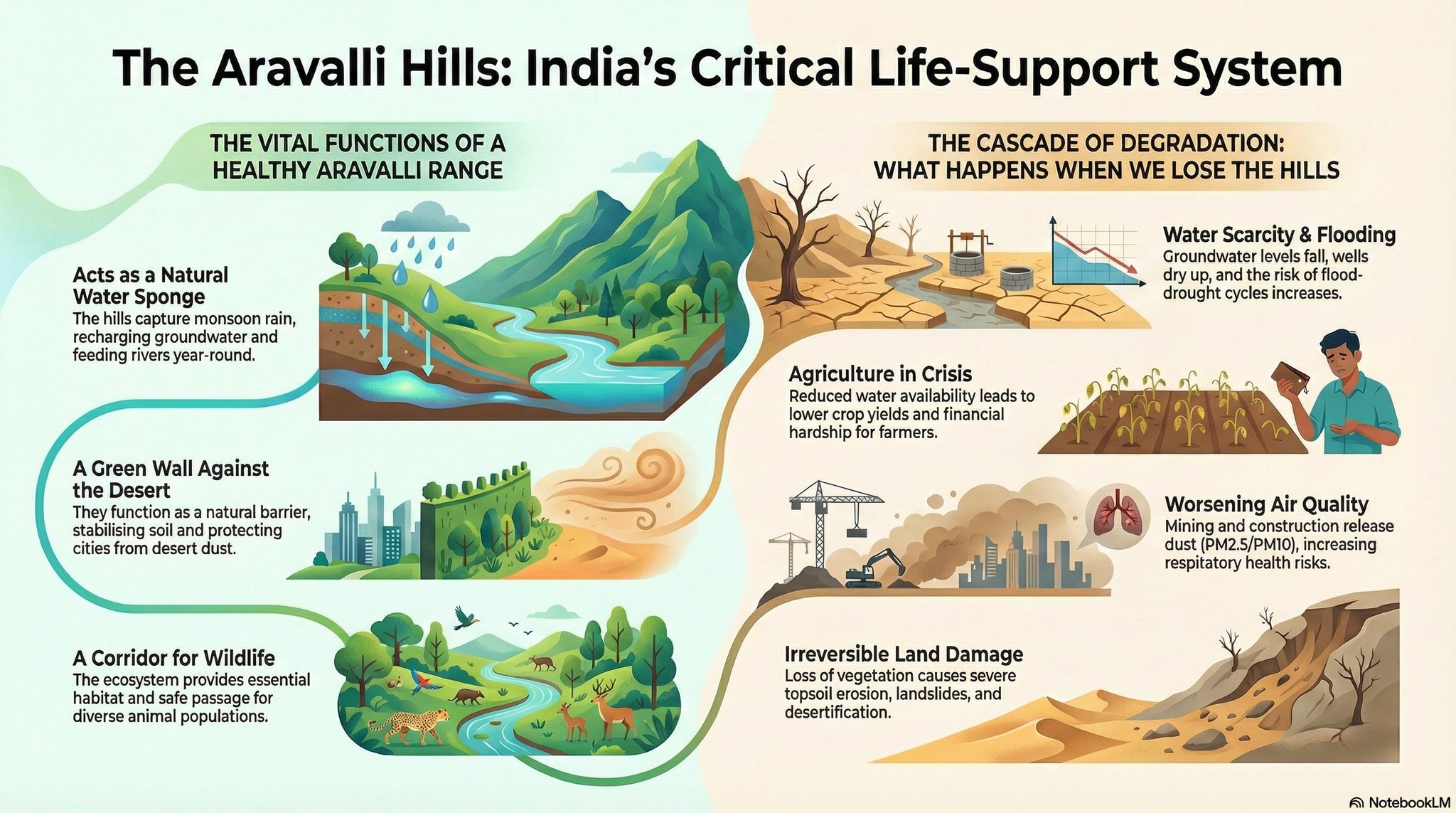
- Ecologically, the Aravallis act as a natural barrier against desertification, preventing the eastward expansion of the Thar Desert into the fertile Indo-Gangetic plains.
- They play a critical role in groundwater recharge, climate regulation, and biodiversity conservation, and are the source region of important rivers such as the Chambal, Sabarmati, and Luni.
- The range is rich in minerals including limestone, marble, sandstone, copper, zinc, and tungsten, historically making it a significant mining zone.
- However, decades of excessive quarrying have led to forest degradation, declining groundwater levels, and severe air pollution, particularly in the National Capital Region (NCR).
- One of the oldest mountain systems in the world, estimated to be nearly two billion years old, stretching approximately 650 km from Delhi to Gujarat.
-
Supreme Court Intervention and Uniform Definition:
-
-
- The absence of a uniform legal definition of Aravalli formations across states had created regulatory loopholes and enforcement challenges.
- To address this, a committee comprising representatives from the Ministry of Environment, Forest Survey of India (FSI), Geological Survey of India (GSI), State Forest Departments, and the Central Empowered Committee (CEC) was constituted.
- Recently, the Supreme Court accepted the committee’s recommendations, defining:
- Aravalli Hill: Any landform with a height of 100 metres or more above local relief
- Aravalli Range: A collection of two or more such hills located within 500 metres of each other
- Aravalli Hill: Any landform with a height of 100 metres or more above local relief
- The definition is intended to be inclusive, scientifically grounded, and administratively workable, replacing inconsistent slope-based or buffer-based criteria.
- Rather than imposing a blanket ban, the Court adopted a calibrated regulatory approach:
- Existing legal mining operations may continue under strict environmental regulation.
- Fresh mining approvals are paused to prevent unregulated and ecologically damaging exploitation.
- Existing legal mining operations may continue under strict environmental regulation.
- The absence of a uniform legal definition of Aravalli formations across states had created regulatory loopholes and enforcement challenges.
-
About the Green Wall Initiative:
-
-
- The Aravalli Green Wall Project (launched in June 2025) aims to:
- Restore 26 million hectares of degraded land by 2030
- Increase green cover within a 5-km buffer zone across 29 districts in Gujarat, Rajasthan, Haryana, and Delhi
- Contribute to India’s Land Degradation Neutrality (LDN) commitments under international environmental frameworks
- Restore 26 million hectares of degraded land by 2030
- The Aravalli Green Wall Project (launched in June 2025) aims to:
-
Significance:
-
-
- Environmental Protection: Safeguards forests, groundwater systems, and regional biodiversity.
- Legal Compliance: Ensures adherence to Supreme Court directives on sustainable mining and conservation.
- Scientific Management: Introduces data-driven, multi-agency, and ecosystem-based conservation strategies.
- Sustainable Development: Balances limited and regulated resource use with the preservation of over 90% of the Aravalli landscape.
- Climate and Desertification Control: Acts as a frontline defence against the eastward spread of the Thar Desert into the Indo-Gangetic plains.
- Environmental Protection: Safeguards forests, groundwater systems, and regional biodiversity.
-
Conclusion:
The Supreme Court–backed definition and management framework for the Aravalli Hills and Ranges represents a science-based, sustainable, and legally robust approach to conserving one of India’s oldest and most ecologically vital mountain systems. By pausing fresh mining, enforcing uniform definitions, and initiating large-scale restoration through initiatives such as the Green Wall Project, the Centre seeks to strike a careful balance between ecological preservation and regulated development, addressing long-standing environmental degradation and governance challenges.



