
Context:
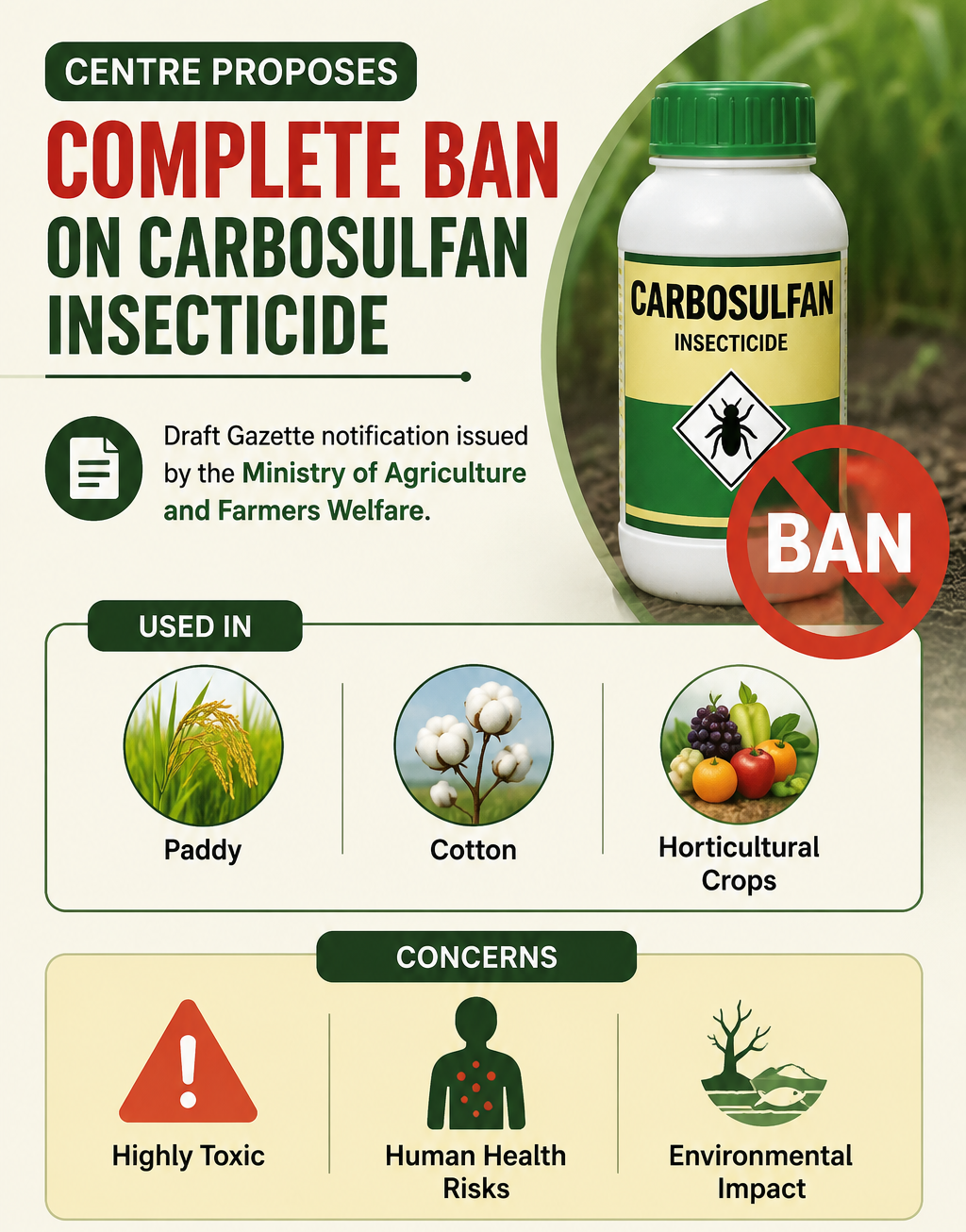
Recently, The Central government has proposed a complete ban on Carbosulfan, an insecticide used in paddy, cotton and horticultural crops, citing concerns over its toxicity, human-health risks and environmental impacts. The proposal has been issued through a draft Gazette notification by the Ministry of Agriculture and Farmers Welfare.
What is Carbosulfan?
Carbosulfan is a carbamate-group insecticide used to control various agricultural pests. It has been used particularly in paddy, cotton and horticultural crops. The proposed ban would prohibit its import, manufacture, sale, transport, distribution and use in India.
Why has the Government Proposed the Ban?
-
-
- The government constituted an expert committee in January 2026 to examine whether Carbosulfan should continue to be permitted, subjected to stricter regulation or banned. The committee submitted its report in June 2026.
- The Registration Committee (RC) subsequently recommended a ban, citing concerns that Carbosulfan can break down into carbofuran, a highly hazardous substance that can adversely affect human health, birds, aquatic organisms and the environment.
- The proposed action is part of India's broader effort to ensure safer use of agricultural chemicals.
- The government constituted an expert committee in January 2026 to examine whether Carbosulfan should continue to be permitted, subjected to stricter regulation or banned. The committee submitted its report in June 2026.
-
Impact on Farmers:
The ban could affect farmers who currently depend on Carbosulfan for pest management. Therefore, the transition should ensure:
-
-
- Availability of safe and affordable alternatives.
- Greater adoption of Integrated Pest Management (IPM).
- Training on proper pesticide use and dosage.
- Promotion of biological and other sustainable pest-control methods.
- Availability of safe and affordable alternatives.
-
About Pesticide Regulation in India:
India primarily regulates insecticides under the Insecticides Act, 1968.
-
-
- Central Insecticides Board (CIB): Advises governments on technical matters.
- Registration Committee (RC): Examines the efficacy and safety of insecticides before registration.
- State Governments: Enforce regulations through insecticide inspectors and licensing authorities.
- Central Insecticides Board (CIB): Advises governments on technical matters.
-
Why is Pesticide Regulation Important?
-
-
- Public Health: Unsafe pesticide use can expose farmers and consumers to harmful residues.
- Environmental Protection: Pesticides may harm non-target organisms such as bees, birds, earthworms and aquatic life.
- Farmer Welfare: Strong regulation can prevent the circulation of fake, adulterated and unsafe agricultural chemicals.
- Sustainable Agriculture: Reducing excessive chemical dependence supports long-term soil and ecosystem health.
- Public Health: Unsafe pesticide use can expose farmers and consumers to harmful residues.
-
Major Challenges:
-
-
- Outdated legal framework: The Insecticides Act, 1968, needs updating to address modern agricultural technologies.
- Enforcement gaps: Shortages of inspectors, laboratories and technical capacity weaken implementation.
- Spurious pesticides: Fake and adulterated products can cause crop losses and financial hardship.
- Chemical dependence: Excessive pesticide use can contribute to pest resistance and ecological damage.
- Pending reforms: The proposed Pesticide Management Bill seeks stronger regulation and penalties but has faced delays.
- Outdated legal framework: The Insecticides Act, 1968, needs updating to address modern agricultural technologies.
-
Way Forward:
India should adopt a science-based, farmer-sensitive pesticide policy combining strict risk assessment with affordable alternatives. Strengthening laboratories, pesticide-residue monitoring, state enforcement and Integrated Pest Management can reduce risks without compromising agricultural productivity.
Conclusion:
The proposed Carbosulfan ban highlights India's need to move towards safer and more sustainable pest management. A successful policy must combine regulation with farmer awareness, affordable alternatives and effective enforcement.



