
Context:
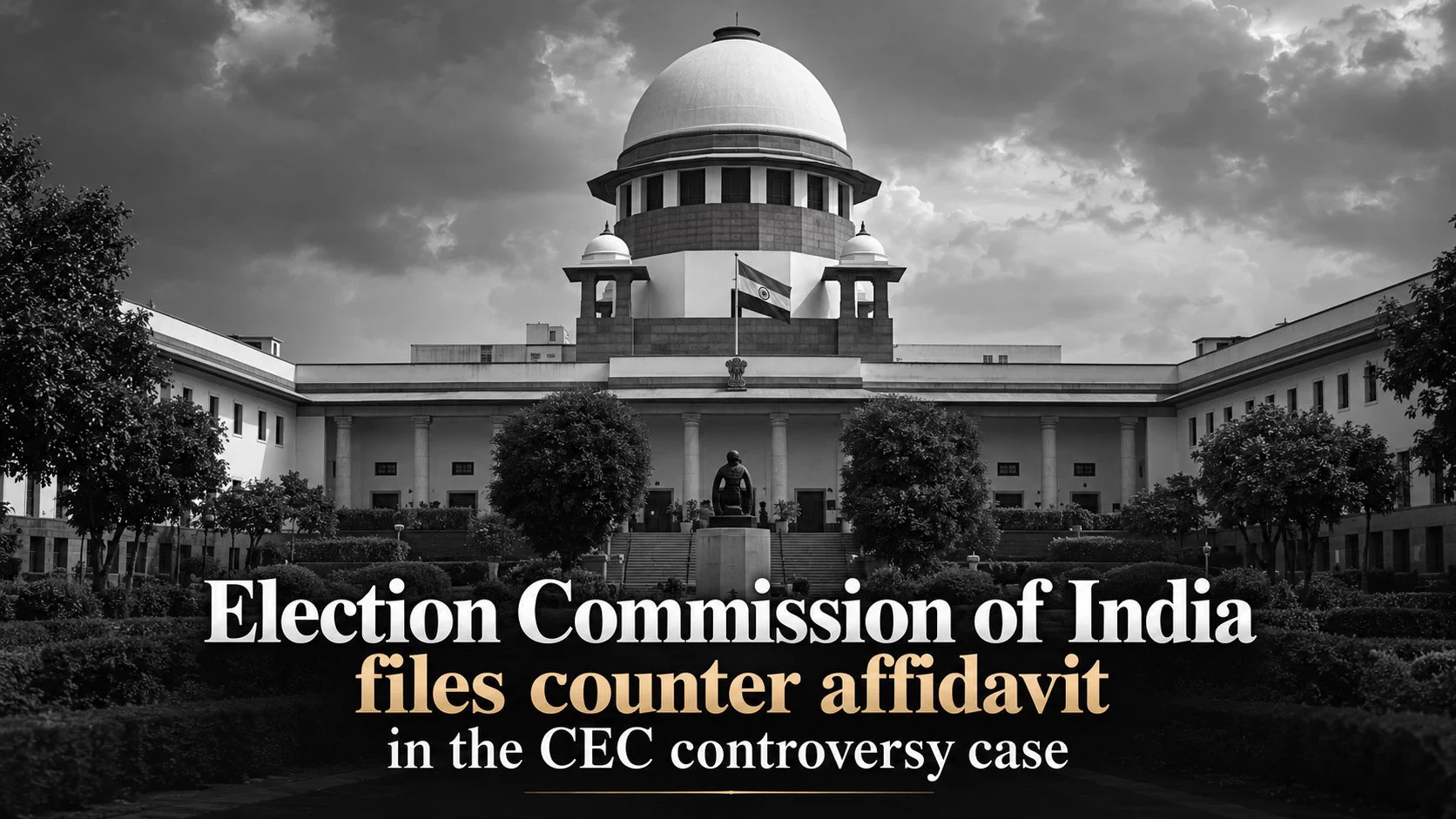
Recently, The Election Commission of India (ECI), in a counter-affidavit filed before the Supreme Court, argued that the Chief Election Commissioner (CEC) can be removed only in the same manner and on the same grounds as a Supreme Court judge. It opposed a petition seeking to restrain CEC Gyanesh Kumar from functioning. The ECI also defended its decision-making process and the conduct of the Special Intensive Revision (SIR) of electoral rolls.
Background:
-
-
- The Election Commission of India is a constitutional body responsible for supervising, directing and controlling elections to Parliament, State Legislatures, and the offices of the President and Vice-President.
- The controversy arose amid legal and political challenges concerning the ECI's functioning, particularly its electoral-roll revision exercise. The petition questioned whether the CEC could individually exercise or represent the powers of the multi-member Commission.
- The ECI argued that the petition relied on a newspaper report without independently establishing the allegations. It also maintained that restraining the CEC would conflict with the constitutional and statutory framework governing the Commission.
- The Election Commission of India is a constitutional body responsible for supervising, directing and controlling elections to Parliament, State Legislatures, and the offices of the President and Vice-President.
-
Constitutional Provisions:
-
-
- Article 324 – Election Commission of India
- Article 324(1) vests the superintendence, direction and control of elections in the ECI.
- Article 324(2) provides for the appointment of the CEC and other Election Commissioners by the President, subject to parliamentary law.
- Article 324(5) protects the CEC from removal except in the same manner and on the same grounds as a Supreme Court judge.
- Other Election Commissioners and Regional Commissioners cannot be removed except on the recommendation of the CEC.
- Article 324 – Election Commission of India
-
Article 124(4) – Removal of Supreme Court Judges
-
-
- A Supreme Court judge can be removed on grounds of proved misbehaviour or incapacity, following an address supported by the required special majorities in both Houses of Parliament and an order of the President.
- Since Article 324(5) extends equivalent removal protection to the CEC, the procedure is deliberately stringent to safeguard institutional independence.
- A Supreme Court judge can be removed on grounds of proved misbehaviour or incapacity, following an address supported by the required special majorities in both Houses of Parliament and an order of the President.
-
Legal Framework:
-
-
- The Chief Election Commissioner and Other Election Commissioners (Appointment, Conditions of Service and Term of Office) Act, 2023 governs appointments, service conditions, tenure and the transaction of business by the ECI.
- Section 11: Prescribes the statutory framework for resignation and removal, including the CEC's protection against removal.
- Section 18: Provides for the transaction of business by the Commission, with decisions to be made unanimously as far as possible and differences resolved by majority.
- Section 11: Prescribes the statutory framework for resignation and removal, including the CEC's protection against removal.
- The ECI stated that its decisions, including those concerning SIR, followed the prescribed decision-making process.
- The Chief Election Commissioner and Other Election Commissioners (Appointment, Conditions of Service and Term of Office) Act, 2023 governs appointments, service conditions, tenure and the transaction of business by the ECI.
-
Significance for Indian Democracy:
-
-
- Institutional independence: Protects the CEC from arbitrary removal by the executive.
- Free and fair elections: Helps preserve public confidence in the electoral process.
- Constitutional accountability: Establishes a demanding procedure for removal while retaining accountability for proved misconduct or incapacity.
- Rule of law: Highlights the importance of resolving disputes through constitutional and judicial processes.
- Institutional independence: Protects the CEC from arbitrary removal by the executive.
-
Conclusion:
The ECI's affidavit brings into focus the constitutional balance between independence, accountability and institutional integrity. Protecting the CEC from arbitrary removal is essential, but public trust also requires transparent procedures, impartial conduct and adherence to constitutional principles.



