
Context:
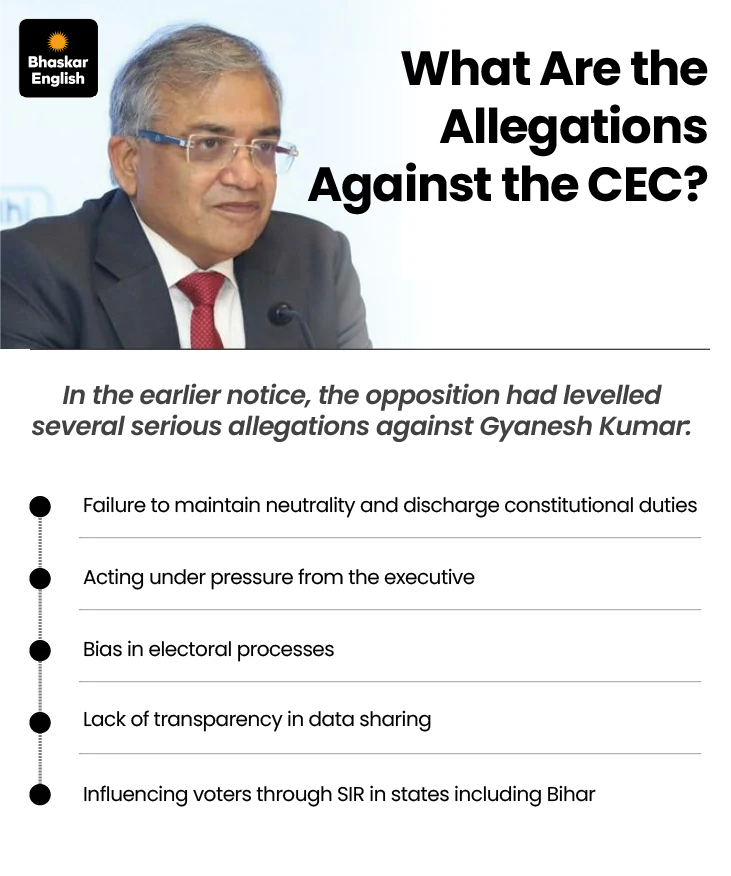
Recently, Opposition has indicated that it may move a motion in Parliament seeking the removal of Chief Election Commissioner (CEC) Gyanesh Kumar, following concerns raised over the functioning and decision-making processes of the Election Commission of India (ECI).
Constitutional Position of the ECI:
-
-
- The Election Commission of India is a constitutional body established under Article 324. It has the responsibility of superintendence, direction and control of elections to Parliament, State Legislatures, and the offices of the President and Vice-President.
- The ECI currently functions as a three-member body, comprising the CEC and two Election Commissioners. The CEC is described as first among equals in the Commission's decision-making structure.
- The Election Commission of India is a constitutional body established under Article 324. It has the responsibility of superintendence, direction and control of elections to Parliament, State Legislatures, and the offices of the President and Vice-President.
-
Appointment of Election Commissioners:
-
-
- Under the Chief Election Commissioner and Other Election Commissioners Act, 2023, the President appoints the CEC and Election Commissioners on the recommendation of a selection committee comprising:
- Prime Minister — Chairperson
- Leader of Opposition in the Lok Sabha — Member
- A Union Cabinet Minister nominated by the Prime Minister — Member
- Prime Minister — Chairperson
- The law provides for a six-year term or appointment until the age of 65 years, whichever is earlier.
- Under the Chief Election Commissioner and Other Election Commissioners Act, 2023, the President appoints the CEC and Election Commissioners on the recommendation of a selection committee comprising:
-
How Can the CEC Be Removed?
-
-
- The CEC enjoys a high degree of constitutional protection under Article 324(5). The Constitution states that the CEC can be removed only “in like manner and on the like grounds” as a Judge of the Supreme Court.
- Under Article 124(4), a Supreme Court judge can be removed only on the ground of proved misbehaviour or incapacity.
- Therefore, removal of the CEC requires a parliamentary removal process based on these grounds.
- The CEC enjoys a high degree of constitutional protection under Article 324(5). The Constitution states that the CEC can be removed only “in like manner and on the like grounds” as a Judge of the Supreme Court.
-
Removal Procedure:
A motion seeking removal must satisfy the following requirements:
-
-
- A notice alleging misbehaviour or incapacity is submitted in either House.
- The notice must have the signatures of at least 100 Lok Sabha MPs or 50 Rajya Sabha MPs.
- If admitted, an inquiry is conducted into the allegations.
- The removal motion must be passed by a special majority in both Houses — a majority of the total membership of the House and at least two-thirds of members present and voting.
- Following successful parliamentary approval, the President issues the order of removal.
- This stringent procedure is intended to protect the independence and impartiality of the Election Commission.
- A notice alleging misbehaviour or incapacity is submitted in either House.
-
CEC vs Other Election Commissioners:
There is an important distinction in their constitutional protection. While the CEC enjoys protection comparable to a Supreme Court judge, an ordinary Election Commissioner or Regional Commissioner can be removed by the President only on the recommendation of the CEC.
Significance for Democracy:
The controversy highlights the importance of an independent and credible Election Commission for maintaining public confidence in elections. At the same time, the high threshold for removal protects constitutional authorities from arbitrary or politically motivated removal.
Conclusion:
The constitutional protection given to the CEC reflects the importance of electoral independence and institutional stability. At the same time, parliamentary accountability through a stringent removal mechanism ensures that constitutional protection does not mean absence of accountability.



