
CBDC Digital Food Currency Pilot under PMGKAY Explained
Context:
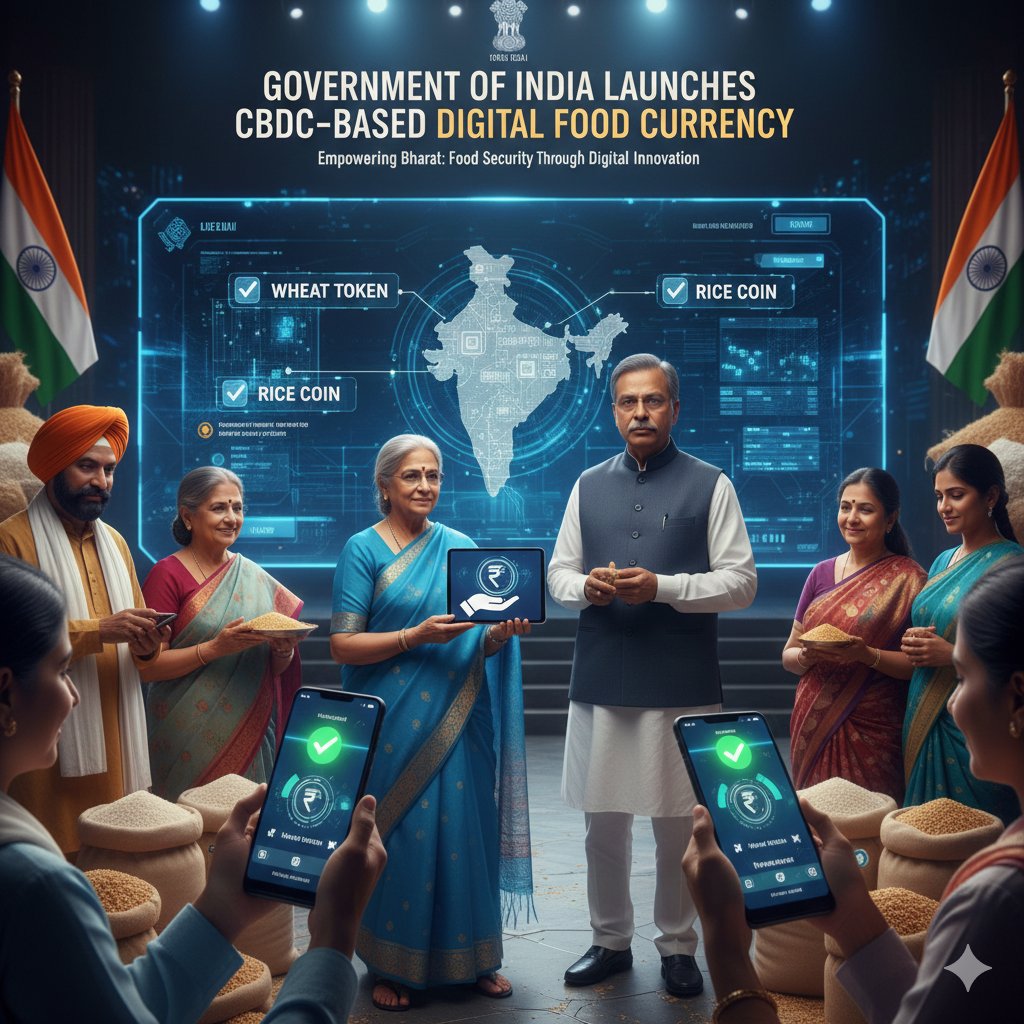
Recently, The Government of India has launched a Central Bank Digital Currency (CBDC)-based Digital Food Currency pilot for Direct Benefit Transfer (DBT) under the Pradhan Mantri Garib Kalyan Anna Yojana (PMGKAY) in Puducherry. The initiative marks a major step in digitising the delivery of food subsidies using emerging financial technologies.
Details of the Puducherry CBDC Pilot:
-
-
- Under the pilot launched, the Government will transfer food subsidy entitlements directly into beneficiaries’ CBDC wallets as programmable digital tokens (e₹). These tokens are:
- Issued by the Reserve Bank of India.
- Credited straight to beneficiaries’ digital wallets under the Direct Benefit Transfer (DBT) framework.
- Redeemable only for purchasing entitled foodgrains and related items at authorised Fair Price Shops and merchant outlets.
- Purpose-bound — designed so that the subsidy cannot be diverted for other uses.
- Issued by the Reserve Bank of India.
- Under the pilot launched, the Government will transfer food subsidy entitlements directly into beneficiaries’ CBDC wallets as programmable digital tokens (e₹). These tokens are:
-
Significance and Expected Impact:
-
-
- Strengthened Transparency: Programmable tokens make it easier to track the flow and use of subsidy in real time.
- Reduced Leakages: By ensuring purpose-bound usage, the system limits diversion of benefits.
- Improved Delivery Efficiency: Direct digital transfers cut out intermediaries and reduce delays.
- Digital Empowerment: The pilot augments India’s digital governance agenda, bringing beneficiaries into formal digital payment ecosystems.
- Strengthened Transparency: Programmable tokens make it easier to track the flow and use of subsidy in real time.
-
About Pradhan Mantri Garib Kalyan Anna Yojana (PMGKAY):
Pradhan Mantri Garib Kalyan Anna Yojana (PMGKAY) is a government food security welfare scheme introduced in March 2020 as part of an emergency relief package during the COVID-19 pandemic. Administered by the Department of Food and Public Distribution under PDS system, it is one of the largest food security programmes globally, benefiting over 81 crore people (about 57 % of India’s population).
About the Public Distribution System (PDS):
-
-
- The Public Distribution System (PDS) is India’s flagship food security mechanism aimed at providing essential foodgrains at subsidised prices to eligible households across the country. Under the PDS, beneficiaries holding ration cards procure foodgrains such as wheat, rice, and millets from authorised Fair Price Shops (FPS) at government-determined prices. PDS is administered under the National Food Security Act and seeks to prevent hunger, ensure nutrition, and support vulnerable populations.
- Traditionally, food grains and subsidies were delivered through physical distribution networks. Over time, reforms like Aadhaar-enabled authentication, ration card portability (ONORC), and e-POS machines have been introduced to improve transparency and reduce leakages in the system.
- The Public Distribution System (PDS) is India’s flagship food security mechanism aimed at providing essential foodgrains at subsidised prices to eligible households across the country. Under the PDS, beneficiaries holding ration cards procure foodgrains such as wheat, rice, and millets from authorised Fair Price Shops (FPS) at government-determined prices. PDS is administered under the National Food Security Act and seeks to prevent hunger, ensure nutrition, and support vulnerable populations.
-
What Is CBDC (Central Bank Digital Currency)?
Central Bank Digital Currency (CBDC) refers to the digital form of a country’s fiat currency — issued and regulated by the nation’s central bank. In India, the CBDC is known as the Digital Rupee (e₹). Unlike private cryptocurrencies, a CBDC is legal tender backed by the Reserve Bank of India (RBI) and holds the same value as physical currency. It is designed to combine the trust and stability of central bank money with the convenience and efficiency of digital transactions.
Conclusion:
The pilot is being executed in collaboration with the Government of Puducherry, RBI, Public Financial Management System (PFMS) and Canara Bank as the banking partner. After evaluating results from Puducherry, authorities plan phased expansion to other Union Territories and states, reinforcing the government’s commitment to technology-led welfare reform.



