
Context:
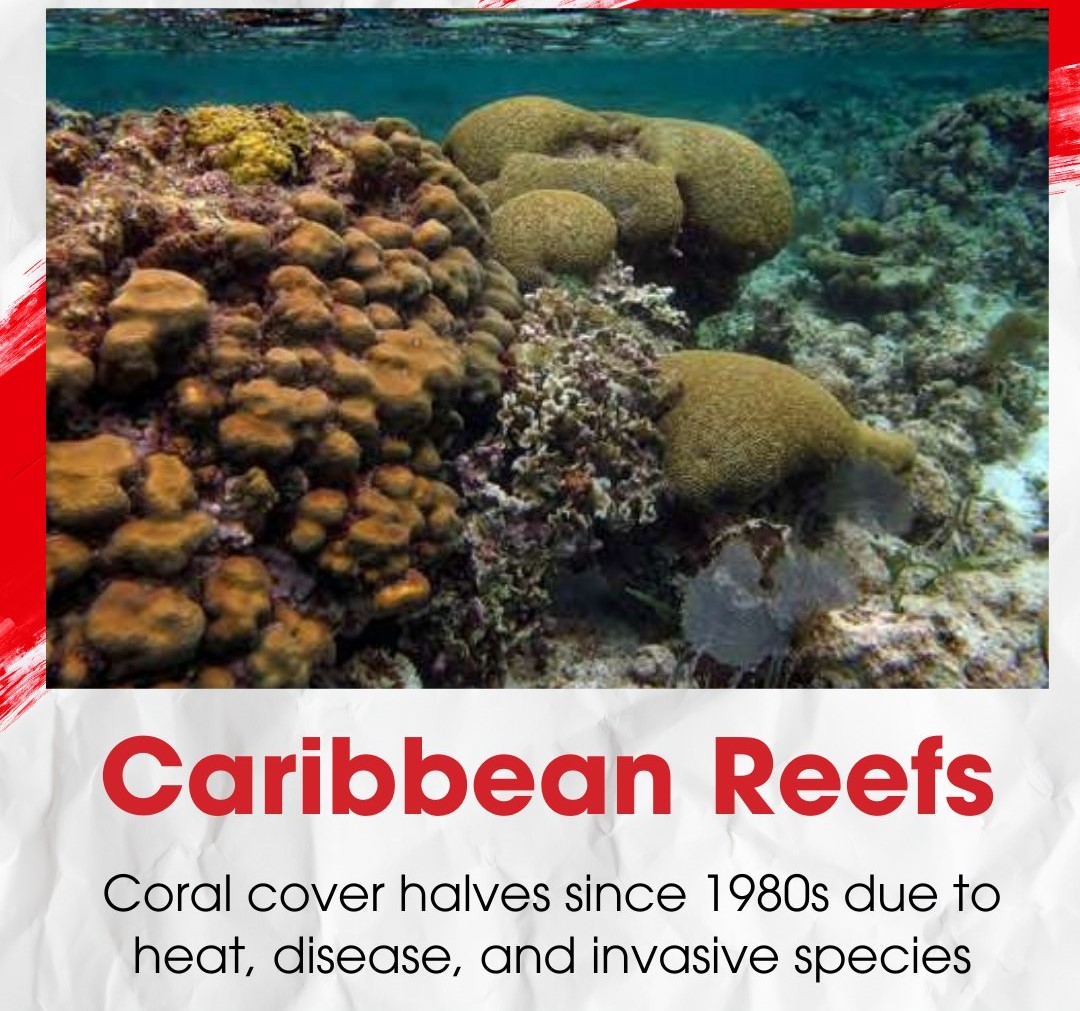
A recent assessment by the Global Coral Reef Monitoring Network (GCRMN) has revealed that hard coral cover in the Caribbean has declined by nearly 48% between 1980 and 2024. The Caribbean region accounts for approximately 9.7% of the world’s total coral reef area, making this decline a matter of global ecological significance. Coral reefs are among the most biodiverse ecosystems on Earth, supporting nearly one-third of all marine species, in addition to providing coastal protection, food security, and livelihoods for millions of people.
About Hard (Stony) Corals:
Hard corals are marine animals composed of thousands of tiny polyps that secrete calcium carbonate, forming the limestone skeletons that build coral reef structures.
Ecological Importance of Hard Corals:
• Create complex reef structures that support marine biodiversity
• Act as natural barriers against storms and coastal erosion
• Sustain fisheries, tourism, and coastal livelihoods
Unlike soft corals, hard corals are the primary architects of reef ecosystems. Their decline leads to loss of structural complexity, biodiversity collapse, and ecosystem instability.
Key Drivers of Coral Decline:
|
Driver |
Key Details / Impact |
|
Ocean Warming & Mass Bleaching |
Rising sea surface temperatures triggered mass bleaching events in 1998, 2005, and 2023–24. Heat stress causes corals to expel symbiotic algae (zooxanthellae), resulting in energy loss and large-scale mortality. |
|
Coral Diseases (SCTLD) |
Stony Coral Tissue Loss Disease (SCTLD) was first detected in 2014 near Miami and has since spread to over 30 Caribbean countries. It affects more than 30 coral species, causes extremely high mortality (including coral recruits), and is considered the most destructive coral disease on record. |
|
Collapse of Keystone Reef Builders |
Acropora corals declined from about 16% cover in the 1970s to around 1.8% since 1980. Orbicella corals declined sharply after the 1998 bleaching event and stabilised at around 5%. Stress-tolerant Porites corals have increased but cannot replace lost reef structure. |
|
Herbivore Loss & Algal Dominance |
The collapse of Diadema sea urchins (1980s and again in 2022) and the decline of parrotfish reduced grazing pressure. As a result, macroalgal cover increased by nearly 85%, shifting reefs from coral-dominated to algae-dominated systems. |
|
Human Pressure & Invasive Species |
Coastal population within 20 km of reefs grew by 27.6% (2000–2020), increasing pollution and nutrient runoff. Invasive species such as lionfish and invasive soft corals (Unomia, Xenia, Latissimia) displace hard corals and disrupt reef ecosystems. |
Conclusion:
The halving of Caribbean coral reefs since the 1980s serves as a stark global warning of the accelerating impacts of climate change on marine ecosystems. Rising ocean temperatures, disease outbreaks, ecological imbalances, and mounting human pressures are pushing coral reefs towards potentially irreversible collapse. Without urgent climate mitigation, effective disease control and ecosystem-based reef management, coral reefs, often described as the “rainforests of the sea” may become among the first major ecosystems lost to anthropogenic climate change.



