
Context:
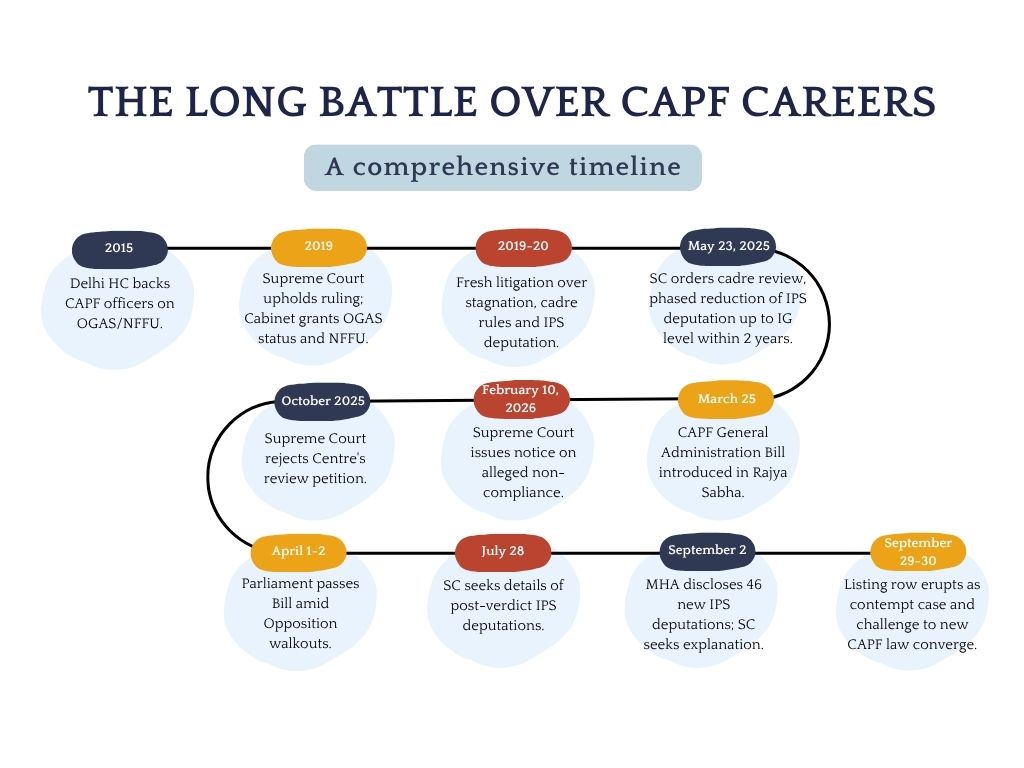
Recently, A fresh controversy has emerged over who should occupy senior leadership positions in India’s Central Armed Police Forces (CAPFs)—IPS officers posted on deputation or officers who have risen through the ranks of the respective forces. The issue has returned to the Supreme Court amid a challenge to the Central Armed Police Forces (General Administration) Act, 2026, which provides for continued IPS deputation at senior levels.
What are CAPFs?
-
-
- The five CAPFs covered by the new law are:
- CRPF – Internal security and counter-insurgency.
- BSF – Border security along Pakistan and Bangladesh.
- CISF – Security of critical infrastructure, airports and industries.
- ITBP – India-China border security.
- SSB – India-Nepal and India-Bhutan border security.
- CRPF – Internal security and counter-insurgency.
- Their Group A executive officers are generally recruited as Assistant Commandants and can rise through the hierarchy to senior command positions.
- The five CAPFs covered by the new law are:
-
What is the Core Dispute?
-
-
- The main grievance of CAPF cadre officers is career stagnation. Senior posts have traditionally been partly filled by officers on deputation, particularly from the IPS.
- Before the 2026 legislation, recruitment rules provided for 20% of DIG posts and 50% of IG posts to be filled through deputation. CAPF officers argue that this reduces the number of promotional vacancies available to officers who have spent their entire careers in the forces.
- The issue has a long history. Around 18,000 CAPF officers had initially been involved in litigation seeking better career progression and recognition of CAPFs as Organised Group A Services (OGAS).
- The main grievance of CAPF cadre officers is career stagnation. Senior posts have traditionally been partly filled by officers on deputation, particularly from the IPS.
-
Supreme Court’s 2025 Judgment:
-
-
- In Sanjay Prakash v. Union of India (2025), the Supreme Court recognised CAPFs as OGAS for cadre-related purposes and directed the government to conduct a cadre review within six months.
- Most importantly, the Court directed that posts earmarked for deputation up to the Senior Administrative Grade (SAG) should be progressively reduced within an outer limit of two years. The objective was to balance operational requirements with career mobility and remove stagnation among CAPF officers.
- In Sanjay Prakash v. Union of India (2025), the Supreme Court recognised CAPFs as OGAS for cadre-related purposes and directed the government to conduct a cadre review within six months.
-
What does the 2026 CAPF Act Provide?
The Central Armed Police Forces (General Administration) Act, 2026 creates an umbrella framework for recruitment, promotion, deputation and service conditions of Group A officers in the five CAPFs.
The Act provides for:
-
-
- 50% of IG posts through deputation;
- At least 67% of ADG posts through deputation;
- All DG and Special DG posts through deputation.
- 50% of IG posts through deputation;
-
Why do CAPF Veterans Oppose It?
-
-
- Career stagnation: Deputation reduces promotional opportunities for officers within the force.
- Institutional expertise: Force veterans possess decades of specialised experience in border management, counter-insurgency, internal security and operational command.
- Morale: Delayed promotions and limited avenues to reach the top can adversely affect organisational morale.
- Organisational ownership: Officers argue that those who have served their entire careers in a force should have a meaningful opportunity to lead it.
- Career stagnation: Deputation reduces promotional opportunities for officers within the force.
-
The Supreme Court in 2025 also noted that reducing deputation would increase the participation of CAPF cadre officers in administrative decision-making.
Why Does the Government Support IPS Deputation?
-
-
- The government argues that CAPFs frequently operate alongside State police forces. IPS officers can therefore provide institutional links between Central and State policing establishments.
- The Centre has also maintained that CAPFs have distinct operational requirements and cannot simply be treated like ordinary civilian Group A services. IPS deputation is viewed as useful for Centre-State coordination, internal security operations and administrative management.
- The government argues that CAPFs frequently operate alongside State police forces. IPS officers can therefore provide institutional links between Central and State policing establishments.
-
Conclusion:
The IPS-CAPF controversy is more than a dispute over senior posts. It reflects the larger challenge of balancing operational efficiency with institutional expertise, career progression and organisational morale. India needs a system in which IPS officers and CAPF veterans complement each other, while ensuring that long-serving CAPF officers have a fair and credible pathway to the highest levels of command.



