
Central Armed Police Forces (General Administration) Bill, 2026
Context:
Recently, The Central Armed Police Forces (General Administration) Bill, 2026 has been introduced in Parliament. The bill comes in the backdrop of a 2025 Supreme Court judgment on CAPF cadre rights.
Background:
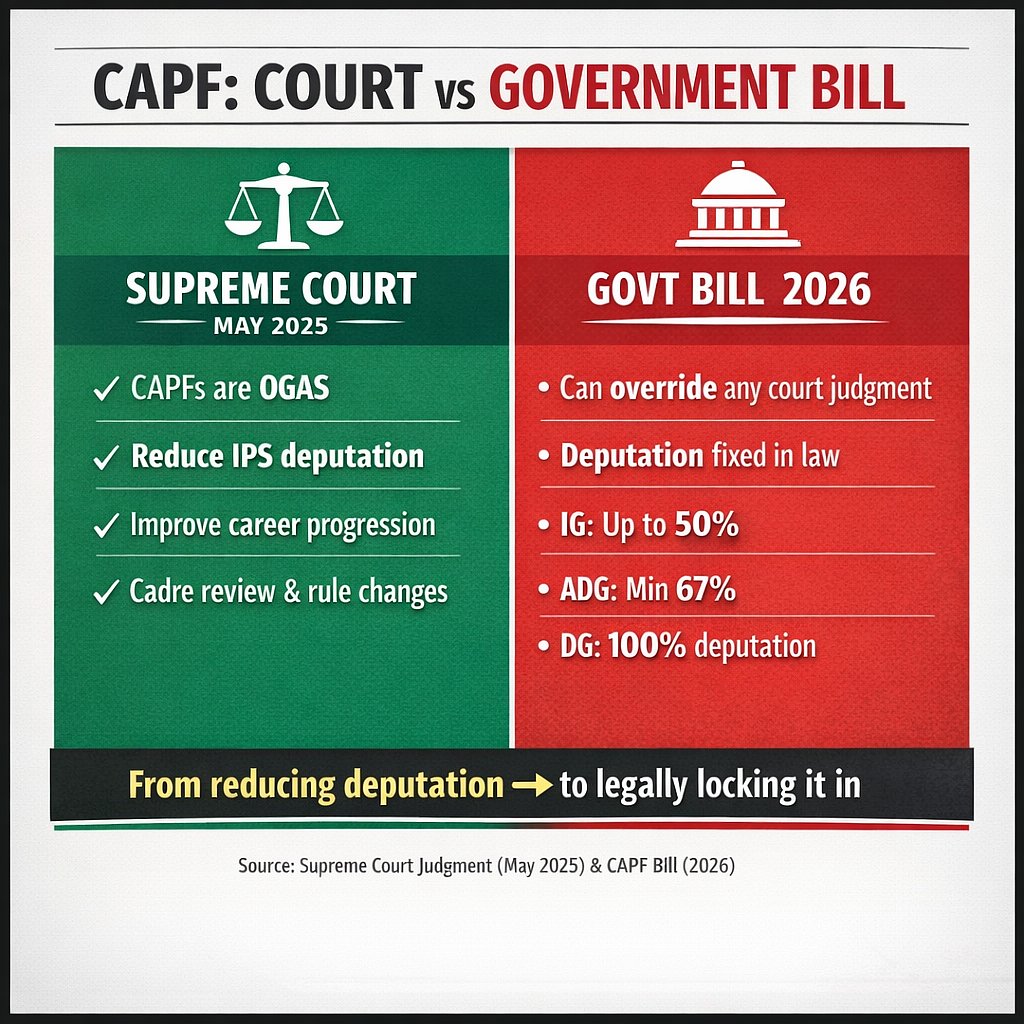
In May 2025, the Supreme Court of India directed the government to progressively reduce IPS deputation in CAPFs at the levels of DIG and IG within two years. The Court observed that excessive IPS dominance:
-
-
- Led to career stagnation of CAPF cadre officers
- Negatively impacted morale and motivation
- Led to career stagnation of CAPF cadre officers
-
The Centre’s review petition was later dismissed, reinforcing the ruling.
About Central Armed Police Forces (CAPFs):
The CAPFs are a group of seven security forces under the Ministry of Home Affairs (MHA) tasked with maintaining internal security, guarding borders and protecting critical infrastructure.
Major CAPFs and Their Roles:
-
-
- Central Reserve Police Force (CRPF, 1939): Largest CAPF; handles internal security, counter-insurgency, and elections
- Border Security Force (BSF, 1965): Guards borders with Pakistan and Bangladesh
- Indo-Tibetan Border Police (ITBP, 1962): Secures the India-China border in high-altitude areas
- Central Industrial Security Force (CISF, 1969): Protects critical infrastructure like airports and PSUs
- Sashastra Seema Bal (SSB, 1963): Guards borders with Nepal and Bhutan
- Central Reserve Police Force (CRPF, 1939): Largest CAPF; handles internal security, counter-insurgency, and elections
-
Other Important Forces:
-
-
- Assam Rifles (1835): Oldest force; guards Indo-Myanmar border
- National Security Guard (NSG): Elite counter-terror force (“Black Cats”)
- CAPFs perform roles such as counter-insurgency, Left Wing Extremism management, border security, VIP protection, and disaster response, forming the backbone of India’s internal security system.
- Assam Rifles (1835): Oldest force; guards Indo-Myanmar border
-
Key Provisions of the Bill:
The Bill proposes an umbrella legal framework for CAPFs and includes provisions that ensure continued IPS presence:
-
-
- Override Clause: Rules framed by the Centre will prevail over any law or court judgment
- Institutionalised IPS Deputation:
- 50% IG posts filled by IPS
- At least 67% Additional DG posts
- 100% DG and Special DG posts reserved for IPS
- 50% IG posts filled by IPS
- Centralised Control: Empowers the Ministry of Home Affairs to regulate recruitment, promotions, and service conditions
- Override Clause: Rules framed by the Centre will prevail over any law or court judgment
-
This effectively ensures continued IPS dominance in higher command positions.
Government’s Rationale:
The government argues that IPS officers are essential for:
-
-
- Centre-State coordination, as they serve in both domains
- Strategic leadership and policy integration
- Unified command in complex security situations
- Centre-State coordination, as they serve in both domains
-
Given India’s challenges, insurgency, Left Wing Extremism, and border threats, integrated leadership is seen as critical.
Concerns Raised by CAPF Officers:
Retired and serving CAPF officers have opposed the Bill, citing:
-
-
- Career Stagnation: Officers reportedly remain at entry-level ranks for extended periods
- Limited Promotions: Deputation reduces opportunities for cadre officers
- Operational vs Leadership Gap: CAPF officers often lead field operations, while IPS officers occupy top administrative posts
- Pay and Status Issues: Inadequate implementation of Non-Functional Upgradation (NFU) benefits
- Career Stagnation: Officers reportedly remain at entry-level ranks for extended periods
-
Conclusion:
The CAPF Bill 2026 attempts to institutionalise a centralised and coordinated leadership model, but raises concerns about cadre justice and organisational balance. A nuanced approach that preserves operational efficiency while ensuring fair career progression is essential to maintain both effectiveness and morale in India’s internal security forces.



