
Context:
Recently, the Cabinet Committee on Economic Affairs (CCEA) approved ₹1.27 lakh crore for Semicon Mission 2.0, ₹62,500 crore for the Mobile Phone Manufacturing Scheme (MPMS), ₹25,400 crore for two highway projects in Varanasi, and the establishment of 8–9 gas-based urea plants under the National Investment Policy for Urea (NIPU-2026).
About India Semiconductor Mission (Semicon Mission 2.0):
The India Semiconductor Mission (ISM) aims to develop a complete semiconductor manufacturing ecosystem in the country and reduce dependence on imports.
Objectives:
-
- Promote indigenous chip design and manufacturing.
- Develop a robust semiconductor supply chain.
- Strengthen India's position in the global electronics value chain.
- Support emerging technologies such as Artificial Intelligence (AI), 5G, Electric Vehicles (EVs), and advanced electronics.
- Promote indigenous chip design and manufacturing.
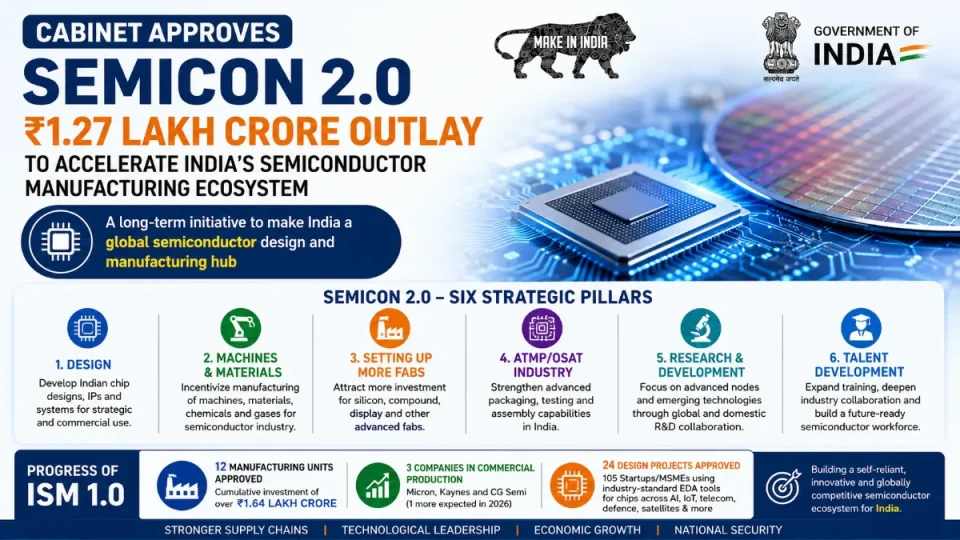
Key Features of Semicon Mission 2.0
-
- Total Outlay: ₹1.27 lakh crore.
- Expected to attract ₹4 lakh crore in investments.
- Estimated semiconductor production worth ₹2 lakh crore.
- Incentives for suppliers of raw materials, gases, and minerals.
- Strong focus on indigenous chip design and manufacturing.
- Aims to achieve self-reliance in the semiconductor sector.
- Total Outlay: ₹1.27 lakh crore.
The first phase had an allocation of ₹76,000 crore, under which 12 projects worth ₹1.64 lakh crore were approved.
About Mobile Phone Manufacturing Scheme (MPMS):
The Cabinet approved the ₹62,500 crore Mobile Phone Manufacturing Scheme (MPMS).
Key Features
-
- Incentives of 2.25%–5% on eligible mobile phone sales.
- 1.5% additional incentive for domestic sourcing of key components.
- 3% additional incentive for investment in product design and Research & Development (R&D).
- Expected mobile phone production worth ₹39 lakh crore.
- Likely to generate around 60,000 direct jobs.
- Incentives of 2.25%–5% on eligible mobile phone sales.
Highway Infrastructure Projects:
The Cabinet approved two National Highway projects worth ₹25,400 crore under the Hybrid Annuity Model (HAM).
Key Highlights
-
- Connectivity between NH-19, NH-31, and the Varanasi Ring Road.
- Part of the PM Gati Shakti National Master Plan.
- Improved connectivity to:
- Lal Bahadur Shastri Airport
- Kashi Vishwanath Temple
- Banaras Hindu University (BHU)
- Ramnagar Inland Waterways Port
- Namo Ghat
- Lal Bahadur Shastri Airport
- Connectivity between NH-19, NH-31, and the Varanasi Ring Road.
The projects will reduce travel time and improve logistics efficiency and tourism.
About National Investment Policy for Urea (NIPU-2026)
Under NIPU-2026, 8–9 gas-based urea plants will be established with an additional production capacity of 10 million tonnes.
Key Features
-
- Separation of fixed and variable costs.
- Return on Equity (RoE) between 12% and 16%.
- Measures to reduce foreign exchange risks.
- Uniform incentives for public, private, and cooperative sector projects.
- Separation of fixed and variable costs.
The policy aims to reduce India's dependence on imported urea.
Significance of the Cabinet Decisions:
-
- Boost to Manufacturing: Semicon Mission 2.0 and MPMS will promote domestic manufacturing and technological innovation.
- Economic Growth: The initiatives will increase investment, employment, exports, and foreign investment.
- Infrastructure Development: The highway projects will improve connectivity, logistics efficiency, and tourism.
- Agricultural Self-Reliance: NIPU-2026 will enhance domestic fertiliser production and reduce dependence on imports.
- Boost to Manufacturing: Semicon Mission 2.0 and MPMS will promote domestic manufacturing and technological innovation.
Conclusion:
The approval of Semicon Mission 2.0, MPMS, highway projects, and NIPU-2026 will strengthen manufacturing, infrastructure, and agricultural self-reliance under the vision of Atmanirbhar Bharat. These initiatives are expected to enhance technological capabilities, create employment, improve logistics, and support India's long-term economic growth.



