
Context:
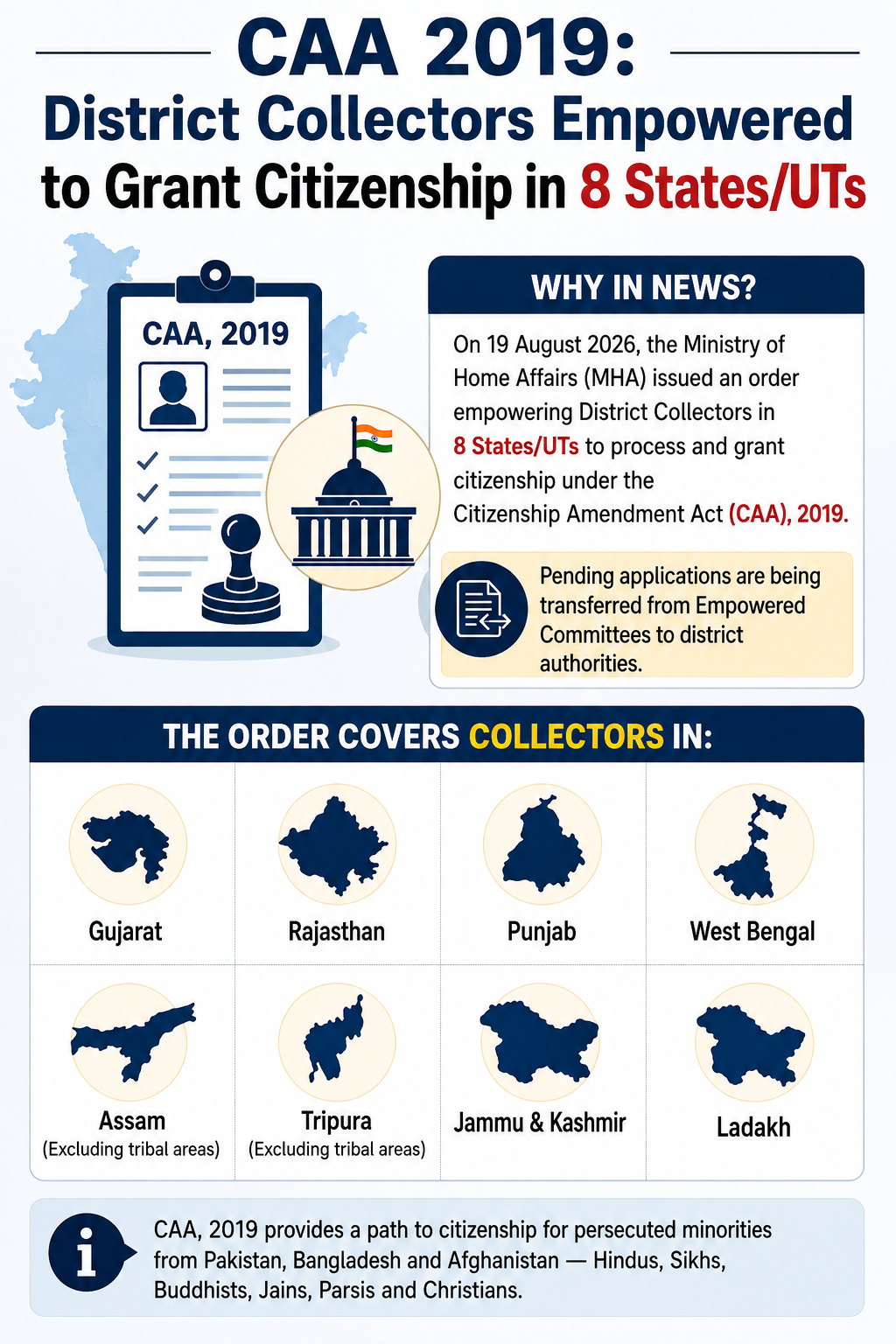
Recently, The Ministry of Home Affairs (MHA), through an order issued on 19 August 2026, has empowered District Collectors in eight States/UTs to process and grant citizenship under the Citizenship Amendment Act (CAA), 2019. The move transfers pending applications from Empowered Committees to district authorities.
States and UTs Covered:
The order covers Collectors in:
-
-
- Gujarat
- Rajasthan
- Punjab
- West Bengal
- Assam, excluding tribal areas
- Tripura, excluding tribal areas
- Jammu and Kashmir
- Ladakh
- Gujarat
-
All pending applications before the earlier Empowered Committees and District Level Committees will be transferred to the concerned Collectors.
What Powers Do Collectors Have?
Under the Citizenship (Third Amendment) Rules, 2026, Collectors can:
-
-
- Receive and scrutinise applications.
- Verify documents and conduct necessary enquiries.
- Administer the Oath of Allegiance.
- Determine eligibility under Section 6B of the Citizenship Act, 1955.
- Grant citizenship to eligible applicants found to be fit and proper.
- Receive and scrutinise applications.
-
An application may be rejected if an applicant fails to appear personally for required procedures despite reasonable opportunities.
Background of the CAA:
-
-
- The Citizenship Amendment Act, 2019 amended the Citizenship Act, 1955. It provides a special route to citizenship for six non-Muslim communities—Hindus, Sikhs, Buddhists, Jains, Parsis and Christians—from Pakistan, Bangladesh and Afghanistan who entered India on or before 31 December 2014.
- For eligible applicants, the naturalisation residence requirement was reduced from 11 years to 5 years, subject to the prescribed conditions.
- The Citizenship Amendment Act, 2019 amended the Citizenship Act, 1955. It provides a special route to citizenship for six non-Muslim communities—Hindus, Sikhs, Buddhists, Jains, Parsis and Christians—from Pakistan, Bangladesh and Afghanistan who entered India on or before 31 December 2014.
-
CAA Rules, 2024
The CAA Rules were notified on 11 March 2024, establishing the procedure for receiving and processing applications. The latest 2026 amendment changes the administrative mechanism by giving greater authority to District Collectors.
Why is West Bengal Important?
-
-
- The decision has particular significance for West Bengal, where the CAA has been politically sensitive. The Matua community, comprising largely Hindu Namasudras with roots in Bangladesh, is among the important communities expected to benefit.
- The earlier State government had strongly opposed the CAA, while the Union government had constituted Empowered Committees to process applications.
- The decision has particular significance for West Bengal, where the CAA has been politically sensitive. The Matua community, comprising largely Hindu Namasudras with roots in Bangladesh, is among the important communities expected to benefit.
-
Constitutional and Legal Aspects:
-
-
- Citizenship is a Union subject under the Constitution. Part II (Articles 5–11) deals with citizenship, while Article 11 empowers Parliament to regulate citizenship through legislation.
- The CAA has also faced criticism and constitutional challenges, particularly concerning Article 14, which guarantees equality before law.
- Citizenship is a Union subject under the Constitution. Part II (Articles 5–11) deals with citizenship, while Article 11 empowers Parliament to regulate citizenship through legislation.
-
Exempted Areas:
The CAA does not apply uniformly to certain protected regions, including specified Inner Line Permit areas and Sixth Schedule tribal areas. Assam and Tripura are specifically excluded from the latest order in their tribal areas.
Conclusion:
The August 2026 MHA order marks a significant shift from centralised committees to district-level administration in implementing the CAA. For UPSC preparation, it is important to connect the development with Articles 5–11, Article 14, federalism, migration and the special safeguards for tribal regions.



