
Context:
In its 2025 annual review of India under Article IV consultations, the IMF assigned a ‘C’ grade to India’s national accounts data (which includes GDP / GVA statistics) — the second‑lowest on its four‑tier scale (A to D). A “C” signals that while data are provided, methodological and structural weaknesses remain. Notably, other statistical categories (prices, fiscal, external sector, financial statistics) received a “B” — indicating they are “broadly adequate.”
Reason for C grade:
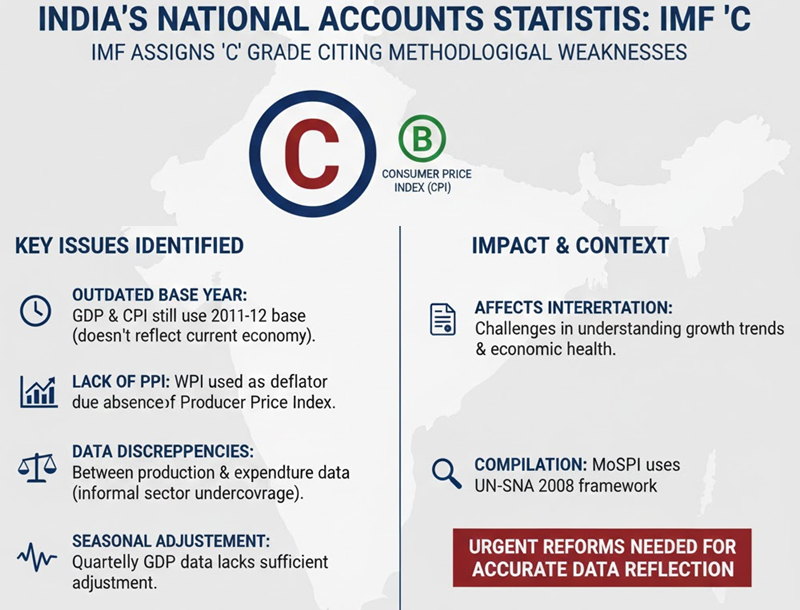
The IMF cited several long‑standing issues with India’s national accounts and GDP estimation methodology. Major concerns include:
-
- Outdated Base Year (2011–12): India still uses 2011–12 as the base year for GDP, GVA, and related indices. Over one decade, the structure of the economy — sectoral composition, price dynamics, emergence of new sectors (digital services, platform economy) — has changed significantly. The outdated base distorts real value-added and growth estimates.
- Deflation Method Issues: India often uses the Wholesale Price Index (WPI) to deflate nominal output to real GDP — instead of a comprehensive Producer Price Index (PPI) or sector‑wise deflators. This can introduce distortions, particularly with divergent inflation across sectors.
- Weak Informal Sector Coverage & Data Gaps: The informal/unorganized sector remains large but is difficult to capture — data on small enterprises, unregistered services, household enterprises, etc., remain patchy. This undermines expenditure-side estimates, leading to potential underestimation or misreporting of value added and consumption.
- Outdated Base Year (2011–12): India still uses 2011–12 as the base year for GDP, GVA, and related indices. Over one decade, the structure of the economy — sectoral composition, price dynamics, emergence of new sectors (digital services, platform economy) — has changed significantly. The outdated base distorts real value-added and growth estimates.
Significance of IMF’s Assessment:
|
Aspect |
Details / Implications |
|
Policy Formulation & Macroeconomic Management |
Reliable GDP, GVA, inflation, and fiscal data underpin monetary policy, fiscal planning, social welfare schemes, and macroeconomic forecasting. Data gaps hinder effective decision-making. |
|
Investor Confidence & Global Perception |
Institutional investors, multilateral agencies, and rating agencies rely on credible data. Persistent methodological issues may weaken confidence, affecting foreign investment and India’s global economic standing. |
|
Transparency, Accountability & Public Trust |
Credible data supports democratic accountability, evidence-based policy debates, and informed public discourse. |
|
IMF C-Grade Significance |
Acts as both a warning and opportunity — highlighting need for deep statistical reforms and signaling India’s recognition of these gaps to global stakeholders. |
Way Forward:
|
Reform Area |
Planned Actions |
|
New GDP Series (Base Year 2022–23) |
Launch in February 2026; incorporate structural changes, updated sector weights, and new data sources. |
|
Revision of CPI & Other Indices |
Update consumption basket and base year to improve inflation measurement accuracy. |
|
Improved Data Coverage & Methods |
Integrate informal sector estimates, leverage corporate/GST/tax data, enhance enterprise & household surveys, and use producer/sector-wise price indices instead of WPI. |
|
Institutional Strengthening & Transparency |
Ensure methodological transparency, data integrity, and alignment with international best practices for global comparability. |
Conclusion:
While India’s GDP data currently exhibit certain limitations, ongoing reforms promise a modernised, internationally aligned statistical framework. The release of the new GDP series in 2026 is likely to enhance data credibility and strengthen India’s macroeconomic monitoring.



