
BRICS–MENA Dialogue
Context:
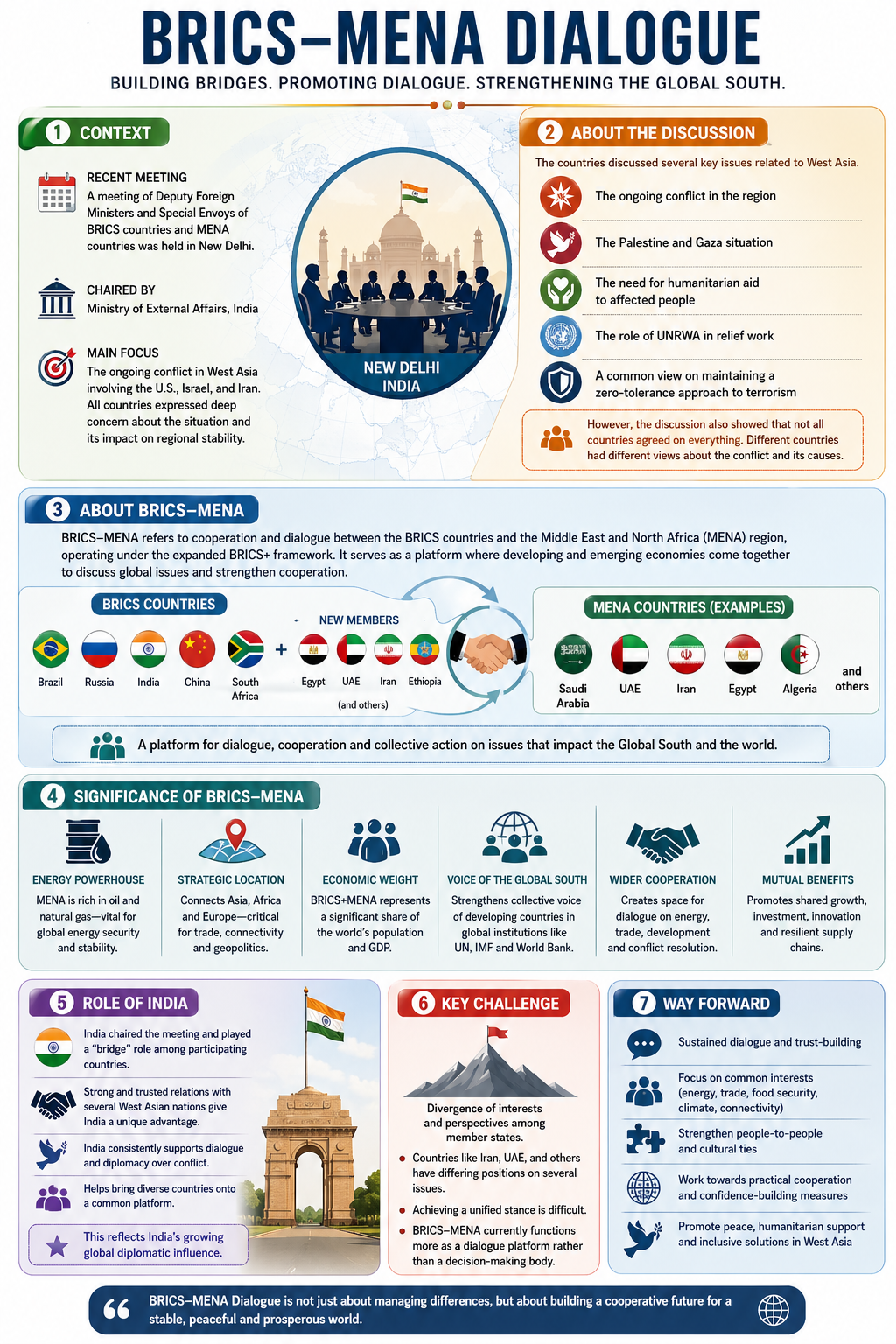
Recently, a meeting was held in New Delhi between Deputy Foreign Ministers and Special Envoys of BRICS countries and MENA (Middle East and North Africa) countries. The meeting was chaired by India’s Ministry of External Affairs. The main focus of the meeting was the ongoing conflict in West Asia involving the U.S., Israel, and Iran. All participating countries expressed deep concern about the situation and its impact on regional stability.
About the Discussion:
-
-
- The countries discussed several important issues related to West Asia:
- The ongoing conflict in the region
- The Palestine and Gaza situation
- The need for humanitarian aid to affected people
- The role of UNRWA in relief work
- A common view on maintaining a zero-tolerance approach to terrorism
- The ongoing conflict in the region
- However, the discussion also showed that not all countries agreed on everything. Different countries had different views about the conflict and its causes.
- The countries discussed several important issues related to West Asia:
-
About BRICS–MENA:
BRICS–MENA refers to cooperation and dialogue between the BRICS countries and the Middle East and North Africa (MENA) region, operating under the expanded BRICS+ framework. It serves as a platform where developing and emerging economies come together to discuss global issues and strengthen cooperation.
Significance of BRICS–MENA:
-
-
- This grouping is important for several reasons. The MENA region is rich in energy resources such as oil and natural gas, making it crucial for global energy security. Geographically, it holds strategic importance as it connects Asia, Africa, and Europe. Together, BRICS and MENA countries account for a significant share of the global population and GDP, giving the grouping considerable economic weight.
- The platform also strengthens the voice of the Global South and helps raise the concerns of developing countries in global institutions like the United Nations, IMF, and World Bank. Additionally, it provides an important space for dialogue on global issues such as energy, trade, development, and conflict resolution.
- This grouping is important for several reasons. The MENA region is rich in energy resources such as oil and natural gas, making it crucial for global energy security. Geographically, it holds strategic importance as it connects Asia, Africa, and Europe. Together, BRICS and MENA countries account for a significant share of the global population and GDP, giving the grouping considerable economic weight.
-
Role of India:
India chaired the meeting and played a “bridge” role among participating countries. Its importance is enhanced by its strong relations with several West Asian nations. India consistently supports dialogue and diplomacy over conflict and helps bring diverse countries onto a common platform. This reflects India’s growing global diplomatic influence.
Key Challenge:
Despite bringing countries together, the major challenge is the divergence of interests and perspectives among member states. For example, countries like Iran, the UAE, and others have differing positions on several issues. As a result, achieving a unified stance is difficult. Currently, BRICS–MENA functions more as a dialogue platform rather than a decision-making body.
Conclusion:
BRICS–MENA cooperation is significant as it brings together major emerging economies and energy-rich countries. Its evolution reflects the shift towards a multipolar world order, where Global South countries are playing an increasingly important role in global decision-making processes.



