
Context:
Recently, The BRICS Agriculture Ministers' Meeting held in Indore concluded with the unanimous adoption of the Indore Declaration, a landmark document aimed at strengthening food security, farmer welfare, climate-resilient agriculture, agricultural trade, and digital transformation in agriculture.
Key outcomes of the Indore Declaration:
Four Priority Areas
The BRICS countries identified four major priorities:
-
-
- Food security and nutritious diets.
- Agricultural trade and cooperation.
- Climate-resilient and regenerative agriculture.
- Innovation, technology, and partnerships in food systems.
- Food security and nutritious diets.
-
Special emphasis was placed on the welfare of small and marginal farmers, access to credit, fair prices, and market linkages.
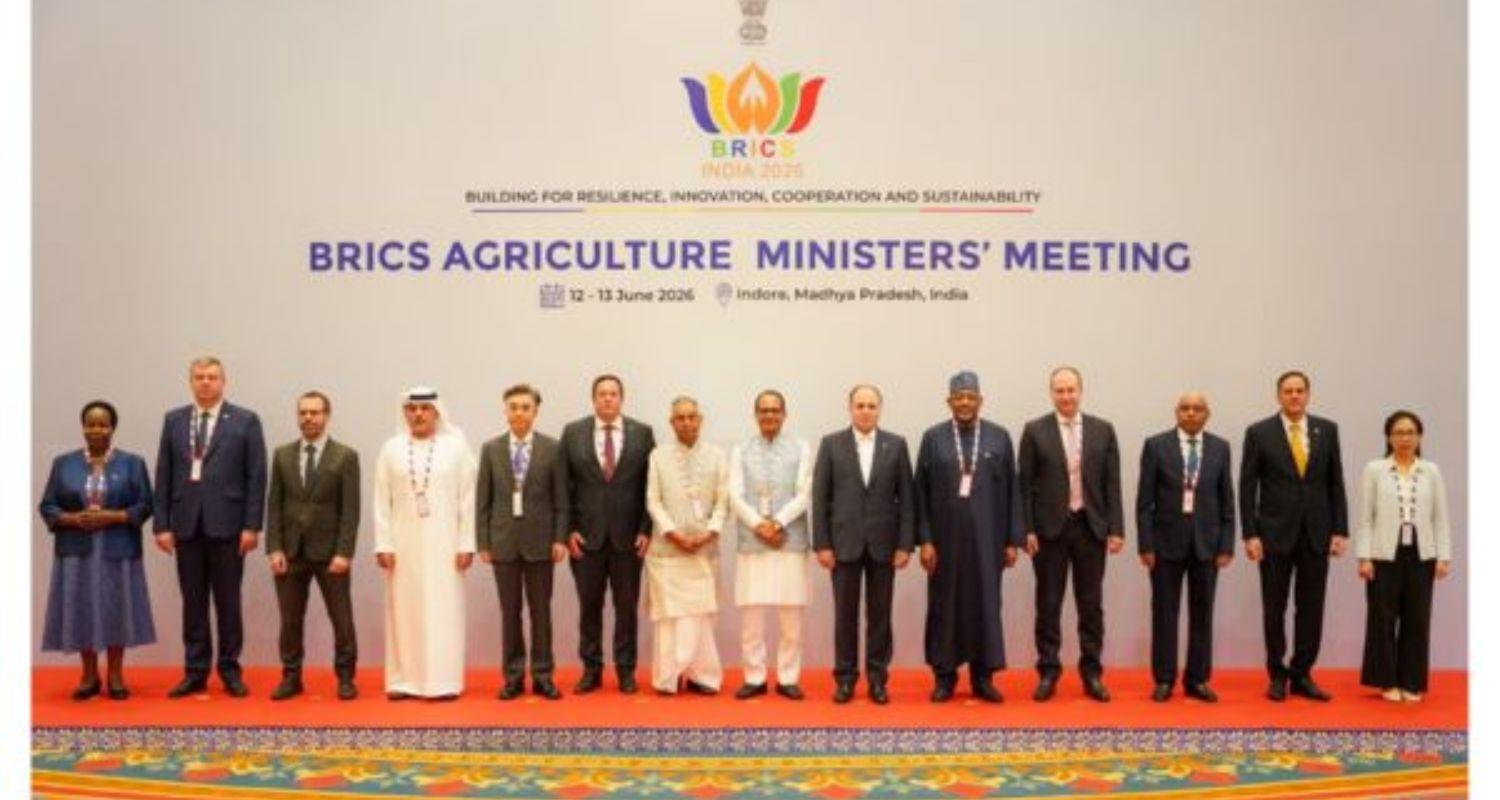
Four New Institutional Initiatives:
1. BRICS Network of Centres of Excellence on Agro-Ecology and Regenerative Agriculture
· Promotes natural farming, organic agriculture, and sustainable farming practices.
· Facilitates joint research, capacity building, and knowledge sharing.
· India's Indian Institute of Farming Systems Research (Modipuram) will play a key role.
2. BRICS Network on Digital Agriculture
-
-
-
- Focuses on Artificial Intelligence (AI), geospatial technologies, digital public infrastructure, and data-driven farming.
- Coordinated by IIT Delhi.
- Aims to connect technological innovation directly with farmers.
- Focuses on Artificial Intelligence (AI), geospatial technologies, digital public infrastructure, and data-driven farming.
-
-
3. Global Forum on Farmers’ Rights in Seed Systems
-
-
-
- Protects farmers' seed rights and indigenous seed diversity.
- Promotes conservation of traditional knowledge and biodiversity.
- Addresses food security and climate resilience concerns.
- Protects farmers' seed rights and indigenous seed diversity.
-
-
4. BRICS AgriN (Agro Inputs, Genetic Resources and Information Network)
-
-
-
- Strengthens cooperation in seeds, genetic resources, and agricultural inputs.
- Promotes information sharing, technical cooperation, and capacity building.
- Strengthens cooperation in seeds, genetic resources, and agricultural inputs.
-
-
Other Important Outcomes:
-
-
-
- Strengthening the BRICS Agricultural Research Platform as a "Knowledge-to-Action Hub."
- Support for a fair and transparent multilateral agricultural trading system.
- Discussion on a potential BRICS Grain Exchange.
- Cooperation on reducing food loss and food waste.
- Focus on climate adaptation, regenerative agriculture, and carbon credit opportunities for farmers.
- Greater participation of youth, women, startups, and agri-entrepreneurs in agriculture.
- Strengthening the BRICS Agricultural Research Platform as a "Knowledge-to-Action Hub."
-
-
Significance:
-
-
- BRICS countries represent nearly 50% of the world's population, about 42% of global agricultural land, and around 42% of world foodgrain production. Therefore, decisions taken by BRICS can significantly influence global agricultural governance.
- For India, the declaration aligns with priorities such as Natural Farming, Digital Agriculture Mission, food security, climate resilience, and farmer-centric development. It also strengthens India's leadership role in shaping global agricultural cooperation.
- BRICS countries represent nearly 50% of the world's population, about 42% of global agricultural land, and around 42% of world foodgrain production. Therefore, decisions taken by BRICS can significantly influence global agricultural governance.
-
Conclusion:
The Indore Declaration marks an important step toward building a more sustainable, technology-driven, and farmer-centric agricultural future. By promoting innovation, climate resilience, seed sovereignty, and digital transformation, BRICS countries have demonstrated that international cooperation can play a crucial role in addressing global food and agricultural challenges.
Frequently Asked Questions (FAQs):
Q. What is the Indore Declaration adopted by BRICS Agriculture Ministers?
Ans. The Indore Declaration is a joint commitment by BRICS countries to strengthen food security, farmer welfare, climate-resilient agriculture, agricultural trade, and digital transformation in agriculture through greater cooperation and innovation.
Q. What are the four priority areas identified under the Indore Declaration?
Ans. The four priority areas are:
-
-
- Food security and nutritious diets
- Agricultural trade and cooperation
- Climate-resilient and regenerative agriculture
- Innovation, technology, and partnerships in food systems
- Food security and nutritious diets
-
Q. What is the BRICS Network on Digital Agriculture?
Ans. It is a new institutional mechanism aimed at promoting Artificial Intelligence (AI), geospatial technologies, digital public infrastructure, and data-driven farming. It will be coordinated by IIT Delhi and seeks to connect technological innovations directly with farmers.



