
Context:
Recently, Chhattisgarh announced plans to translocate 50 blackbucks from Barnawapara Wildlife Sanctuary to Gomarda Wildlife Sanctuary, restoring the species to the region after more than five decades. Blackbucks had disappeared from Gomarda by the 1970s due to hunting, poaching, habitat encroachment and developmental activities.
About Blackbuck:
-
-
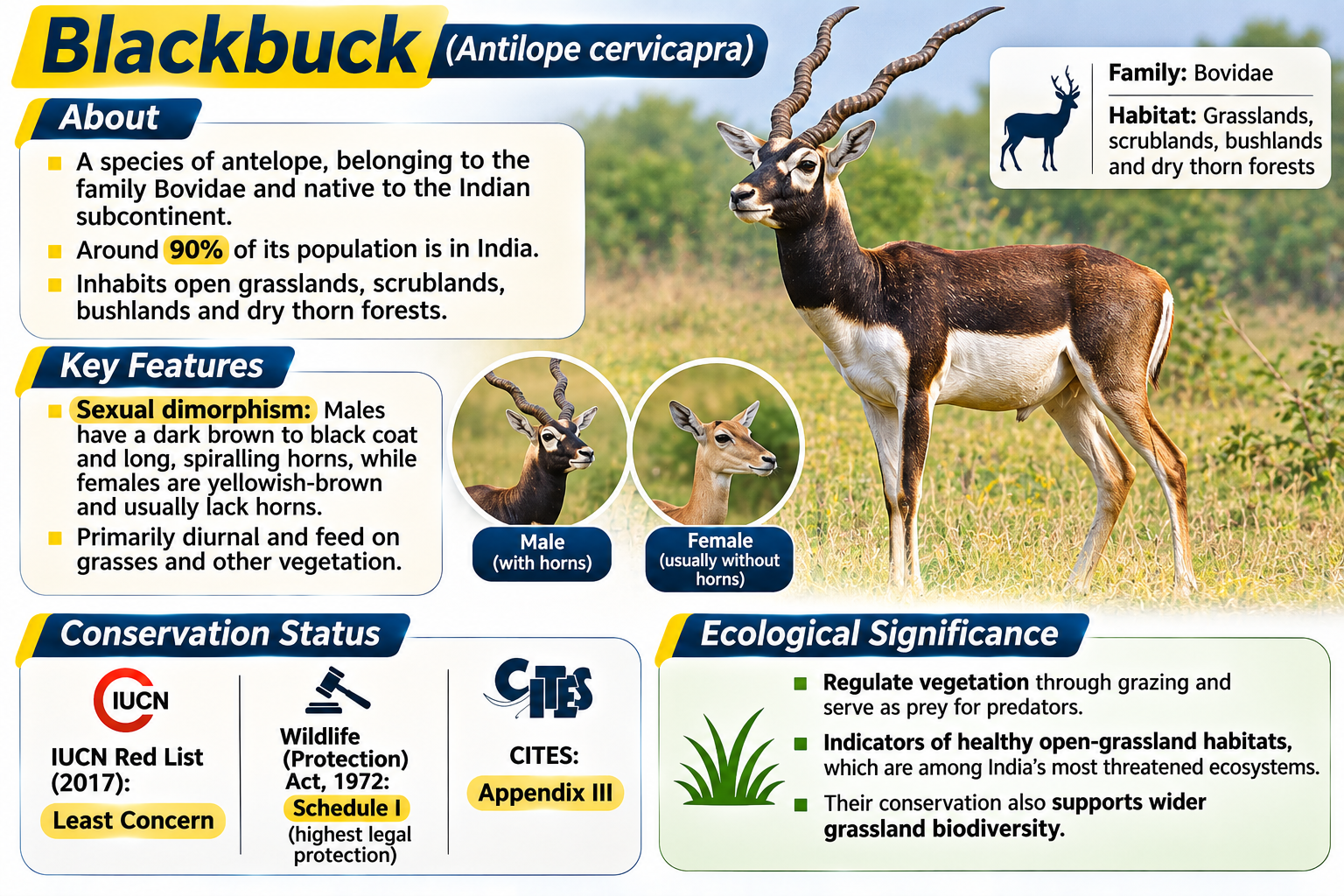
- The blackbuck (Antilope cervicapra) is a species of antelope belonging to the family Bovidae and is native to the Indian subcontinent. Around 90% of its population is found in India. It primarily inhabits open grasslands, scrublands, bushlands and dry thorn forests.
- Blackbucks exhibit sexual dimorphism: males have a dark brown to black coat and long, spiralling horns, while females are generally yellowish-brown and usually lack horns. They are primarily diurnal animals and feed on grasses and other vegetation.
- Conservation Status: The blackbuck is listed as Least Concern on the IUCN Red List (2017). It is included in Schedule I of the Wildlife (Protection) Act, 1972, providing the highest level of legal protection. It is also listed under Appendix III of CITES.
- The blackbuck (Antilope cervicapra) is a species of antelope belonging to the family Bovidae and is native to the Indian subcontinent. Around 90% of its population is found in India. It primarily inhabits open grasslands, scrublands, bushlands and dry thorn forests.
-
Ecological Significance:
Blackbucks play an important role in grassland ecosystems by regulating vegetation through grazing and serving as prey for predators. They are indicators of healthy open-grassland habitats, which are among India's most threatened ecosystems. Their conservation also supports wider grassland biodiversity.
About Gomarda and Barnawapara Wildlife Sanctuaries:
-
-
- Gomarda Wildlife Sanctuary, located near Sarangarh in Chhattisgarh, was established in 1975. It comprises dry deciduous forests, grasslands and water bodies, with vegetation including Sal, Bija, Tendu and bamboo. The Laat and Manai rivers flow through its core area.
- Barnawapara Wildlife Sanctuary, situated in Chhattisgarh, is known for its mixed forests of Sal and teak. Its fauna includes gaur, chital, sambar, nilgai and wild boar. The Balmedhi, Jonk and Mahanadi river systems support the region.
- Gomarda Wildlife Sanctuary, located near Sarangarh in Chhattisgarh, was established in 1975. It comprises dry deciduous forests, grasslands and water bodies, with vegetation including Sal, Bija, Tendu and bamboo. The Laat and Manai rivers flow through its core area.
-
About Wildlife Translocation:
-
-
- Wildlife translocation involves deliberately moving animals from one location to another for conservation or management purposes. It helps restore locally extinct populations, strengthen small populations and improve genetic diversity.
- Chhattisgarh previously translocated 77 blackbucks to Barnawapara during 2017–18. The programme helped establish a population that has subsequently grown to over 150.
- Successful translocation requires suitable habitat, adequate food and water, disease screening, gradual acclimatisation and post-release monitoring. Habitat improvement, control of invasive weeds, protection against poaching and veterinary support are equally important.
- Wildlife translocation involves deliberately moving animals from one location to another for conservation or management purposes. It helps restore locally extinct populations, strengthen small populations and improve genetic diversity.
-
Conclusion:
The proposed return of blackbucks to Gomarda represents an important step towards restoring locally extinct wildlife populations. However, long-term success will depend on habitat restoration, scientific monitoring, effective protection and community participation. It also highlights how wildlife translocation, combined with traditional conservation values, can strengthen biodiversity conservation in India.



