
The Bhojshala Complex Judgment and Its Historical Significance
Context:
Recently, The Indore Bench of the Madhya Pradesh High Court has delivered a landmark 242-page judgment declaring the disputed Bhojshala–Kamal Maula Mosque complex in Dhar as a Hindu temple dedicated to Goddess Vagdevi (Saraswati). The verdict marks a major development in one of India’s long-standing religious and heritage disputes.
Key Observations of the Court:
The High Court noted:
-
-
- Continuous historical evidence of Hindu worship
- Strong indications of a Sanskrit learning centre
- Archaeological findings supporting temple origin
- The court ruled in favour of the Hindu side while directing ASI to continue conservation of the monument.
- Continuous historical evidence of Hindu worship
-
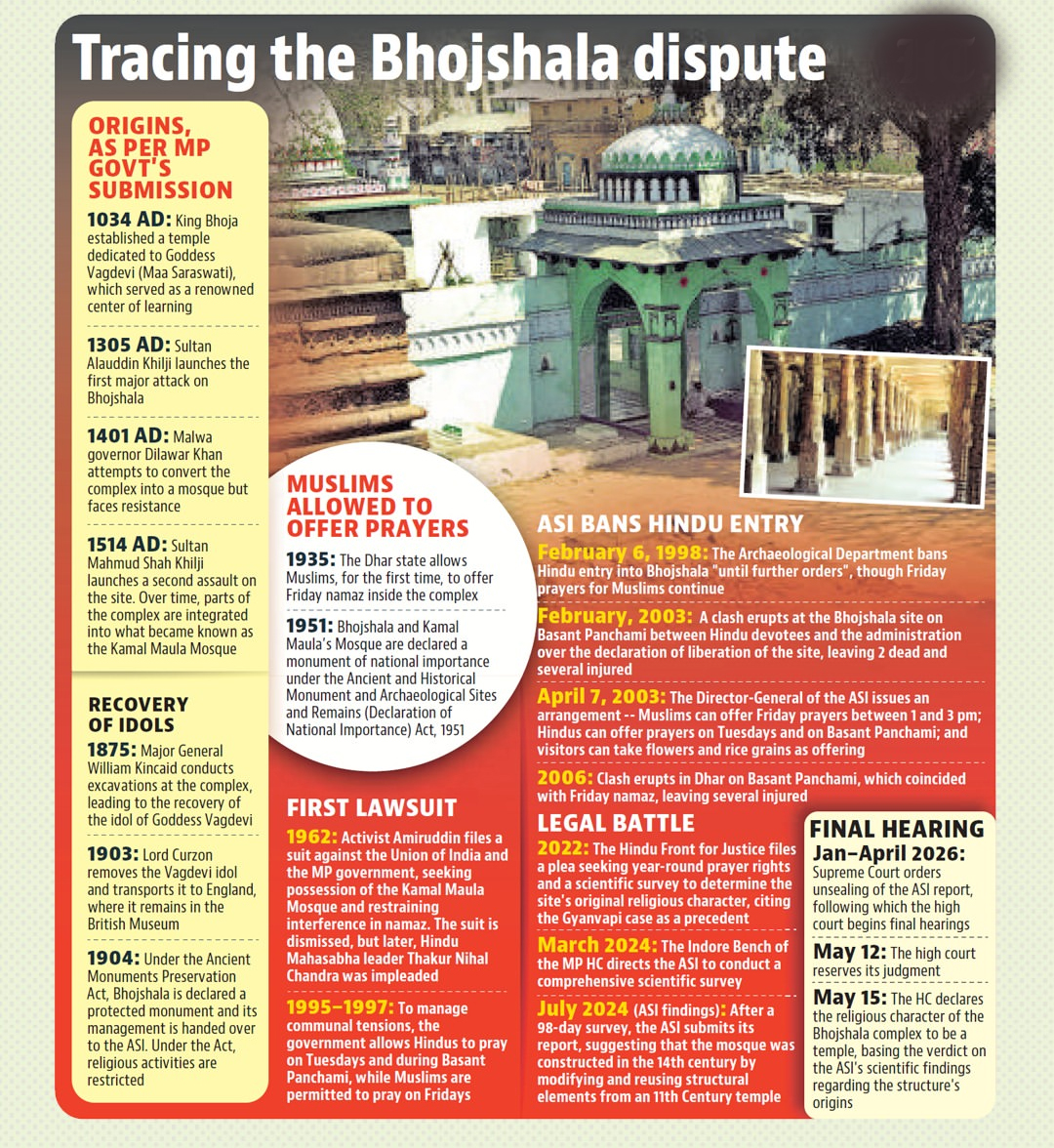
About Bhojshala Complex:
The Bhojshala complex is an 11th-century protected monument that originally functioned as a major centre of Sanskrit learning and a temple dedicated to Goddess Vagdevi (Saraswati). Over time, parts of the temple structure were incorporated into what became known as the Kamal Maula Mosque, making it a deeply contested religious site.
-
-
- Location
- District: Dhar (historically Dhara), Malwa region
- State: Madhya Pradesh
- Historical importance: Former capital of the Paramara dynasty
- District: Dhar (historically Dhara), Malwa region
- Location
-
Historical Background:
-
-
- Foundation (1000–1055 AD): The complex was established by Raja Bhoja, the most prominent ruler of the Paramara dynasty, as a centre of higher learning and Sanskrit education.
- Expansion Phase: Successors like Udayaditya and Naravarman expanded and maintained the institution, with further patronage under Arjunavarma Deva in the early 13th century.
- Islamic Period Transition: In the 14th century, during the Malwa Sultanate period, the site underwent conversion into a mosque and became associated with the Sufi saint Shaikh Kamal Maula, leading to its dual religious identity.
- Modern Legal Status: The site was declared a protected monument under the Ancient Monuments Preservation Act in 1904. A 2003 ASI arrangement allowed:
- Hindu worship on Tuesdays and Basant Panchami
- Muslim prayers on Fridays
- Hindu worship on Tuesdays and Basant Panchami
- Foundation (1000–1055 AD): The complex was established by Raja Bhoja, the most prominent ruler of the Paramara dynasty, as a centre of higher learning and Sanskrit education.
-
Architectural and Epigraphic Features:
-
-
- Temple Architecture: The structure includes a large courtyard, colonnades, and a prayer hall with carved pillars and ceilings reflecting clear Hindu temple architectural styles.
- Sarpabandha Inscriptions: Two unique inscriptions are found at the site:
- One containing Sanskrit alphabets and grammatical structures
- Another detailing Sanskrit verb forms across tenses and moods
- One containing Sanskrit alphabets and grammatical structures
- Literary and Religious Inscriptions:
- Prakrit inscriptions praising Kurma Avatara (Vishnu’s tortoise incarnation)
- Slabs containing classical Sanskrit dramatic compositions linked to royal scholars
- Prakrit inscriptions praising Kurma Avatara (Vishnu’s tortoise incarnation)
- Temple Architecture: The structure includes a large courtyard, colonnades, and a prayer hall with carved pillars and ceilings reflecting clear Hindu temple architectural styles.
-
Conclusion:
The Bhojshala judgment by the Madhya Pradesh High Court represents a significant legal milestone in heritage dispute resolution. While it clarifies ownership of religious rights, it also underscores the need for sensitive handling of historically layered cultural sites to ensure harmony and preservation.



